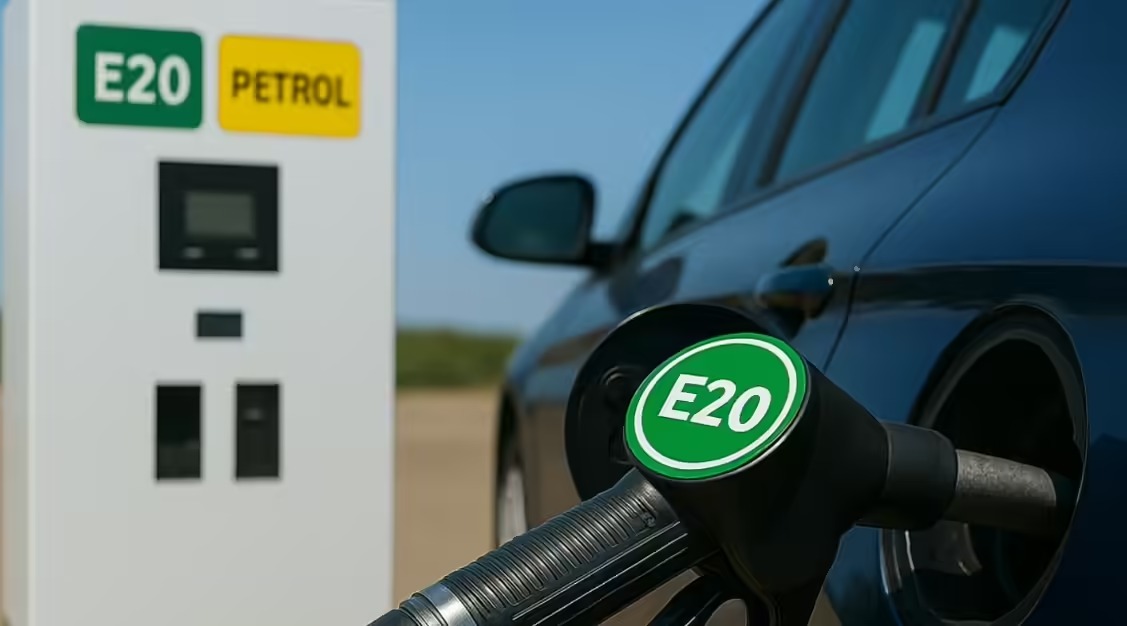
The Indian government has clarified that E20 petrol use may cause a minor decrease in vehicle mileage due to ethanol's lower energy density. However, officials dismissed viral claims about engine damage and insurance invalidation, reaffirming the E20 programme’s role in enhancing energy security and reducing crude oil import costs.
Union Minister Hardeep Singh Puri has officially addressed public concerns regarding E20 fuel, acknowledging a minor reduction in vehicle mileage while debunking myths about engine damage and insurance coverage.
As India continues its transition toward cleaner energy, the national rollout of E20 petrol—a blend of 20% ethanol and 80% gasoline—has become a focal point of public discourse. While the initiative is central to India's energy security roadmap and foreign exchange savings, recent weeks have seen a surge in social media speculation regarding the fuel's long-term effects on vehicle health, insurance validity, and fuel efficiency.
Official Stance on Fuel Efficiency
Addressing the concerns at a press conference in New Delhi on July 2, 2026, Union Minister for Petroleum and Natural Gas Hardeep Singh Puri acknowledged that motorists might experience a slight decrease in fuel efficiency when using E20 petrol.
"Mileage, yes, it may drop a little, but it can happen because of many other reasons also," Minister Puri stated. He emphasized that the minor decline is often outweighed by the benefits of the fuel, noting that ethanol-blended petrol improves engine knocking performance and enhances vehicle acceleration. The Minister’s remarks follow a series of clarifications from the Ministry of Petroleum and Natural Gas aimed at curbing what the government describes as "misleading and unsubstantiated" narratives circulating online.
Debunking Myths: Insurance and Engine Damage
The Ministry has worked to systematically address several viral claims regarding the E20 blending programme. In a formal statement, the government reiterated that there is no scientific evidence to suggest that E20 fuel causes engine failure or that it invalidates vehicle insurance.
According to official Ministry of Petroleum and Natural Gas communications, insurance companies have confirmed that the use of E20 fuel does not impact the coverage or validity of vehicle insurance policies. Furthermore, the Ministry dismissed claims that E20 petrol attracts insects or causes accelerated corrosion, noting that fuel-grade ethanol undergoes strict industrial fermentation and purification processes before being blended with petrol.
The Broader Energy Security Strategy
The E20 programme is a cornerstone of India’s strategy to reduce its reliance on imported crude oil. By integrating ethanol—produced from feedstocks like sugarcane, maize, and broken rice—the government aims to lower carbon emissions and bolster the rural economy.
Industry data shows that the transition has already resulted in significant savings, with the government estimating over ₹1.4 lakh crore saved in foreign exchange since 2014. While the rollout has reached the 20% blending target ahead of schedule, the Ministry of Petroleum and Natural Gas has clarified that any future increase to higher blends, such as 25% or 30%, will only occur after comprehensive scientific testing and stakeholder consultations.
Impact on Consumers and Vehicle Owners
For the average consumer, the shift to E20 represents a move toward more sustainable mobility. However, owners of older vehicle models have expressed concerns regarding compatibility. While modern vehicles are designed with ethanol-resistant materials, automotive experts suggest that older engines may require more frequent maintenance of fuel lines and filters. The government maintains that the program was implemented following extensive consultations with the Society of Indian Automobile Manufacturers (SIAM) and the Automotive Research Association of India (ARAI), ensuring that the transition remains safe for the vast majority of the fleet.
Key Facts at a Glance
Mileage Impact: The government acknowledges a "minor" drop in mileage, attributed to the lower energy density of ethanol compared to pure petrol.
Insurance Validity: Official statements confirm that the use of E20 fuel has no impact on the validity or claims process of vehicle insurance.
Economic Benefit: The E20 initiative has helped India save over ₹1.4 lakh crore in foreign exchange by reducing crude oil imports.
Engine Safety: The government denies that E20 causes widespread engine failure and notes that fuel-grade ethanol is denatured to prevent insect attraction.
Future Targets: While India has reached the 20% target, any move to higher percentages (e.g., 25% or 30%) will be subject to further scientific evaluation.
Frequently Asked Questions (FAQ)
1. Does E20 petrol damage vehicle engines?
The Ministry of Petroleum and Natural Gas states there is no evidence of widespread engine failure linked to E20. Modern vehicles are built to handle these blends, and older vehicles generally require only routine maintenance.
2. Will using E20 fuel void my insurance policy?
No. The government and insurance stakeholders have clarified that using government-approved E20 fuel does not affect insurance coverage.
3. Why is there a drop in mileage with E20?
Ethanol has a lower energy content per unit volume than traditional petrol. This minor difference in chemical composition is the primary reason for the slight reduction in fuel efficiency observed by some drivers.
4. Is the government planning to increase ethanol blending beyond 20%?
Yes, the national goal is to eventually reach higher blends. However, the government has committed to testing and stakeholder consultation before any further rollout beyond 20%.
Source: Ministry of Petroleum and Natural Gas (PIB), Society of Indian Automobile Manufacturers (SIAM), Automotive Research Association of India (ARAI), The Economic Times, Indian Express