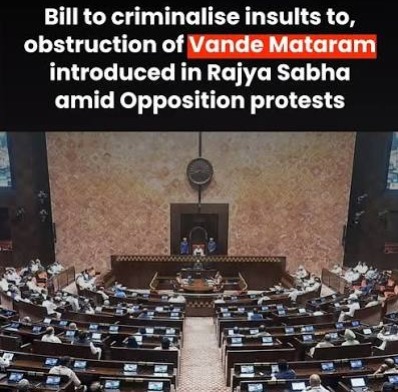
The Indian government introduced a bill in the Rajya Sabha on July 24, 2026, seeking to criminalize insults to or intentional disruption of the national song Vande Mataram. Amending the 1971 Act, the legislation grants the song statutory protection equal to the national anthem, carrying penalties up to three years.
NEW DELHI, July 25, 2026 — The Union Government introduced a pivotal piece of legislation in the Rajya Sabha on Friday, seeking to penalize any intentional insult, disrespect, or obstruction to the singing of the national song, Vande Mataram. Tabled amidst sharp opposition from several political parties, the proposed bill seeks to place the national song on equal statutory footing with the national anthem, Jana Gana Mana, and the national flag.
Legislative Scope and Proposed Penalties
Minister of State for Home Affairs Nityanand Rai introduced "The Prevention of Insults to National Honour (Amendment) Bill, 2026" on behalf of the Ministry of Home Affairs during the ongoing parliamentary session. The proposed legislation explicitly amends Section 3 of the original 1971 statute to bring Vande Mataram directly under its penal jurisdiction.
Under the draft provisions, any individual found guilty of intentionally preventing or disrupting an assembly engaged in the singing or rendition of the national song could face a prison term of up to three years, a financial fine, or both.
| Provision | Existing 1971 Framework | Proposed 2026 Amendment |
| Covered Symbols | National Flag, Constitution, National Anthem | Adds National Song (Vande Mataram) |
| Maximum Penalty | Up to 3 years imprisonment or fine | Up to 3 years imprisonment or fine |
| Offence Scope | Intentional insult, desecration, or disruption | Extends to deliberate obstruction of singing |
Historical Context and Government Rationale
The government highlighted the historical significance of Bankim Chandra Chattopadhyay’s composition, which served as a central anthem during India's freedom movement. The initiative coincides with nationwide commemorations marking 150 years since the creation of the song.
In the Statement of Objects and Reasons accompanying the legislation, the government referenced the historic January 24, 1950 declaration by Constituent Assembly President Dr. Rajendra Prasad, stating that Vande Mataram "shall be honoured equally with Jana Gana Mana and shall have equal status with it". The Home Ministry emphasized that the amendment resolves a long-standing legislative omission by codifying this equal status into statutory criminal law.
Parliamentary Debate and Opposition Objections
The introduction of the bill triggered heated exchanges between treasury and opposition benches in the Upper House. Opposition leaders, including members of the Communist Party of India (Marxist) and other parties, voiced constitutional reservations regarding the measure.
"Parliament cannot rewrite constitutional settlement through ordinary legislation. The Constituent Assembly consciously refrained from placing the National Song and National Anthem on identical statutory footing," stated CPI(M) Member of Parliament John Brittas during procedural objections raised in the Rajya Sabha.
Critics argue that converting civic respect for national symbols into a strictly enforceable criminal matter raises concerns regarding Article 19 freedoms and potential overreach. The government rejected these arguments, stating that the law targets deliberate disruption rather than passive non-participation.
Official Sources Section
Official information, procedural notices, and statements regarding the proposed legislation were made available via official government channels and parliamentary records:
Why It Matters
If enacted by Parliament, the amendment will establish binding legal consequences for conduct deemed disrespectful toward Vande Mataram in public spaces, educational institutions, and official state functions.
For law enforcement agencies and judicial institutions, the law provides a concrete statutory framework to prosecute instances of intentional disruption. For educational bodies and civil organizations, it underscores heightened compliance requirements during national events and public gatherings.
Key Facts at a Glance
Legislation Tabled: The Prevention of Insults to National Honour (Amendment) Bill, 2026 was introduced in the Rajya Sabha on July 24, 2026.
Maximum Punishment: Conviction for intentional obstruction or insult carries up to three years' imprisonment, a fine, or both.
Statutory Parity: Grants Vande Mataram identical legal protections as the national anthem, Jana Gana Mana.
1971 Act Expansion: Amends the Prevention of Insults to National Honour Act, 1971 to expand the list of protected national symbols.
Frequently Asked Questions (FAQ)
What does the proposed Vande Mataram Bill aim to change?
The bill seeks to amend the Prevention of Insults to National Honour Act, 1971 to make intentional insults to or obstruction of the national song, Vande Mataram, a punishable criminal offence.
What is the maximum penalty for insulting Vande Mataram under the proposed law?
Violators face a penalty of up to three years of imprisonment, a fine, or both, bringing it in line with penalties for disrespecting the national flag or national anthem.
Why is the government introducing this amendment now?
The government stated that the amendment gives full statutory weight to the Constituent Assembly's 1950 declaration of equal status, coinciding with the 150th anniversary of Vande Mataram.
Does the bill criminalize non-participation?
The draft text specifically targets acts that "intentionally prevent or obstruct" the singing or cause intentional disturbance to an assembly engaged in singing the national song.
Source: Ministry of Home Affairs, Rajya Sabha Official Secretariat, and Press Information Bureau.