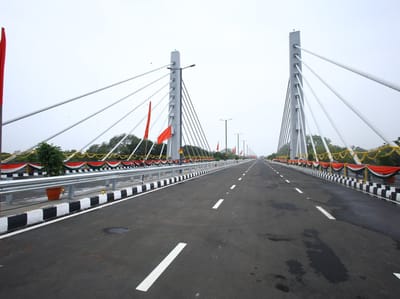
Gujarat Chief Minister Bhupendra Patel has inaugurated the state's first urban cable-stayed flyover at Bhat Crossroads on the Ahmedabad-Gandhinagar corridor. The Rs 175-crore, 1.48-km bridge separates intersecting traffic streams to ease travel for 1.93 lakh daily vehicles, complemented by a new project to expand the nearby Narmada Canal bridge to 12 lanes.
AHMEDABAD — Transport mobility between Gujarat's administrative capital and its premier commercial hub received a major infrastructural upgrade on Sunday, July 5, 2026. Gujarat Chief Minister Bhupendra Patel officially inaugurated the state’s first urban cable-stayed flyover along the busy Ahmedabad-Gandhinagar corridor. Located at the high-traffic Bhat Crossroads on the Gandhinagar-Ahmedabad Airport Road, the newly operational bridge is strategically designed to eliminate severe gridlocks at one of the region's most heavily congested intersections. The development marks an important step forward in urban planning, modernizing the twin-city transit network to match the state's rapid industrial growth.
Modern Structural Engineering and Shared Public Investment
The newly constructed urban cable-stayed flyover spans 1.48 kilometers and was completed at an estimated cost of Rs 175 crore. Architecturally, the landmark structure is the first of its kind to be built within a municipal urban area in Gujarat.
Financing for the project was executed through an equal cost-sharing model. The State Government's Roads and Buildings Department and the Ahmedabad Urban Development Authority (AUDA) each contributed 50 percent of the total capital requirements.
To ensure comprehensive traffic management, the project features dedicated service roads with three lanes on each side, totaling six lanes. These flanking lanes are optimized to funnel vehicles smoothly onto the Sardar Patel (S.P.) Ring Road and onward toward major economic channels leading to Vadodara and Surat.
Decoupling Busiest Traffic Streams at Bhat Circle
Statistical indicators provided by regional transportation bureaus highlight the urgent need for a multi-level layout at this junction. The intersection of the Gandhinagar-Koba-Airport Road and the S.P. Ring Road handles an estimated daily volume of over 1.93 lakh vehicles. This heavy concentration of personal, commercial, and transit vehicles frequently caused long delays and increased fuel consumption for airport-bound travelers.
The new cable-stayed structure fixes this bottleneck by cleanly separating the area's two busiest traffic streams. Vehicles traveling long-distance routes along the S.P. Ring Road will now pass uninterrupted beneath the flyover. Meanwhile, local commuters moving directly between Ahmedabad and Gandhinagar will use the elevated upper level. This layout creates a continuous two-level traffic flow that completely eliminates signal wait times at the main crossroads.
Future-Proofing the Corridor: 12-Lane Canal Expansion
Alongside the ribbon-cutting ceremony, Chief Minister Patel performed a groundbreaking ceremony to widen another critical section of the highway network. The state has launched a Rs 48-crore project to expand the existing bridge over the Narmada Main Canal between Koba Circle and Bhat Circle.
The expansion project will add new three-lane bridges on both sides of the canal crossing, turning the current six-lane road into a massive 12-lane transit facility. This project aims to prevent a bottleneck from forming where traffic exits the new flyover, ensuring consistent multi-lane capacity across the entire transit corridor while preparing the area for future traffic growth.
Official Sources Section
According to official project summaries released by the Chief Minister’s Office (CMO), the twin infrastructure projects represent a long-term approach to urban development. High-level administrative reviews attended by Roads and Buildings Secretary Prabhat Patelia, MP Hasmukh Patel, and Gandhinagar Mayor Mira Patel confirmed that these engineering assets are designed to lower carbon emissions by reducing idling times at major intersections.
Quote Section
"According to officials from the regional planning departments, the completion of this cable-stayed bridge establishes a new design benchmark for future urban bypasses in high-density areas," organizers stated following Sunday's launch. "By combining aesthetic architectural forms with high-capacity lane separation, the state is actively safeguarding its economic corridors against projected transit growth over the next two decades."
Why It Matters
For daily commuters, logistics operators, and commercial businesses, the opening of this cable-stayed flyover brings immediate practical benefits. Separating local traffic from regional freight trucks reduces travel times to Sardar Vallabhbhai Patel International Airport. For corporate professionals and real estate investors working along the rapidly growing Ahmedabad-Gandhinagar axis, this signal-free infrastructure directly supports the area's expansion as a hub for commerce, technology, and governance.
Key Facts at a Glance
The Milestones: Gujarat's first urban cable-stayed flyover is now fully operational at the Bhat Crossroads.
Financial Details: The 1.48-km bridge cost Rs 175 crore, funded through a 50:50 partnership between the Gujarat Government and AUDA.
Traffic Capacity: The structure resolves a major bottleneck that accommodates over 1.93 lakh vehicles daily.
Next Expansion Phase: A Rs 48-crore project has commenced to widen the nearby Narmada Main Canal bridge into a 12-lane facility.
FAQ Section
Where is the new cable-stayed flyover located?
The flyover is located at Bhat Crossroads (Bhat Circle) along the Gandhinagar-Ahmedabad Airport Road, a critical junction connecting the twin cities with the airport and the S.P. Ring Road.
How does this project improve daily travel times for commuters?
The flyover separates local traffic from regional transit. Ahmedabad-Gandhinagar commuters travel on the upper level, while S.P. Ring Road traffic moves underneath, eliminating congestion at the intersection.
What are the details of the Narmada Main Canal bridge project?
The state is investing Rs 48 crore to build new three-lane bridges on either side of the existing structure between Koba Circle and Bhat Circle. This will expand the canal crossing from six lanes to 12 lanes to accommodate future traffic.
Source: Press Trust of India / ANI Regional Bureau Reports, Ahmedabad Urban Development Authority Infrastructure Portal.