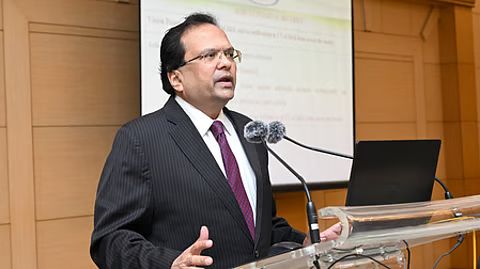
Union Home Secretary Govind Mohan led a comprehensive multi-state assessment to finalize security and logistics for the upcoming June 21 NEET-UG re-examination. Supported by special student trains from the Railway Board, the security blueprint introduces multi-layered police protection and digital tracking to guarantee total examination integrity nationwide.
NEW DELHI, India — Union Home Secretary Govind Mohan chaired a comprehensive inter-ministerial review meeting on Monday, June 15, 2026, to assess institutional readiness across states for the upcoming National Eligibility cum Entrance Test (NEET-UG) re-examination. The high-stakes medical assessment is officially scheduled to take place on Sunday, June 21, 2026. The urgent government intervention follows widespread allegations of structural irregularities and administrative malpractices that compromised the original nationwide test held earlier in May, leading to its complete cancellation by federal authorities.
Zero-Tolerance Protocol Anchors Nationwide Logistics
According to official briefings issued by the Ministry of Home Affairs (MHA), the primary objective of the administrative review was to fortify security protocols at every designated test venue. Home Secretary Govind Mohan issued explicit directives to state chief secretaries and police heads, ordering a zero-tolerance approach toward any attempts to subvert the evaluation framework.
Local law enforcement agencies have been instructed to set up multi-layered security cordons around centers. The central directive prioritizes student convenience, structural security, and absolute exam integrity. The administrative oversight directly impacts over a million medical aspirants who rely on the National Eligibility cum Entrance Test to secure admission to premier state and private medical colleges across India.
Rail Transit and State Machinery Mobilized for Students
A significant focus of the coordination meeting was the seamless mobilization of student transit networks across states. Recognizing the immense logistical friction faced by candidates traveling to distant urban hubs, the Home Secretary secured full operational backing from the Ministry of Railways.
The Railway Board has committed to operating dedicated regional trains and expanding booking counters to facilitate student travel. Simultaneously, state transport departments have been ordered to run extra municipal buses to prevent overcrowding and ensure that all candidates reach their respective centers on time.
Administrative Fallout and Legal Oversight
The upcoming June 21 re-test is being monitored closely by both the executive branch and a parliamentary panel on health. The initial cancellation of the May 3 examination triggered a Central Bureau of Investigation (CBI) probe into paper leak syndicates operating across multiple states. This structural failure created a wave of anxiety among young aspirants and led to intense public scrutiny of the National Testing Agency (NTA).
To rebuild institutional trust, the Ministry of Education has implemented revamped digital tracking logs for paper transit boxes. Each container is tracked via GPS and digital keys that only activate minutes before the scheduled start time.
Official Sources Section
The information contained in this report is based on formal notifications issued by the Ministry of Home Affairs (MHA), project delivery updates from the National Testing Agency (NTA), administrative briefs from the Railway Board, and official statements recorded by the Press Information Bureau (PIB).
Quote Section
"According to officials present in the high-level meeting, any negligence by state law enforcement or centre administrators will result in immediate penal action under national anti-paper leak laws," stated an MHA representative. "The priority is an absolute, airtight system where no student faces unfair disadvantages."
"Organizers stated that state administrations have already mapped out localized traffic management systems around test halls to ensure candidates face zero arrival delays on Sunday morning."
Why It Matters
For medical aspirants and their families, the re-test brings an end to weeks of intense psychological stress and administrative uncertainty. For the broader educational ecosystem, executing a completely clean, secure National Eligibility cum Entrance Test is vital to restoring the shattered credibility of India's national competitive examination framework. Practically, the stricter guidelines protect honest students from being displaced by fraudulent paper-buying networks.
Key Facts at a Glance
Final Exam Date: The nationwide NEET-UG re-examination is locked in for Sunday, June 21, 2026.
Transit Strategy: The Railway Board is actively coordinating with states to manage heavy passenger flows via special student trains.
Security Overhaul: Multi-tiered verification mechanisms and strict local police cordons are being set up around all testing sites.
Anti-Leak Safeguards: The National Testing Agency is utilizing GPS-tracked, digitally locked security boxes to move question sets safely.
FAQ Section
1. Why was the original NEET-UG examination cancelled?
The original national entrance test held on May 3 was cancelled by the government following validated reports of question paper leaks and organized institutional malpractices across several regional test hubs.
2. What special transport arrangements are available for the re-examination?
The Railway Board and state transport corporations are operating special trains and additional public buses to help students reach their examination venues comfortably.
3. Which agency is responsible for overseeing the security of the re-test?
While the National Testing Agency (NTA) manages the academic execution, the Union Home Secretary and state police forces are directly running the physical security operations.
Source: Ministry of Home Affairs (MHA) India, National Testing Agency (NTA), and The Economic Times.