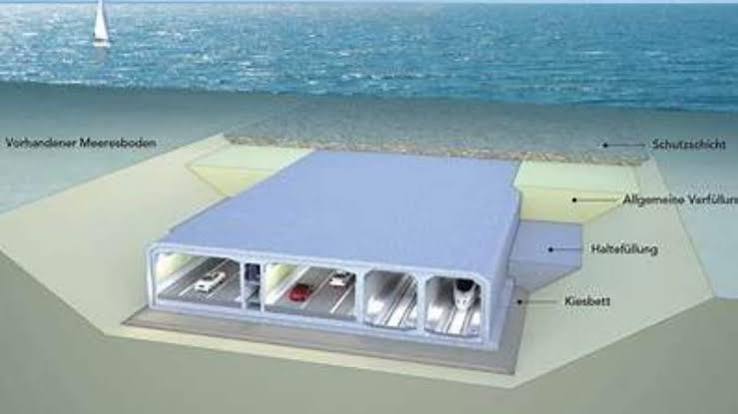
The construction of the 18-kilometer Fehmarnbelt Fixed Link between Denmark and Germany entered its primary subsea assembly phase. The €7 billion immersed concrete tunnel will reduce crossing times across the Baltic Sea to just 7 minutes by train, creating a highly efficient transit link between Scandinavia and Central Europe.
COPENHAGEN — In a major development for trans-European transit, engineers have successfully immersed the first massive concrete segment of the Fehmarnbelt Fixed Link. The 18-kilometer submerged tunnel, constructed at a cost of over €7 billion ($7.5 billion), will permanently bridge the geographic gap between Denmark and Germany.
Once fully operational, the megaproject will replace an unpredictable 45-minute ferry crossing with a reliable transit time of just 7 minutes by passenger train and 10 minutes by car. The state-owned enterprise overseeing construction confirmed that the primary underwater assembly phase has officially begun, accelerating the realization of an uninterrupted transport corridor linking Scandinavia directly to Central Europe.
Constructing the World’s Longest Immersed Tunnel
Unlike traditional bored tunnels that rely on tunnel boring machines to cut deep through solid rock, the Fehmarnbelt Fixed Link is engineered as an immersed tube tunnel. This method involves prefabricating colossal concrete segments on land, towing them to sea, and sinking them into a precisely dredged trench 40 meters beneath the surface of the Baltic Sea.
To manage an infrastructure project of this magnitude, the Danish state-owned developer, Femern A/S, converted the town of Rødbyhavn into the largest active construction site in Northern Europe.
The structural blueprint reveals a complex, sequential deployment system:
Massive Unit Dimensions: The framework requires the assembly of 89 distinct concrete elements. Out of these, 79 are standard sections, each measuring 217 meters long and weighing a massive 73,000 tonnes.
Specialized Immersion Logistics: A custom-engineered immersion catamaran, named IVY, was subjected to final systemic approvals by the Danish Maritime Authority to transport and precisely sink each block.
Precision Bedding Foundations: Prior to submersion, the sections are carefully lowered onto a uniform bed of gravel laid along the seafloor trench, with the final connections verified by real-time laser measurement systems.
Shifting Freight to Green Infrastructure and Cutting Commute Times
The industrial and commercial implications of the newly established link extend far beyond localized regional commuting. Currently, a rail trip connecting Copenhagen and Hamburg takes approximately four and a half hours, requiring trains to execute significant detours or load onto slow maritime transport vessels. The completed tunnel will slash that intercity travel window down to just two and a half hours.
From a commercial logistics perspective, the corridor serves as a priority section of the European Union's broader Scandinavian-Mediterranean transport network. It is designed to host a high-speed double-track railway supporting trains moving at 200 kilometers per hour, alongside a modern four-lane highway.
By shifting long-haul freight traffic away from circuitous mainland detours and carbon-heavy short-sea shipping routes, the project aligns closely with the long-term carbon reduction targets outlined in the European Green Deal.
Official Sources Section
The engineering timelines, funding frameworks, and operational data detailed in this report are verified by formal documentation and progress tracking reports issued by:
Femern A/S: Official construction project logs, maritime positioning data, and technical engineering bulletins.
Sund & Bælt Holding A/S: Parent company financial statements, toll-refinancing roadmaps, and administrative updates.
The European Commission: Trans-European Transport Network (TEN-T) regulatory filings and priority corridor funding allocations.
Quote Section
"The immersion of the first tunnel element is a historic achievement. The world is watching, and you are demonstrating European engineering and construction at its very best. The tunnel will bring regions closer together and create new momentum between Malmö, Copenhagen, Hamburg and the rest of Europe."
— Apostolos Tzitzikostas, European Union Transport Commissioner, during a site inspection briefing following the successful deployment of the initial concrete segment.
Why It Matters
The completion of this submerged tunnel provides an incredibly reliable, weather-independent logistical artery for international shipping businesses and cross-border travelers alike. By cutting travel time across the strait down to single digits, the infrastructure effectively binds the economies of Germany and Denmark closer together. Furthermore, it shifts the economic calculation for regional shipping, giving freight operators a fast rail alternative to maritime routes, significantly modernizing northern European logistics.
Key Facts at a Glance
Drastic Time Reduction: Cuts maritime crossing durations from 45 minutes by ferry to a mere 7 minutes by rail.
Colossal Components: Assembled using 89 separate prefabricated concrete elements, with standard pieces weighing 73,000 tonnes each.
Sub-Sea Depth: The permanent structure rests in a specialized trench carved up to 40 meters below Baltic Sea levels.
Long-Term Financing: The project utilizes a user-pays toll model backed by state-guaranteed loans, projected to be fully amortized over a 28-year operational window.
Frequently Asked Questions (FAQ)
How is this tunnel different from the English Channel Tunnel?
The Channel Tunnel between France and the United Kingdom was constructed using traditional boring machines to drill deep through the rock beneath the seabed. In contrast, the Fehmarnbelt Fixed Link is an immersed tunnel, meaning its hollow sections were pre-cast in a dry dock factory on land, floated out to sea, and carefully sunk into a dug-out trench on the seafloor.
When will the submerged tunnel be completely open to the public?
While initial construction began in 2020 and major underwater element assembly hit its stride in 2026, the comprehensive infrastructure link, including upgraded rail lines on both the German and Danish mainland sides, is projected to open for commercial traffic by 2029.
Who is paying for the construction of the tunnel?
The core financial responsibility for the construction rests on Denmark, which is raising funds through government-guaranteed loans alongside over DKK 10 billion in infrastructure grant support from the European Union. The total cost will be fully refinanced over approximately 28 years using user tolls collected from crossing vehicles and railway fees.
Source: Technical press updates and deployment notifications from Femern A/S and transport infrastructure briefings from the European Commission.