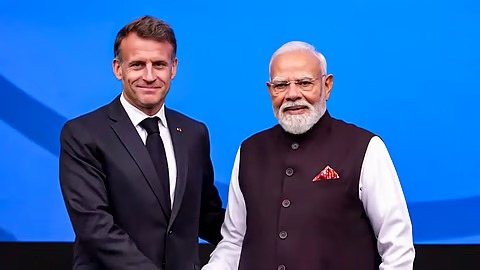
Prime Minister Narendra Modi and French President Emmanuel Macron have elevated bilateral ties to a Special Global Strategic Partnership. Meeting in Nice, the leaders set a target to double bilateral trade within five years, launched a joint AI working group, and expanded cross-border UPI infrastructure across major French airports.
NICE, France — In a major diplomatic breakthrough ahead of the upcoming G7 Summit, Prime Minister Narendra Modi and French President Emmanuel Macron held high-level bilateral talks in Nice, establishing sweeping new economic and technological targets. Moving to deepen ties under the newly elevated "Special Global Strategic Partnership," the two leaders finalized an institutional mechanism to double annual bilateral trade from its current estimate of $16 billion within the next five years.
A central pillar of the high-profile meeting was a comprehensive roadmap on artificial intelligence (AI) and deep-tech innovation. Jointly inaugurating the "Bharat Innovates 2026" conclave, both heads of state positioned their nations as unified architects of trusted, human-centric emerging technologies, emphasizing that advancements must serve public welfare rather than markets alone.
Establishing the India-France AI Governance and Innovation Framework
To operationalize their technological alignment, Prime Minister Modi and President Macron announced the creation of a Joint India-France AI Working Group. This task force is mandated to build safe, open, and trustworthy AI infrastructure, following up on foundational frameworks drafted during previous summits in Paris.
The technological strategy is further driven by the "Innovation Roadmap 2030," designed to catalyze collaborative development across frontier fields including quantum computing, semiconductors, and green energy. Under this framework, 19 institutional agreements were signed to link startup ecosystems. Notably, Indian deep-tech startups have secured expanded operational placements at France’s prominent startup incubator, Station F, providing domestic entrepreneurs with direct entry points into European venture networks.
Trade Overhaul, Fintech Integration, and Aviation Expansion
Beyond software and algorithms, the meeting introduced practical measures to lower transactional friction for businesses, travelers, and students moving between both regions.
Fintech Expansion: Following successful test phases, the Unified Payments Interface (UPI) is expanding across France. Crucially, the airports in Nice and Paris will now directly support UPI transactions, streamlining financial access for Indian travelers.
Transit and Talent Mobility: Prime Minister Modi formally acknowledged France's implementation of visa-free transit for Indian nationals navigating French airports, alongside expanded measures to facilitate the mutual recognition of university qualifications.
Industrial Skilling: Aiming to fortify commercial aviation manufacturing links, an agreement was reached to establish a dedicated Centre of Excellence for Skilling in Aeronautics in Kanpur, India.
Advancing Defence Industrialization and Sovereign Tech Supply Chains
The leaders also reviewed progress under their extensive Defence Industrial Roadmap. Shifting away from standard buyer-seller arrangements, the ongoing strategy prioritizes co-design, co-development, and joint manufacturing of advanced defense platforms.
Recent milestones highlighted during the talks include the operational setup of a Maintenance, Repair, and Overhaul (MRO) facility for LEAP commercial engines near Hyderabad, alongside a dedicated MRO center for M88 military engines powering Rafale fighter jets. Additionally, a newly active joint venture between Bharat Electronics Limited (BEL) and France’s Safran group will produce Hammer modular air-to-surface missiles directly in India, boosting local defense manufacturing capabilities.
Official Sources Section
The agreements, economic metrics, and collaborative goals outlined in this report are compiled from official data released by the Ministry of External Affairs (MEA), India and the French Ministry for Europe and Foreign Affairs. Operational milestones are cross-verified against corporate disclosures from the National Stock Exchange of India (NSE) regarding defense joint ventures and the National Payments Corporation of India (NPCI) for global UPI rollouts.
Quote Section
"According to officials from the Ministry of External Affairs briefing the press after the Nice deliberations, the transition toward a Special Global Strategic Partnership serves as a critical mechanism to establish trusted, reliable supply chains and safeguard the mutual economic security of both nations amid evolving global disruptions."
Why It Matters
The outcomes of the Modi-Macron summit offer clear structural benefits for multiple sectors. For tech businesses and investors, the formalization of the AI Working Group and Innovation Roadmap 2030 creates a legally backed, highly integrated cross-border sandbox. For travelers and the Indian diaspora, the deployment of UPI across major French transport hubs removes foreign exchange friction. Strategically, the five-year trade-doubling target provides a predictable roadmap for shipping, logistics, and manufacturing firms aiming to diversify away from over-concentrated Asian supply hubs.
Key Facts at a Glance
Trade Mandate: High-level institutional mechanisms deployed to double bilateral trade within five years from the current $16 billion benchmark.
AI Alliance: A new Joint India-France AI Working Group established to manage governance and trusted software rollouts.
Fintech Reach: UPI payment protocols actively launching across major French airports, including Paris and Nice.
Industrial Scaling: Joint defense ventures initiated to manufacture Hammer precision missiles in India.
FAQ Section
1. What are the main objectives of the India-France Innovation Roadmap 2030?
The roadmap is designed to give long-term structure to collaboration in frontier deep-tech sectors. It focuses on joint research, talent exchange, and commercial scaling in quantum computing, semiconductors, green energy, and advanced medical technologies.
2. How will the expansion of UPI in France benefit regular Indian travelers?
By integrating UPI into French transport networks and airports (like Nice and Paris), travelers can scan quick-response (QR) codes to pay directly from their Indian bank accounts, bypassing traditional international credit card surcharges and exchange rate markups.
3. What defense projects are currently being developed under this partnership?
Key projects include the manufacturing of Hammer air-to-surface missiles through a BEL-Safran joint venture, the local assembly of H125 helicopters in Karnataka, and the setup of deep-level MRO facilities for commercial and military aircraft engines in Hyderabad.
Source: