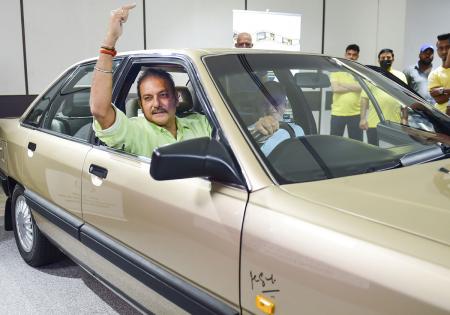
Ravi Shastri's gold Audi 100, won during India's 1985 World Championship of Cricket victory in Melbourne, revolutionized the business of Indian sports. The iconic moment bridged elite athletic performance with prime-time television and corporate endorsements, laying the commercial foundation for modern sports marketing and multi-billion-dollar broadcast rights across India.
MELBOURNE, Australia — On March 10, 1985, at the Melbourne Cricket Ground, 22-year-old all-rounder Ravi Shastri drove a metallic gold Audi 100 around the outfield. He had just been named "Champion of Champions" at the Benson & Hedges World Championship of Cricket after India defeated Pakistan in the final. Beyond marking a historic sporting triumph, Ravi Shastri's gold Audi catalyzed a fundamental shift in how commercial brands, broadcast media, and sports federations viewed Indian athletes as commercial assets. Decades later, the legend of Ravi Shastri's gold Audi remains a defining cornerstone in the commercial evolution of Indian sports marketing.
The Melbourne Triumph and the Golden Sedan
India's 1985 campaign in Australia stood as an unprecedented display of dominance. Under Sunil Gavaskar's leadership, the Indian cricket team won all five matches, culminating in an eight-wicket victory over Pakistan in the final. Shastri delivered an outstanding individual performance across the tournament, scoring 182 runs and taking eight wickets. His all-round consistency earned him the Player of the Tournament award, which came with the luxury sedan.
The visual of Team India players piling onto the hood, roof, and boot as Shastri drove around the MCG was broadcast live via satellite to millions of viewers across India. In a pre-liberalization era dominated by strict import quotas and limited consumer goods, the image of an Indian sportsman steering a West German luxury vehicle captured the public imagination and symbolized the country's rising global aspirations.
Commercial Transformation of the Indian Sports Ecosystem
Prior to 1985, corporate endorsement opportunities for Indian athletes were minimal and largely confined to modest domestic print advertisements. The arrival of Ravi Shastri's gold Audi in Mumbai—which required a special import duty waiver authorized by then-Prime Minister Rajiv Gandhi—demonstrated the massive marketing potential inherent in Indian sports broadcasting.
The international spectacle illustrated how television viewership, corporate sponsorship, and star power could merge into a lucrative business model. Following this landmark event:
Corporate Endorsements Multiplied: Advertisers recognized cricket stars as premier brand ambassadors, paving the way for multi-million-rupee talent representation contracts.
Broadcast Revenue Soared: Board of Control for Cricket in India (BCCI) officials realized the exponential commercial value of broadcast rights, setting the stage for future media rights auctions.
Automotive Brand Strategy Shifted: Luxury automotive manufacturers identified India as a high-potential future market for high-end vehicles.
Restoration and Preserving a National Asset
After decades of use in Mumbai, the vehicle sat idle due to the scarcity of original replacement parts. In 2022, industrialist Gautam Singhania's Super Car Club Garage (SCCG) undertook a painstaking, nearly year-long complete restoration of the vintage sedan. Mechanics sourced authentic factory parts globally and matched the exact original metallic paint code to return the car to mint condition.
The restored vehicle was officially unveiled at a special event where Shastri publicly referred to the car as a "national asset," highlighting that the prize belonged conceptually to the entire 1985 Indian cricket team and the nation. The car was recently showcased at the Raymond 100 Autofest in Thane, continuing to attract fans and automotive enthusiasts.
Impact on Sports Marketing, Investors, and Fans
The legacy of Ravi Shastri's gold Audi extends far beyond nostalgia, influencing multiple sectors of the Indian economy:
For Sports Marketing Industry: Established cricket as the primary vehicle for corporate advertising, eventually leading to modern commercial properties like the Indian Premier League (IPL).
For Athletes and Talent Agencies: Transformed elite sports into a highly viable corporate career, enabling modern athletes to generate substantial income through intellectual property and endorsement portfolios.
For Fans and Collectors: Created an enduring pop-culture moment that continues to inspire vintage car restoration initiatives and sports memorabilia culture in South Asia.
Official Sources and Corporate Disclosures
Information regarding the 1985 World Championship victory, vehicle import history, and subsequent restoration project is sourced from official statements by the Board of Control for Cricket in India (BCCI), archived tournament records from Cricket Australia, public statements by Gautam Singhania, and official disclosures from Audi India.
Official Statement and Quotes
According to official statements made during the vehicle's restoration ceremony, the car remains an indelible symbol of Indian sporting achievement.
"Organizers stated that restoring the 1985 Audi 100 required sourcing rare original parts internationally to ensure the historic vehicle retained its exact factory specification and national heritage value".
Why It Matters
The story of Ravi Shastri's gold Audi highlights the exact juncture where Indian sports transitioned from an amateur pursuit into a billion-dollar commercial industry. The global visibility generated by the 1985 tournament proved that sports broadcasting in India possessed unmatched commercial reach. This single moment established the blueprint for modern athlete marketing, broadcast monetization, and corporate brand integration that defines the global sports economy today.
Key Facts at a Glance
Event: 1985 Benson & Hedges World Championship of Cricket in Australia.
Prize: Gold Audi 100 sedan awarded to Shastri as "Champion of Champions".
Tournament Stats: 182 runs and 8 wickets in 5 matches by Shastri.
Historical Import: Import duty waived by Prime Minister Rajiv Gandhi upon arrival in India.
Restoration: Fully restored in 2022 by Gautam Singhania's Super Car Club Garage.
Frequently Asked Questions (FAQ)
Why was Ravi Shastri awarded the gold Audi in 1985?
Ravi Shastri was named Player of the Tournament ("Champion of Champions") at the 1985 Benson & Hedges World Championship of Cricket after scoring 182 runs and taking 8 wickets across five unbeaten matches.
How did Ravi Shastri bring the Audi 100 to India?
Due to high import duties on foreign cars in 1985, then-Prime Minister Rajiv Gandhi granted a special tax waiver, enabling Shastri to import the car into Mumbai.
Where is Ravi Shastri's gold Audi today?
The car was fully restored by Super Car Club Garage in 2022 and remains in pristine driving condition, frequently featured at special automotive exhibitions like the Raymond Auto Fest.
How did this event change the business of Indian sports?
The widespread televised celebration highlighted the commercial potential of cricket endorsements, paving the way for multi-million-dollar sponsorships, professional athlete management, and television rights expansion in India.
Source: Board of Control for Cricket in India (BCCI), Cricket Australia Official Archives, Audi India Official Portal