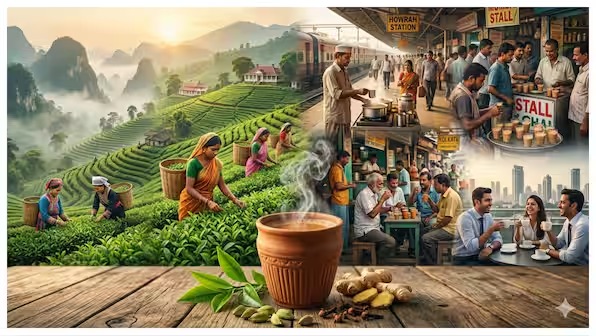
India’s love for tea stems from a complex history that began with British attempts to break China’s historic production monopoly by cultivating native plants in Assam. Through 20th-century promotional drives and the creative addition of milk and local spices by street vendors, the imported leaf transformed into a ubiquitous national beverage.
NEW DELHI, India: India’s domestic tea market continues to expand across both rural and urban sectors, reinforcing the beverage's status as an essential consumer staple. Commercial agricultural data published on Tuesday, June 2, 2026, shows that domestic tea leaves consumption has surpassed previous fiscal milestones, maintaining its position as the nation's most consumed prepared liquid after water. The modern commodity market, heavily anchored by the ubiquity of milk-boiled masala chai, is the direct result of a complex historical evolution involving ancient Chinese botany, British imperial trade strategies, and 20th-century Indian consumer adaptation.
The Chinese Origins and the British Botanical Search
The global foundation of the modern tea trade traces its roots to ancient China, where the consumption of Camellia sinensis leaves began as a medicinal practice before evolving into a formal cultural ritual. For centuries, the Chinese empire maintained a strict monopoly on tea leaves production and processing techniques. By the 18th century, the British East India Company faced significant economic pressure due to its massive purchases of Chinese tea, which required vast outlays of silver bullion.
To counter this trade imbalance, British colonial administrators looked for alternative production sites within the Indian subcontinent. In the 1820s, Scottish explorer Robert Bruce identified a native variant of the tea plant, Camellia sinensis var. assamica, growing wild in the hills of Assam. This discovery allowed the British state to establish large-scale plantations in Northeast India, directly challenging China's global trade dominance.
From Colonial Export to Indian Consumer Adaptation
Initially, the vast tea volumes harvested in Assam and Darjeeling were intended almost exclusively for export to European markets. Indigenous Indian communities rarely consumed the processed leaves, occasionally using wild tea varieties only for specific medicinal applications. The transition from an export-oriented cash crop to India's most famous national drink required a deliberate, multi-decade promotional push.
Following systemic overproduction in the early 1900s, the colonial Indian Tea Market Expansion Board launched targeted promotional campaigns across the country. Factory owners and railway networks were encouraged to introduce mandatory "tea breaks" for workers. Crucially, Indian vendors quickly modified the traditional British style of drinking black tea with a splash of milk. To optimize profits and suit local tastes, street vendors combined small quantities of cheap CTC (Crush, Tear, Curl) tea leaves with high volumes of milk, sugar, and regional spices like ginger and cardamom, creating the modern masala chai.
Production Scales and Economic Footprint
The modern Indian tea industry is a major driver of agricultural employment and industrial output, particularly within regional economies like Assam, West Bengal, and Tamil Nadu. According to national agricultural tracking boards, India stands as the world's second-largest producer of tea leaves, trailing only China, while consuming roughly 80% of its own total harvest domestically.
| Principal Production Region | Primary Tea Variant Produced | Traditional Harvesting Season |
| Assam Valley | CTC & Robust Black Teas | May to November |
| Darjeeling Hills | Orthodox & Premium Flushes | March to October |
| Nilgiri Mountains | Fragrant & Dark Leaf Blends | Year-Round Production |
The industrial shift toward mechanized CTC processing in the mid-20th century lowered retail pricing across the subcontinent. This price reduction turned the beverage into an affordable daily option for working-class citizens, cutting across diverse socio-economic, linguistic, and regional boundaries.
Official Sources Section
Historical timelines, trade statistics, and botanical classifications are compiled from documentation curated by the Tea Board of India and archival records maintained by the Ministry of Commerce and Industry. Regional production figures and consumption datasets are validated using data sets from the Food and Agriculture Organization (FAO) corporate statistical databases.
Quote Section
"According to officials, the transformation of the domestic tea industry from a colonial export operation into an independent consumer market established the structural framework for our modern agro-processing sector. Organizers stated that tea remains a key indicator of agricultural health, supporting millions of plantation workers across our eastern and southern states."
Agricultural economists reviewing historical domestic commodity trends.
Why It Matters
The historical trajectory of how tea became India's favourite drink carries practical economic implications for modern fast-moving consumer goods (FMCG) corporations, rural laborers, and commodity investors. Understanding how changing consumer tastes transformed a foreign luxury item into a universal baseline commodity helps agricultural planners manage seasonal crop distribution and pricing cushions. For the millions of families dependent on the harvesting sector, steady domestic consumption acts as a key economic safety net, protecting local wages from sudden drops in international trade demand.
Key Facts at a Glance
Monopoly Shift: British colonial agencies expanded tea cultivation in Assam during the 19th century to break China's global production monopoly.
Local Adaptation: Indian street vendors created the modern milk-boiled masala chai by adding local spices to cheap CTC tea grades, adapting the traditional British black tea style.
Volume Leader: India is the second-largest producer of tea leaves globally, with domestic households consuming roughly 80% of the total annual yield.
Mechanization Boost: The mid-20th century rollout of automated CTC processing lowered manufacturing costs, making the beverage affordable for all income groups.
Employment Anchor: The organized plantation sector provides consistent livelihoods for over a million registered agricultural workers nationwide.
FAQ Section
Who discovered the native Indian tea plant variety in Assam?
The indigenous variant, Camellia sinensis var. assamica, was identified in the early 1820s by Scottish explorer Robert Bruce, with assistance from local Assamese nobleman Maniram Dewan.
What does the acronym CTC stand for in commercial tea processing?
CTC stands for "Crush, Tear, Curl." It refers to a highly mechanized operational method that processes harvested green leaves into uniform, black pellets, yielding a robust brew well-suited for milk-boiled preparations.
Where can consumers verify updated export and auction prices for Indian tea?
Weekly auction values, export clearing quantities, and quality standards are updated transparently on the official portal of the Tea Board of India.
Source: Tea Board of India, Food and Agriculture Organization, Indian Chamber of Commerce.