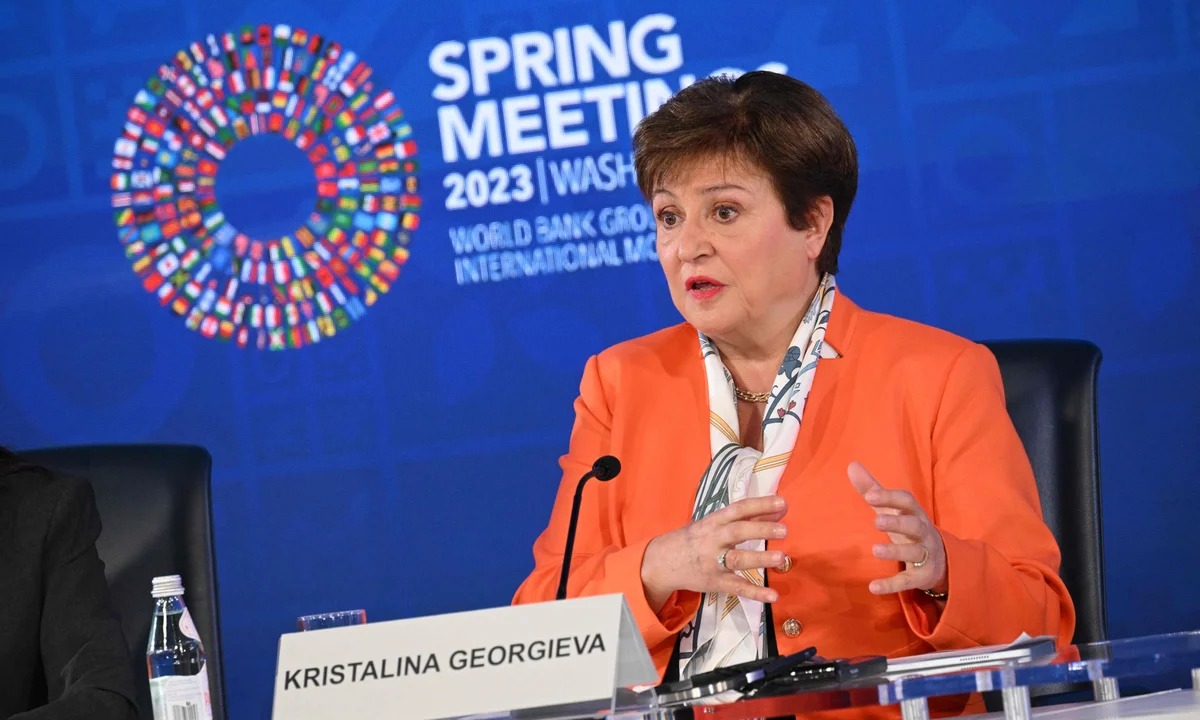
IMF Managing Director Kristalina Georgieva confirmed the global economy is weathering the Middle East conflict without showing signs of a generalized slowdown. Welcoming the US-Iran ceasefire, she noted that most member countries are requesting targeted macroeconomic policy guidance rather than emergency capital bailouts, supported by economic momentum in the US and China.
WASHINGTON — International Monetary Fund (IMF) Managing Director Kristalina Georgieva stated on Monday, June 15, 2026, that the global economy is proving highly resilient three months into the Middle East conflict, showing no immediate signs of a systemic global slowdown. Speaking from the fund's headquarters, Georgieva formally welcomed Sunday’s diplomatic breakthrough between the United States and Iran, declaring that the comprehensive ceasefire agreement avoids an escalated crisis that would have posed a critical danger to international growth.
The IMF leader highlighted a notable shift in state-level interactions with the global lender. Rather than rushing for multi-billion dollar financial bailouts, the vast majority of IMF member countries are proactively seeking targeted macroeconomic policy guidance to safely navigate heightened inflation and volatile energy markets. While several highly vulnerable nations are currently collaborating with the IMF to secure increased economic aid, the broader international framework remains anchored by surprisingly robust growth in the world’s two largest economic engines.
Divergent Momentum: US and China Surge While Gulf Exporters Slip
The IMF’s real-time statistical tracking reveals a deeply fractured global outlook. Despite the immense strains placed on supply chains and maritime transit over the past 90 days, both the United States and the People's Republic of China continue to demonstrate strong economic momentum. China has successfully cushioned domestic industrial disruptions by drawing strategically from its extensive domestic oil reserves, which has simultaneously absorbed severe demand shocks across wider Asian trade corridors.
In stark contrast, the oil-exporting nations of the Gulf Cooperation Council (GCC) are facing sharp downward revisions to their near-term GDP projections. The prolonged closure of the Strait of Hormuz, paired with extensive local infrastructure damage sustained during the initial phase of the fighting, has constrained regional logistics.
The primary macroeconomic metrics tracking the conflict's shock wave demonstrate this geographic divergence:
Energy Pricing Pressure: Global crude oil prices spiked more than 30% above pre-war baselines following the initial outbreak of hostilities.
Alternative Supply Integration: Increased refinery utilization and crude production outside the Persian Gulf have successfully prevented an unmitigated global energy collapse.
Fiscal Cushion Limitations: Emerging markets are reaching structural boundaries regarding how long national budgets can absorb elevated domestic fuel subsidies and higher external borrowing costs.
Inflation Expectations Anchored Despite Commodity Price Shocks
A major point of reassurance highlighted by the central fund is the structural stability of global consumer pricing models. While the outbreak of active warfare in late February pushed headline inflation upward via instantaneous supply bottlenecks, medium-term inflation expectations across advanced and major emerging economies remain generally well-anchored.
Structural Resilience Assessment: Corporate boards and retail consumers have treated the energy supply shock as a transitory crisis rather than a permanent structural reset, allowing central banks to maintain structured target projections.
The International Monetary Fund is scheduled to release its finalized, data-verified global growth projections on July 8, 2026, during the publication of its comprehensive World Economic Outlook (WEO) Update.
Official Sources Section
The operational updates and economic findings outlined by Managing Director Kristalina Georgieva were distributed officially through the International Monetary Fund Executive Board media briefing registry. Supporting trade and maritime freight metrics correspond directly with data recorded by global shipping logistics bureaus and institutional records from member central banks.
Quote Section
"According to officials at the global lender, the framework deal marks a highly significant milestone toward restoring commercial stability to upended energy corridors. IMF leadership stated that while the immediate risk of an unmitigated global recession has subsided due to the US-Iran ceasefire, international policymakers must remain highly disciplined to prevent lingering commodity volatility from seeping into core domestic retail prices."
Why It Matters
The IMF’s latest economic diagnosis brings concrete implications for international business entities, institutional investors, and common consumers. The formal implementation of the US-Iran ceasefire and the reopening of the Strait of Hormuz will rapidly remove the geopolitical risk premium that has inflated commercial shipping container rates and fuel surcharges for three months.
For retail consumers, this prevents a severe round of imported inflation on basic everyday goods. For international investors, the structural reality that member nations are demanding technical policy advice over raw emergency loans signals that national banking reserves are in a stronger position than during past global geopolitical disruptions.
Key Facts at a Glance
Ceasefire Acknowledged: IMF Chief Georgieva officially welcomed the Sunday framework agreement between the US and Iran, calling it vital to protecting global growth.
No Slowdown Materializing: Despite three months of regional warfare, world economic growth has held up without entering a generalized slowdown.
Shift to Policy Support: The vast majority of IMF member states are utilizing the fund for policy guidance rather than requesting emergency credit lines.
Two-Speed Economy: The United States and China show highly resilient momentum, while Gulf oil exporters undergo sharp downward revisions.
WEO Update Set: The IMF will officially publish its revised, scenario-tested global growth forecasts on July 8, 2026.
FAQ Section
Why are countries asking the IMF for policy advice instead of financial loans right now?
Unlike previous global crises where nations depleted their foreign currency reserves and required emergency capital injections, most governments currently possess sufficient fiscal cushions. They are turning to the IMF for specialized technical guidance on managing local inflation, optimizing interest rates, and absorbing high energy costs without damaging growth.
How did the United States and China maintain economic momentum during the war?
The US benefited from robust domestic energy production and consumer demand, shielding it from direct import dependencies. China relied on deep strategic crude oil reserves built up over previous years, allowing its manufacturing sectors to continue operating smoothly without suffering from immediate international fuel spikes.
When will the final economic impact of the Middle East war be quantified by the IMF?
The IMF will publish its comprehensive, verified macroeconomic figures and updated country-by-country GDP growth forecasts in the next World Economic Outlook Update, scheduled for global release on July 8, 2026.
Source: International Monetary Fund Official Media Center, Reuters Economics Newsdesk Reports.