India and France are expanding their strategic defence partnership through major aerospace initiatives. Following high-level bilateral summits, Dassault Aviation submitted a proposal to build 96 Rafale jets in India. Concurrently, New Delhi has initiated formal talks to co-join France's sixth-generation Future Combat Air System (FCAS) fighter development programme.
NICE, France — India and France have significantly advanced their strategic partnership by deepening collaboration on key defence projects, including the potential co-development of a sixth-generation fighter aircraft under the Future Combat Air System (FCAS).
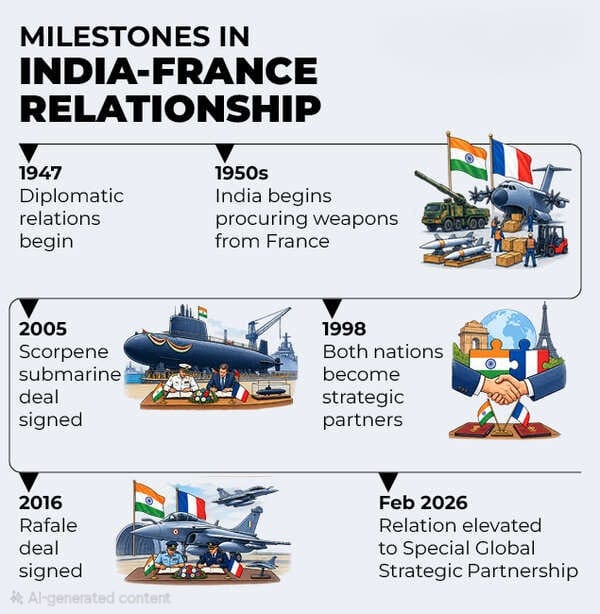
Following bilateral talks between Indian Prime Minister Narendra Modi and French President Emmanuel Macron in Nice on June 14, 2026, the two nations agreed to expand cooperation from conventional military equipment procurement toward joint design, co-development, and co-production of next-generation combat technology.
The shift marks a major evolution in bilateral ties following the elevation of the relationship to a Special Global Strategic Partnership earlier this year.
India Explores Entry Into Sixth-Generation Combat Jet Programme
The Indian Ministry of Defence formally confirmed in a report to the Parliamentary Standing Committee on Defence that New Delhi has initiated concerted efforts to join the French-led FCAS project. The move opens a direct pathway for India to access sixth-generation air combat technologies, which integrate stealth design, artificial intelligence, autonomous unmanned systems, and high-speed combat-cloud networks.
France's decision to seek new partners follows the restructuring of its joint fighter initiative with European allies, leaving Paris to lead the FCAS platform. Under proposed frameworks, France would retain principal design authority while India could serve as a primary manufacturing and assembly base.
The parliamentary panel has requested a comprehensive roadmap from the Defence Ministry outlining workshare, intellectual property rights, technology transfer arrangements, and timelines for India's participation.
Dassault Submits Proposal for 114 Rafale Aircraft Manufacture in India
The near-term focus of bilateral aerospace cooperation centers on the Indian Air Force's (IAF) requirement for 114 multi-role fighter aircraft. Dassault Aviation has submitted its technical and commercial proposal for the estimated ₹3.25 lakh crore ($39 billion) procurement effort.
The proposal stipulates that 18 aircraft will be delivered directly in fly-away condition, while the remaining 96 jets will be manufactured within India. The arrangement aims to ramp up local manufacturing content from an initial 30% to over 60% as production matures.
The acquisition is designed to address the IAF's current fighter force deficit, which currently operates at 29 squadrons against a sanctioned strength of 42.
Naval Aviation and Maritime Subsurface Capabilities
Beyond combat aircraft, naval cooperation remains an anchor of the bilateral defence framework. Following the contract for 26 Rafale-M carrier-borne fighters for the Indian Navy, joint teams are establishing technology transfer mechanisms to integrate indigenous weapon systems onto the platforms.
In the maritime subsurface domain, India completed the commissioning of all six Kalvari-class (Scorpene) submarines built at Mazagon Dock Shipbuilders Limited under French technology transfer. Industrial collaboration has also expanded into precision munitions, with Safran partnering alongside domestic defence manufacturers to produce HAMMER precision-guided kits in India.
Official Statements
"The two leaders expressed satisfaction at the excellent growth and depth of bilateral defence collaboration across all domains and agreed to further intensify it with focus on co-design, co-development and co-production of defence platforms and advanced technologies."
— Ministry of External Affairs (MEA), Government of India
According to officials in the Standing Committee on Defence report, the Ministry of Defence has "initiated efforts in a concerted manner to co-join" the French-led sixth-generation combat aircraft project to build long-term aerial defence autonomy.
Operational and Economic Impact
For the Armed Forces: Acquiring additional Rafale jets stabilizes operational readiness for the IAF, while access to sixth-generation technology accelerates the capability gap transition alongside the indigenous Advanced Medium Combat Aircraft (AMCA) project.
For Domestic Industry: Manufacturing 96 Rafale fighters locally creates high-skilled jobs and expands micro, small, and medium enterprise (MSME) integration within India's aerospace supply chains.
For Investors: Bilateral trade between India and France reached €13.6 billion in 2025–26, driven by rising aerospace and technology investments.
Key Facts at a Glance
114 Jet Offer: Dassault proposal includes 18 fly-away Rafale jets and 96 manufactured in India.
6th-Gen FCAS Push: India seeks formal participation in the French-led FCAS next-generation fighter system.
Naval Integration: Delivery preparation continues for 26 Navy Rafale-M fighters featuring domestic armaments.
Indigenization Target: Local production framework aims for over 60% domestic content in aircraft manufacturing.
Frequently Asked Questions
What is the status of the 114 Rafale fighter deal?
Dassault Aviation has submitted its technical and commercial proposal. The project outlines 18 jets delivered from France and 96 assembled in India to enhance domestic manufacturing capabilities.
Is India officially a full partner in France's FCAS 6th-generation jet programme?
No, India is currently in formal exploratory talks and has initiated steps to co-join the programme. Terms regarding funding, workshare, and intellectual property remain under negotiation.
Does FCAS replace India's indigenous AMCA 5th-generation jet project?
No. The Defence Ministry frames FCAS participation as a complementary effort to acquire 6th-generation combat-cloud and autonomous drone capabilities alongside the AMCA program.
How does this impact the Indian Navy's aircraft carrier operations?
The procurement of 26 Rafale-M jets provides dedicated deck-based fighters tailored for Indian aircraft carriers, backed by technology transfers for indigenous weaponry.
Source: Official releases from the Ministry of External Affairs (MEA), official filings from the Press Information Bureau (PIB), parliamentary reports from the Standing Committee on Defence, and corporate announcements from Dassault Aviation.