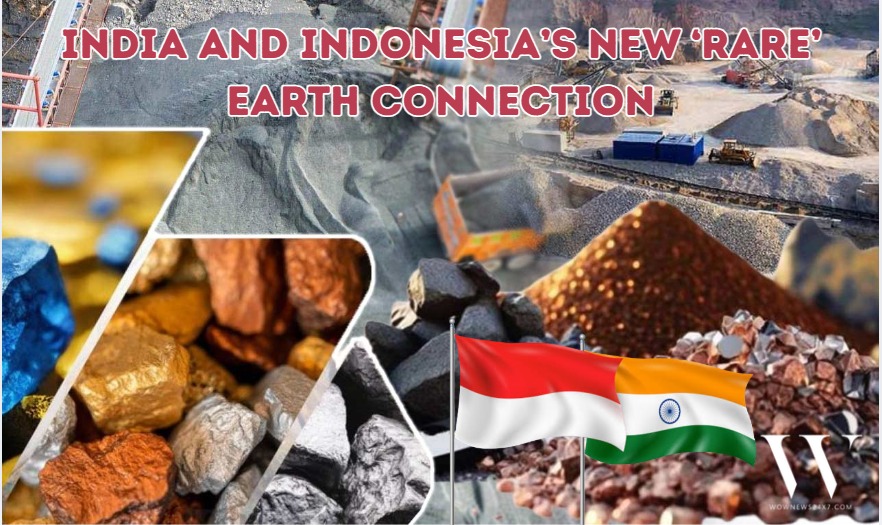
India and Indonesia have signed a landmark MoU to collaborate on critical minerals and rare earths, a move designed to secure supply chains for electric vehicles and high-tech manufacturing. The agreement includes joint ventures in steel production and aims to strengthen the strategic partnership between the two Asian nations.
As India seeks to secure its supply chain for electric vehicles and clean energy, a new memorandum of understanding with Indonesia promises deeper cooperation in critical minerals and rare earths.
JAKARTA — India and Indonesia have formally solidified their commitment to strengthening supply chain resilience by signing a high-profile memorandum of understanding (MoU) focused on critical minerals and rare earths. The agreement was reached during Prime Minister Narendra Modi’s state visit to Jakarta this week, marking a significant step in the burgeoning "India-Indonesia Comprehensive Strategic Partnership."
The partnership, one of 14 key agreements signed between the two nations, aims to address the growing global demand for strategic resources essential to modern technology, including semiconductors, electric vehicle (EV) batteries, and renewable energy infrastructure. By diversifying its sourcing, India seeks to reduce its historical reliance on single-source suppliers and stabilize the availability of materials vital for its "Atmanirbhar Bharat" (Self-Reliant India) initiative.
Strategic Cooperation on Rare Earths
The collaboration focuses on identifying and extracting resources that are increasingly scarce in the global market. Indonesian mining firm Midwest Ltd. has separately entered into a memorandum of understanding with the Perusahaan Mineral Nasional (PERMINAS) to explore rare earth collaboration, reinforcing the bilateral focus on non-ferrous metals.
Official statements from both capitals emphasized that the cooperation is not limited to extraction but extends to the "technology of the steel supply chain." The pacts include a joint venture between the Steel Authority of India (SAIL) and PT Krakatau Steel, aimed at exploring stainless steel slab manufacturing in Indonesia. This integrated approach ensures that India gains a strategic foothold in Indonesia’s vast mineral landscape while Indonesia benefits from Indian technological expertise in mineral processing and value-added manufacturing.
Why the Partnership Matters
In an era of shifting global trade dynamics, access to critical minerals—such as nickel, lithium, and rare earth elements—has become a cornerstone of national economic security. India, a rapidly expanding manufacturing hub, requires these components to power its transition toward green energy and high-tech defense production.
"According to officials," the MoU serves as a framework to ensure "stable, affordable, and reliable" supply chains for industries that are expected to define the next decade of industrial growth. For Indonesia, the partnership provides a platform to move up the value chain from exporting raw ore to manufacturing high-value products, such as processed steel and battery components.
Key Facts at a Glance
Focus Areas: Rare earths, nickel, lithium, and steel supply chain technology.
Strategic Entities: Collaboration between Steel Authority of India (SAIL) and PT Krakatau Steel.
Scope: Part of a broader 14-agreement package spanning trade, maritime security, and research.
Objective: Diversifying mineral supply chains to support EV, defense, and semiconductor industries.
FAQ
Why is Indonesia a strategic partner for India?
Indonesia holds some of the world's largest reserves of critical minerals like nickel, which are essential for EV batteries, making it a natural partner for India’s growing green energy ambitions.
What does the new MoU cover regarding steel?
The MoU includes a specific focus on the "technology of the steel supply chain" and explores joint ventures for stainless steel manufacturing between Indian and Indonesian state-owned firms.
How does this affect India’s reliance on other markets?
The agreement is part of a deliberate effort by New Delhi to diversify its mineral sourcing and reduce over-reliance on single-country supply chains, particularly for raw materials used in defense and high-tech sectors.
Official Sources