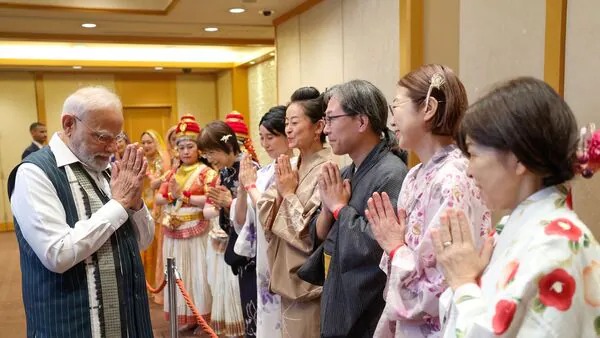
Prime Minister Narendra Modi’s two-day visit to Tokyo has brought renewed focus to the enduring and evolving relationship between India and Japan. From spiritual roots in Buddhism to cutting-edge cooperation in bullet train technology and economic security, the visit marks a pivotal moment...
Prime Minister Narendra Modi’s two-day visit to Tokyo has brought renewed focus to the enduring and evolving relationship between India and Japan. From spiritual roots in Buddhism to cutting-edge cooperation in bullet train technology and economic security, the visit marks a pivotal moment in a partnership that spans centuries. This is Modi’s first standalone trip to Japan in seven years, and it comes at a time when both nations are recalibrating their roles in a shifting Indo-Pacific landscape.
The visit includes the 15th India-Japan Annual Summit, bilateral talks with Japanese Prime Minister Shigeru Ishiba, and a high-profile address at the India-Japan Economic Forum. The leaders are expected to unveil a new 2035 Vision Statement, building on the 2025 framework announced a decade ago.
Key Highlights From The Tokyo Summit
- India and Japan to co-develop the next-generation E10 Shinkansen bullet trains for the Mumbai-Ahmedabad corridor
- Japan commits to a new investment target of 10 trillion yen (approximately USD 68 billion) over the next decade
- Bilateral discussions cover trade, defence, clean energy, semiconductors, and critical minerals
- Modi and Ishiba to ride the Shinkansen together, symbolizing technological and diplomatic convergence
- A new people-to-people exchange program aims to bring 500,000 Indians to Japan over five years
Historical Foundations And Cultural Bridges
India-Japan ties trace back to the sixth century, when Buddhism first reached Japanese shores. Over time, this spiritual connection evolved into a cultural and diplomatic bond, reinforced by shared values of peace, resilience, and innovation. The legacy of Buddhist exchanges continues to influence modern diplomacy, with both nations emphasizing ethical governance and regional stability.
In 2007, Japanese Prime Minister Shinzo Abe’s landmark speech in the Indian Parliament invoked Mughal prince Dara Shikoh’s vision of unity, setting the tone for a deeper strategic partnership. Today, that vision finds expression in joint infrastructure projects, defence cooperation, and multilateral engagement.
Economic Security And Strategic Cooperation
1. Japan is India’s fifth-largest source of foreign direct investment, with USD 43.2 billion invested to date
2. Bilateral trade stands at USD 22.8 billion, with efforts underway to expand market access for Indian pharmaceuticals and textiles
3. The summit will upgrade the 2008 Declaration on Security Cooperation, with new defence hardware and joint technology development
4. A new framework for economic security will focus on building resilient supply chains for semiconductors and rare earths
5. Maritime security and Indo-Pacific coordination remain central to both countries’ strategic outlook
Technology And Talent Synergy
Modi’s address at the India-Japan Economic Forum emphasized the fusion of Japanese technology and Indian talent. He called for collaboration in robotics, batteries, shipbuilding, and nuclear energy, echoing Japan’s strengths in precision engineering and India’s scale in implementation.
India’s AI, quantum computing, and biotech sectors are expected to benefit from Japanese investment and expertise. The leaders also discussed expanding cooperation in space and clean energy, with a focus on hydrogen and solar technologies.
Geopolitical Context And Regional Balance
The Tokyo visit precedes Modi’s trip to China for the Shanghai Cooperation Organisation summit, where he will meet Xi Jinping and Vladimir Putin. The timing underscores India’s multi-alignment strategy, balancing its rivalry with China while deepening ties with Japan and other Quad partners.
Japan’s decision to cancel a planned trade meeting with the US over tariff disputes adds further weight to its engagement with India. Both nations are seeking to insulate their economies from geopolitical shocks and build sustainable, diversified partnerships.
Conclusion: A Timeless Bond With A Future Focus
Prime Minister Modi’s visit to Japan is more than a diplomatic engagement—it is a reaffirmation of a relationship rooted in history and driven by shared ambition. From the spiritual legacy of Buddhism to the technological marvel of bullet trains, India and Japan are crafting a partnership that blends tradition with transformation. As both nations look ahead to 2035, their convergence promises to shape not just bilateral ties, but the future of the Indo-Pacific.
Sources: Financial Express, Indian Express, Firstpost, The Hindu, India Today, Livemint