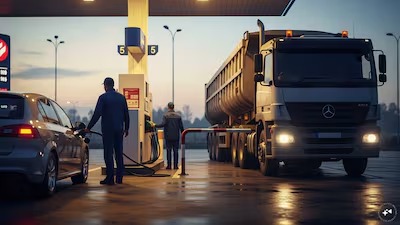
The Indian government has enforced a 90-day emergency order stopping commercial, industrial, and institutional users from buying cheaper, consumer-subsidized petrol and diesel at public retail pumps. Sourcing is capped at 200 litres daily per retail customer to protect civilian supply lines from corporate hoarding.
NEW DELHI — In a major regulatory intervention to safeguard domestic fuel distribution, the Indian government has barred industrial, commercial, and institutional consumers from purchasing motor spirit (petrol) and high-speed diesel directly from retail fuel stations. The temporary restriction framework, enacted via an official ministry notification on June 11, 2026, remains operational for a strict window of up to 90 days. The mandate seeks to suppress an artificial spike in retail sales volumes driven by bulk commercial operations attempting to bypass market-linked wholesale pricing channels.
Price Arbitrage Triggers Emergency Supply Order
The Ministry of Petroleum and Natural Gas enacted the Motor Spirit and High Speed Diesel (Temporary Regulation of Supply through Retail Outlets) Order, 2026 under the provisions of the Essential Commodities Act. The sweeping order commands public sector Oil Marketing Companies (OMCs) and private fuel retailers to eliminate massive institutional drawdowns at retail pumps.
The economic driver behind this unusual supply migration stems from an acute pricing divergence between consumer retail channels and wholesale bulk distributions. For example, in New Delhi, retail high-speed diesel trades at approximately ₹95.20 per litre. Conversely, the market-linked rate for commercial bulk procurement hovers significantly higher at ₹134.50 per litre.
This massive gap widened after multiple fuel price hikes affected the wholesale segment. State-run entities modulated retail consumer prices to shield regular citizens from rising global crude costs, while wholesale buyers remained subject to floating international costs.
Macro Supply Realities and Daily Purchase Caps
The Central Government explicitly identified compounding macro threats to local supply logistics in its regulatory notification. Extreme pressure across global shipping lanes and geopolitical disruptions across regional energy zones have directly impaired international petroleum supply chains.
Under the statutory terms of the new emergency order, strict daily operating boundaries have been deployed across all functional fuel dispensaries to ensure equitable availability:
Retail Sourcing Bans: Heavy entities, including independent telecom tower operators, manufacturing units, and commercial complexes utilizing diesel for power generation, must source exclusively through their designated consumer pumps or bulk points.
Volumetric Purchases Restricted: Local fuel dealers are barred from selling more than 200 litres of high-speed diesel to any single customer or individual vehicle during a calendar day.
Resale Prohibition: Any volume acquired under the daily 200-litre ceiling cannot be legally resold or distributed to secondary buyers.
Impacts on Logistics and General Consumer Networks
The administrative measures prioritize the logistical needs of everyday domestic consumers, retail transport vehicles, and agricultural networks. Heavy arbitrage purchasing by industrial firms risked starving regional retail pumps, raising the threat of structural, localized supply gaps.
With the daily restriction of up to 200 litres of diesel per vehicle in place, average passenger vehicle and two-wheeler owners across India remain entirely unaffected. The typical fuel tank capacity for passenger cars ranges between 35 and 60 litres, while two-wheelers generally hold between 8 and 14 litres. However, long-haul logistics operations and multi-axle commercial vehicles with fuel tank sizes spanning up to 600 litres will need to recalibrate their fueling routes to utilize authorized wholesale channels securely.
Official Institutional Directives
According to the official gazette announcement published by the central administration, the 90-day restriction parameters can be legally extended, modified, or repealed depending on structural changes in global ocean freight and shipping security. The Petroleum and Explosives Safety Organisation (PESO) will simultaneously monitor retail compliance alongside state enforcement teams to ensure diesel is only filled in vehicle fuel tanks or approved containers.
Statement From Ministry Representatives
"According to officials at the Ministry of Petroleum and Natural Gas, abnormal increases in sales of motor spirit and high-speed diesel through retail outlets have triggered immediate regulatory intervention. Organizers stated that bulk consumers shifting to consumer pumps to capture the price difference risks diverting supplies intended for retail consumers. This temporary framework prevents localized shortages and ensures equitable fuel distribution nationwide."
Why It Matters
For common motorists, logistics operators, and local commuters, the policy move safeguards price stability at the pump while guaranteeing uninterrupted access to fuel. For corporate entities, it enforces a return to real market-linked bulk pricing, which could briefly elevate near-term operational costs for industrial generators and infrastructure firms dependent on off-grid power.
Key Facts at a Glance
Regulatory Duration: The supply restriction is effective for a temporary phase of up to 90 days.
Wholesale Price Spread: Diesel costs ₹134.50 per litre in bulk but sits at ₹95.20 at retail pumps in Delhi.
Daily Retail Ceiling: High-speed diesel purchases are strictly capped at 200 litres per vehicle or customer per day.
Enforcement Control: Structural fuel compliance will be actively managed alongside the Petroleum and Explosives Safety Organisation (PESO).
Target Entities: Restrictions apply strictly to industrial, commercial, and institutional users.
FAQ Section
Why did industrial users start buying fuel from consumer petrol pumps?
A large pricing gap emerged after state-owned oil marketing firms held retail consumer fuel rates steady during global market shocks. Because industrial bulk buyers are subject to floating global prices, wholesale diesel rose to ₹134.50 per litre while retail pumps remained at ₹95.20, driving companies to buy from consumer stations to save costs.
Will common car owners or motorcyclists face restrictions at petrol bunks?
No. Normal civilian vehicle owners, private transport users, and agricultural operators are completely exempt from the bulk sourcing ban. The 200-litre daily cap is designed to easily accommodate regular consumer transport vehicles while blocking large commercial tankers from taking industrial volumes.
What happens if an industrial consumer violates this temporary order?
Any corporate entity, factory owner, or commercial institution caught sourcing fuel from retail pumps or reselling retail diesel will face asset review and enforcement penalties under the Essential Commodities Act.
Source: Official regulatory notifications from the Ministry of Petroleum and Natural Gas, news wires from Reuters, and statutory guidelines via the Petroleum and Explosives Safety Organisation (PESO).