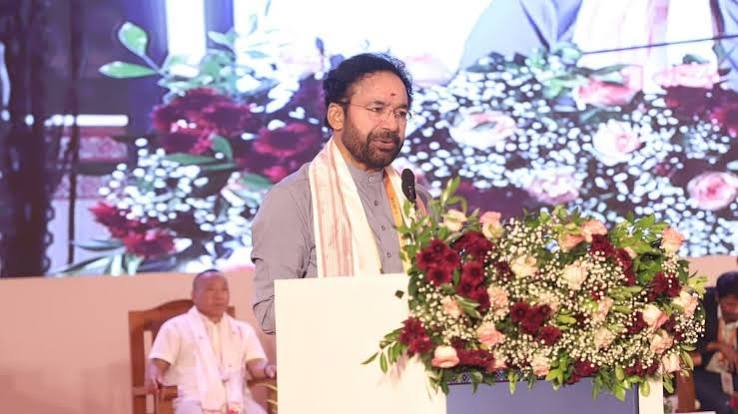
Union Minister of Mines G. Kishan Reddy announced that India will soon establish a regulated Minerals Exchange to facilitate electronic delivery-based mineral trading. Introduced under the Mines and Minerals (Development and Regulation) Amendment framework, the digital marketplace aims to standardize trade, ensure transparent price discovery, and reduce import dependencies.
NEW DELHI, India — Union Minister of Mines G. Kishan Reddy has confirmed that India will soon launch its first official Minerals Exchange, establishing a nationwide electronic trading platform for domestic raw materials. Speaking in parliament following legislative developments under the Mines and Minerals (Development and Regulation) Amendment Act, the minister emphasized that the exchange will standardize trading, improve market efficiency, and enhance supply chain visibility for industrial stakeholders.
The regulatory initiative marks a major structural reform aimed at replacing opaque, private bilateral negotiations with a centralized, technology-driven marketplace. The decision aligns with India's broader national agenda to secure critical minerals, bolster domestic manufacturing, and create a transparent price discovery mechanism similar to global commodity venues like the London Metal Exchange.
Regulatory Framework and Market Governance
The upcoming platform is governed by the newly notified Mineral Exchange Rules, which outline mandatory registration, trade surveillance, and operational standards for prospective exchange operators. To ensure market integrity, the central government has designated the Indian Bureau of Mines (IBM) as the primary market regulator and supervisory body overseeing exchange operations, routine audits, and compliance enforcement.
Under the established framework:
Regulated Digital Trading: All listed exchanges will operate as electronic, delivery-based trading platforms offering standardized contracts for notified non-coal and non-atomic minerals.
Capital and Operational Eligibility: Entities applying to operate a recognized exchange must maintain a minimum net worth of ₹50 crore, with approvals valid for 25 years.
Data Transparency Mandates: Operating exchanges will be required to publish real-time trade data, including daily highest, lowest, and volume-weighted average contract prices.
Regulatory Exclusions: Trading for coal, lignite, and atomic minerals will remain outside the scope of the Indian Bureau of Mines oversight, under separate administrative mechanisms.
Strategic Shift Toward Transparent Price Discovery
Historically, India's domestic mineral trade has functioned through decentralized, private contracts between miners, traders, and industrial buyers. This fragmented arrangement often led to significant price disparities, information asymmetry, and administrative inefficiencies in royalty calculations for mineral-producing states.
By transitioning to a digital exchange architecture, the Ministry of Mines aims to establish rupee-denominated benchmark prices for essential industrial input materials, including iron ore, copper, bauxite, and critical green-transition minerals like lithium and cobalt.
Industry analysts note that transparent price discovery will benefit both public sector undertakings—such as NMDC, NALCO, and Hindustan Copper—and private industrial conglomerates by allowing them to hedge raw material input risks and auction surplus production on an open exchange.
Industry and Macroeconomic Impact
The launch of a dedicated Minerals Exchange supports India's expanding manufacturing base, automobile sector, and clean energy transition programs. The initiative complements the National Critical Mineral Mission (NCMM), which focuses on strengthening domestic supply chain resilience and reducing reliance on foreign raw material benchmarks.
For downstream manufacturers, steelmakers, and battery producers, the platform provides guaranteed delivery channels, transparent pricing, and standardized quality certifications. Furthermore, mineral-rich state governments in eastern and central India are expected to see streamlined royalty collection processes aligned with real-time market valuations.
Official Sources Section
The announcement and details regarding the upcoming exchange launch were confirmed by Union Coal and Mines Minister G. Kishan Reddy during parliamentary proceedings and official Ministry of Mines announcements. Further operational guidelines were issued through the official publication of the Mineral Exchange Rules under the Mines and Minerals (Development and Regulation) framework.
Official Quote Section
"According to official statements from the Union Ministry of Mines, the establishment of regulated mineral exchanges will modernize domestic raw material trade, provide an efficient price discovery mechanism, and ensure transparent, tech-enabled governance across the nation's mining sector."
Why It Matters
Creating a national Minerals Exchange equips India with its own spot and derivative pricing benchmark for strategic raw materials, reducing foreign market dependencies. The platform offers industrial buyers price certainty, curbs market manipulation, and fosters investor confidence across the domestic mining and manufacturing ecosystems.
Key Facts at a Glance
Initiative: Launch of India's first regulated national Minerals Exchange for electronic mineral trading.
Regulatory Oversight: Supervised directly by the Indian Bureau of Mines (IBM).
Net Worth Requirement: Operators must maintain a minimum net worth of ₹50 crore.
Primary Objective: Transparent price discovery, standardized contracts, and supply chain digitalization.
Legislative Anchor: Enacted under the Mines and Minerals (Development and Regulation) Amendment framework.
Frequently Asked Questions (FAQs)
What is the purpose of the proposed Indian Minerals Exchange?
The Minerals Exchange is designed as an electronic, delivery-based trading platform to facilitate transparent price discovery, standardized contracts, and organized trading of minerals across India.
Who will regulate the Minerals Exchange in India?
The Indian Bureau of Mines (IBM) serves as the primary regulatory and market oversight authority for registered mineral exchanges.
Which minerals will be traded on the exchange?
The exchange will facilitate trading for notified metallic, non-metallic, and critical minerals, excluding coal, lignite, and atomic materials.
Where can stakeholders review official announcements from the Ministry of Mines?
Official releases and statutory rules are published directly on the official portal of the Ministry of Mines and disseminated via the Press Information Bureau (PIB).
Source: Official regulatory announcements from the Ministry of Mines, legislative proceedings published by the Press Information Bureau (PIB), statutory rules issued under the Indian Bureau of Mines, and parliamentary records maintained by the Parliament of India.