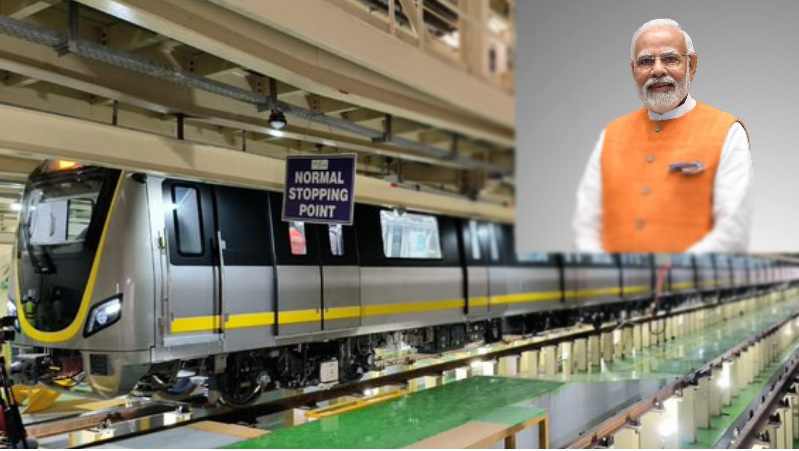
August 10, 2025, marked a transformative day for India’s transport infrastructure as Prime Minister Narendra Modi inaugurated three new Vande Bharat Express trains and launched the long-awaited Yellow Line of the Bengaluru Metro. These developments are set to enhance high-speed rail connect...
August 10, 2025, marked a transformative day for India’s transport infrastructure as Prime Minister Narendra Modi inaugurated three new Vande Bharat Express trains and launched the long-awaited Yellow Line of the Bengaluru Metro. These developments are set to enhance high-speed rail connectivity across states and improve urban mobility in one of India’s fastest-growing cities.
Three Vande Bharat Trains Flagged Off
At 11 am, PM Modi flagged off three Vande Bharat Express trains from KSR Bengaluru Railway Station, reinforcing India’s commitment to modern, efficient rail travel.
- Bengaluru–Belagavi Vande Bharat Express: This extended service connects Karnataka’s capital with Belagavi, passing through key cities such as Tumakuru, Davangere, Haveri, Hubballi, and Dharwad. It covers 611 km in approximately 8.5 hours, making it the fastest train on this route. The train will operate six days a week, departing Belagavi at 5:20 am and reaching Bengaluru by 1:50 pm, with the return journey starting at 2:20 pm.
- Shri Mata Vaishno Devi Katra–Amritsar Vande Bharat Express: This service strengthens connectivity between two major pilgrimage and cultural hubs in northern India. It will run six days a week, excluding Tuesdays, with stops at Beas, Jalandhar City, Pathankot Cantt, and Jammu Tawi.
- Nagpur (Ajni)–Pune Vande Bharat Express: Designed to serve Maharashtra’s business corridor, this train covers 881 km in 12 hours, making it the fastest option between the two cities. It complements existing services like the Pune Humsafar and Azad Hind Express.
With these additions, India’s Vande Bharat fleet now totals 150 trains. Karnataka’s count rises to 11, while Maharashtra, Punjab, and Jammu & Kashmir also benefit from expanded high-speed rail access.
Bengaluru Metro’s Yellow Line Inaugurated
Following the train flag-off, PM Modi inaugurated the 19.15-km Yellow Line of Namma Metro, connecting RV Road (Ragigudda) to Bommasandra. This corridor links 16 stations across residential, commercial, and industrial zones, including the bustling Electronics City.
- Built under Phase-2 of the metro project at a cost of approximately Rs 7,160 crore
- Designed to serve over 800,000 commuters daily
- Expected to ease congestion at notorious bottlenecks like Silk Board junction
- PM Modi took a metro ride from RV Road to Electronic City, showcasing the line’s strategic importance
Despite the celebratory launch, initial operations faced criticism due to limited train sets and 25-minute service intervals. Commuters expressed concern over frequency, calling for faster ramp-up of capacity.
Foundation Laid for Metro Phase-3
In a forward-looking move, PM Modi laid the foundation stone for Phase-3 of the Bengaluru Metro.
- Estimated cost: Rs 15,610 crore
- Will add 44 km of elevated tracks and 31 new stations
- Aimed at strengthening Bengaluru’s public transport backbone and reducing traffic congestion
Political Undercurrents and Public Sentiment
The day’s events unfolded amid a politically charged atmosphere. Congress leaders emphasized the state’s financial contribution of over Rs 12,000 crore, including land acquisition costs, and accused the BJP of monopolizing credit. Deputy Chief Minister D.K. Shivakumar called the metro project a joint effort, while Transport Minister Ramalinga Reddy criticized BJP leaders for portraying it as a central initiative.
Security was tight across venues, with traffic restrictions enforced from 8:30 am to 2:30 pm. However, disruptions were minimal due to the Prime Minister’s helicopter and metro travel.
Conclusion
August 10, 2025, will be remembered as a pivotal day for Bengaluru and beyond. With high-speed trains connecting distant cities and metro lines weaving through urban landscapes, India’s transport narrative is being rewritten—one track at a time.
Sources: Financial Express, MSN India, UNI India, NewsBytes, Livemint, India Today, News18, Firstpost.