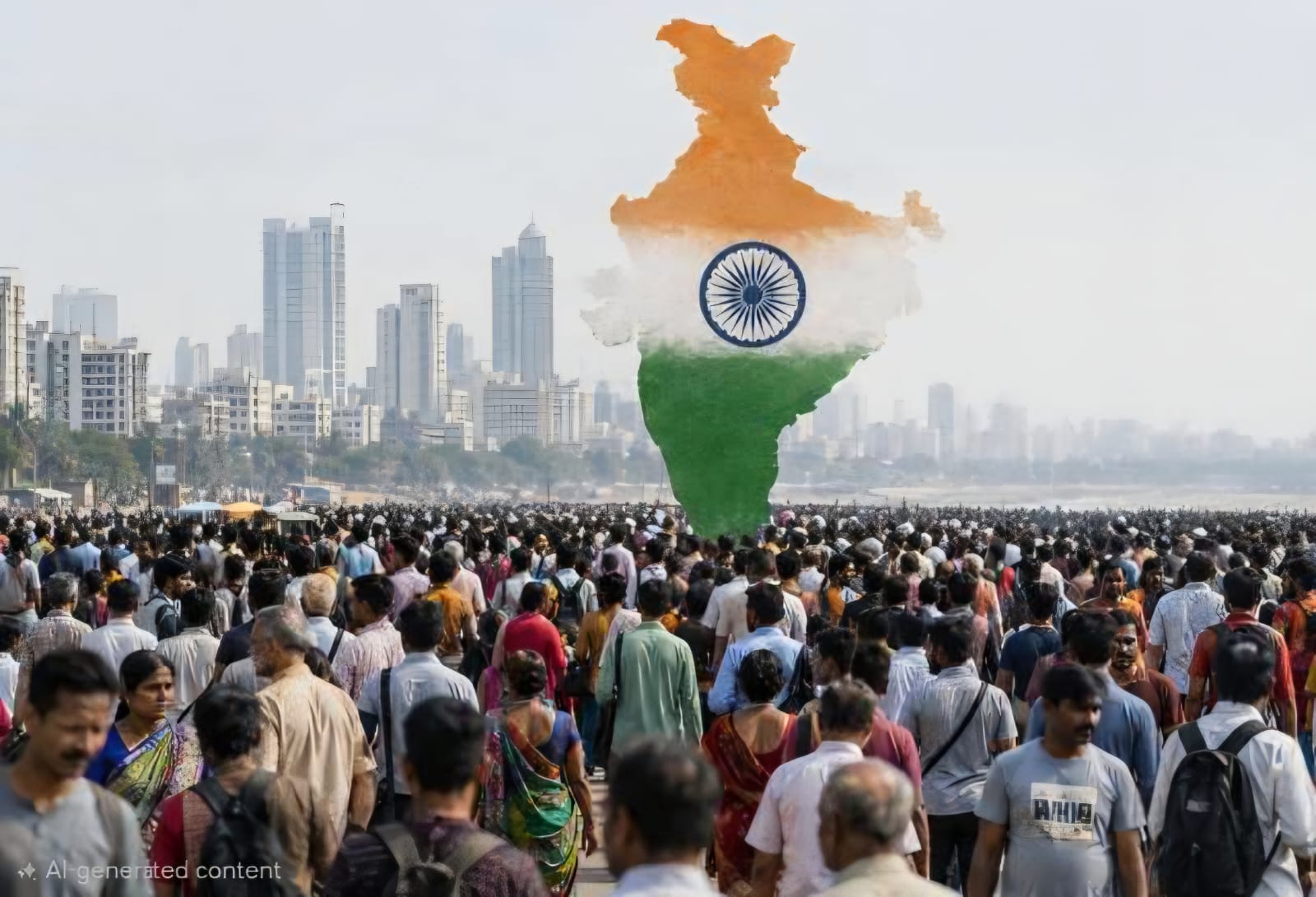
India's population has reached 1.476 billion in 2026, yet the national total fertility rate has dropped sharply to 1.93, well below the replacement level of 2.1. While a median age of 29.2 years fuels immediate economic consumption, a stark demographic divide has emerged between an aging south and a younger north. Policymakers face a narrowing 15-year window to generate millions of formal, high-productivity jobs before population momentum stalls and the demographic dividend gives way to an accelerated aging curve.
NEW DELHI — India’s long-heralded demographic dividend is entering a critical race against time, as updated data from the United Nations Population Fund (UNF UNFPA) and national statistical registries show the country's population growth is slowing down faster than previously projected. The national total fertility rate (TFR) has dropped to an estimated 1.93 children per woman—well below the official replacement threshold of 2.1. While the absolute population has expanded to approximately 1.476 billion in 2026, making India the most populous nation globally, the underlying momentum reveals a rapid structural transition toward an aging society.
This dramatic stabilization of fertility rates means that future expansion will rely almost entirely on population momentum rather than high birth rates. The window for India to convert its young labor resource into a hyper-growth economic engine is narrowing quickly, sparking urgent policy warnings from economists and corporate planners that the nation must generate high-skill employment before its demographic profile begins to constrict.
The Demography Clock: Decoding the Shifts
1. The Rapid Descent of Total Fertility
Data compiled by the Sample Registration System (SRS) and the UN World Population Dashboard confirms that Indian families are shrinking at an unprecedented rate. In 1960, the average Indian woman gave birth to nearly six children over her lifetime. Today, that figure stands at 1.93. This shift places India on par with or below several Western economies in terms of reproductive velocity, driven primarily by expanding female education, rapid urbanization, and greater access to reproductive healthcare.
2. A Nation Bifurcated by Demographics
The national average masks a profound geographic divergence between the north and south. Southern and western states, including Kerala, Tamil Nadu, and Maharashtra, have experienced advanced transitions, with TFR values dropping as low as 1.6 to 1.7. These regional workforces are already peaking and starting to gray. Conversely, northern states like Bihar (TFR ~3.0) and Uttar Pradesh (TFR ~2.35) continue to drive the absolute volume of national population growth, creating localized demand for basic education and entry-level employment.
3. The Working-Age Population Peak
India currently possesses one of the youngest global workforces, with a median age of 29.2 years—strikingly young when contrasted with China’s median age of 40.2 and Europe's average exceeding 42 years. According to demographic projections by EY India, approximately 67% of the domestic population sits within the productive working-age bracket of 15–64 years. This massive cohort is expected to crest between 2035 and 2045, reaching an absolute peak of 1.04 billion workers by 2030, where it will account for nearly a quarter of the world’s incremental labor pool.
Impact on Citizens, Travelers, and Investors
For global investors and domestic businesses, the data points to a massive, immediate surge in discretionary consumer spending. A young workforce with a low initial dependency ratio means higher household savings and elevated purchasing power for housing, consumer electronics, and automotive products.
However, for public planners and citizens, the clock presents structural headwinds. The Ministry of Finance and the Reserve Bank of India face a dual fiscal challenge: funding massive educational and digital skill infrastructure in high-growth northern states while simultaneously scaling up geriatric healthcare, pension allocations, and urban elder care networks in the rapidly aging south. Economists warn that if formal job creation fails to match the 12.7 million citizens added to the population pool annually, the demographic dividend risks transforming into an underemployment crisis.
Official Sources Section
Statistical metrics and long-term projections cited in this report are sourced directly from the United Nations Population Fund (UNFPA), the Government of India's Ministry of Statistics and Programme Implementation (MoSPI), the annual Union Budget Economic Survey, and structural analytical briefings released by EY India.
Quote Section
"According to officials from the Union Ministry and demographic researchers at the Observer Research Foundation, India’s primary challenge over the next fifteen years is transitioning from a demographic dividend to a high-value productivity dividend. If the working-age population is not rapidly upskilled to fit global manufacturing supply chains and high-tech services, the fiscal space will tighten considerably as the national old-age dependency ratio doubles by 2050."
Why It Matters
The practical implication of a sub-replacement fertility rate is that India is moving toward its absolute population peak much faster than 20th-century models predicted. For corporate strategies, the "mass market" of infant and child products is already shrinking, shifting focus toward adult consumerism, digital financial services, and long-term insurance assets. Nationally, infrastructure projects must adapt to a highly mobile, urbanizing workforce moving from labor-surplus northern corridors into industrial southern hubs.
Key Facts at a Glance
Current National Fertility: India’s Total Fertility Rate has declined to 1.93, falling firmly below the 2.1 stabilization benchmark.
Global Workforce Engine: India will house 1.04 billion working-age citizens by 2030, contributing 24.3% of the world’s entire workforce growth over the decade.
The Graying Threshold: The domestic elderly population (60+ years old) is on track to more than double from roughly 149 million to 347 million by 2050.
Median Age Advantage: The national median age stands at 29.2 years in 2026, maintaining a decade-long competitive edge over aging East Asian and European markets.
FAQ Section
Q1: Is India’s population declining?
A: No. While the fertility rate has fallen below the replacement level, the absolute population continues to grow due to "population momentum." Because previous generations were larger, there is a massive cohort of young adults currently in their reproductive years, keeping net births high. The population is projected to peak at 1.7 billion in the 2060s before starting a gradual contraction.
Q2: What is the "demographic dividend" and when does it expire?
A: The demographic dividend occurs when a country has a higher proportion of working-age individuals (15–64) relative to young and elderly dependents. India's dependency ratio will hit an all-time low of 31.2% around 2030. This window will remain optimal until roughly 2040–2045, after which the aging population will cause dependency burdens to climb.
Q3: Why are the demographic trends between North and South India so different?
A: Southern and western states implemented successful healthcare, family planning, and female literacy programs decades earlier than their northern counterparts. As a result, states like Kerala and Tamil Nadu are transitioning into an aging phase similar to Southern Europe, while states like Bihar and Jharkhand remain in an expansive growth phase.
Source: United Nations Population Fund, Ministry of Statistics and Programme Implementation (MoSPI), Union Budget Economic Survey, EY India Insights.