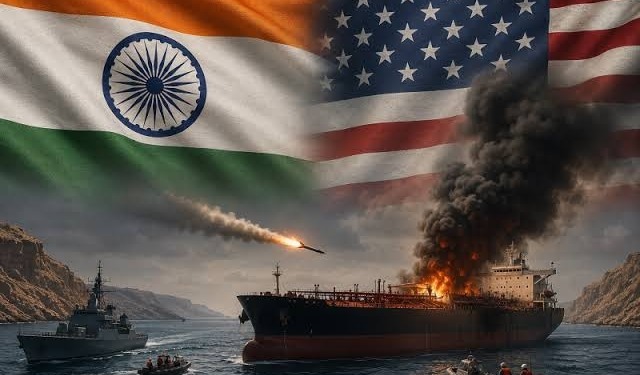
Three Indian seafarers remain missing following a U.S. military strike on the oil tanker MT Settebello off the coast of Oman. India has summoned a top U.S. diplomat to protest the action, citing the danger to civilian shipping and the ongoing risk to Indian nationals employed in the region's volatile maritime corridors.
NEW DELHI — The Indian government has issued a strong condemnation and formally protested a U.S. military strike on the Palau-flagged oil tanker MT Settebello in the Gulf of Oman, an incident that has left three Indian seafarers missing and sparked urgent diplomatic efforts.
The strike, which occurred on June 10, 2026, saw U.S. forces deploy precision munitions against the tanker’s engine room. U.S. Central Command (CENTCOM) justified the action, stating the vessel was targeted after the crew repeatedly failed to comply with directions to halt, alleging that the ship was attempting to violate an ongoing U.S.-led blockade of Iranian ports.
Diplomatic Fallout
In response to the incident, the Ministry of External Affairs (MEA) summoned the U.S. Embassy’s Deputy Chief of Mission, Jason Meeks, to New Delhi to lodge a "strong protest." Indian authorities have expressed grave concern over the safety of Indian nationals working on commercial vessels transiting the volatile Gulf region.
The Indian Embassy in Oman is currently coordinating with Omani authorities in an active search and rescue operation. Of the 24 Indian crew members originally on board, 21 have been successfully rescued. However, three crew members remain missing. According to the Forward Seamen's Union of India (FSUI), reports indicate two crew members have died, though official government channels continue to classify the three as missing pending further verification from ongoing search operations.
Context of Maritime Tensions
This incident marks the second such encounter involving U.S. forces and Indian crews in the region within 48 hours. On June 8, the tanker MT Marivex was similarly disabled by U.S. forces for alleged blockade violations; in that instance, all 24 Indian crew members were rescued safely.
The Indian government has described the recurring attacks on commercial shipping as "deeply worrisome" and a direct consequence of the escalating conflict in West Asia. New Delhi has reiterated its call for immediate de-escalation, emphasizing that the targeting of civilian infrastructure and commercial navigation is unacceptable under international law.
Why It Matters
For the global shipping industry and Indian maritime workers, these strikes represent a dangerous intersection of geopolitical conflict and commercial transit. As the U.S. enforces maritime blockades, the risk to neutral commercial vessels has increased, raising alarms about the safety of seafarers caught in the crossfire. The protest highlights India's commitment to protecting its citizens while balancing its diplomatic stance on regional stability.
Key Facts at a Glance
Incident Date: June 10, 2026.
Vessel Involved: Palau-flagged MT Settebello.
Casualties: 21 Indian crew members rescued; 3 remain missing/unaccounted for.
Official Response: India summoned the U.S. Deputy Chief of Mission to lodge a formal protest.
US Position: CENTCOM claims the vessel violated an oil blockade against Iran and ignored multiple warnings.
Frequently Asked Questions
Why was the tanker Settebello targeted by the U.S.?
U.S. Central Command stated the tanker was targeted for violating a U.S. blockade against Iranian ports and failing to comply with instructions from American forces.
What is the status of the Indian crew?
21 of the 24 Indian crew members have been rescued by Omani authorities. Three remain missing, with search operations currently underway.
How has India responded diplomatically?
India has condemned the attack, summoned a senior U.S. diplomat in New Delhi, and called for an immediate de-escalation of tensions in the region.
Are these attacks affecting other ships?
Yes, maritime intelligence reports confirm a high frequency of incidents in the Strait of Hormuz, with multiple vessels being disabled or redirected as part of the U.S.-Iran maritime standoff.
Source: Ministry of External Affairs (India), U.S. Central Command (CENTCOM), The Hindu, Hindustan Times