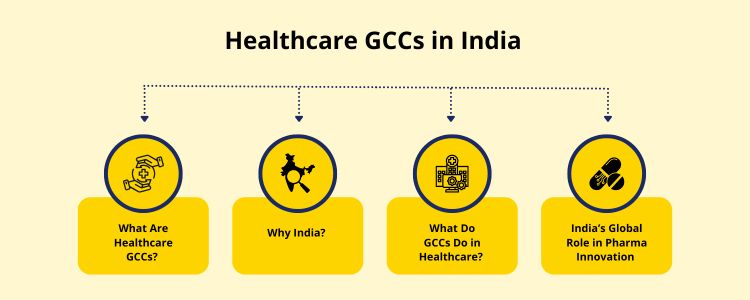
India is reimagining healthcare Global Capability Centres (GCCs) from back-office units into strategic innovation hubs. Housing 23 of the world's top 50 life sciences firms, these centres now co-own core functions—including AI drug discovery, clinical trial modeling, and regulatory science—accelerating global pharmaceutical pipelines and digital health delivery.
BENGALURU — Global Capability Centres (GCCs) in India across the life sciences and healthcare sectors are rapidly shifting from back-office support functions to strategic global innovation engines, according to comprehensive industry analyses from Ernst & Young (EY) and Nasscom. Nearly half of the world’s top 50 life sciences corporations have established dedicated centres in India, deploying local talent to lead end-to-end artificial intelligence (AI) drug discovery, regulatory affairs, clinical trial optimization, and enterprise health data platforms. The structural transition elevates India's role from an operational delivery centre to an essential co-owner of global healthcare innovation pipelines.
Strategic Shift from Cost Arbitrage to Core Value Creation
For decades, international healthcare organizations relied on Indian centres primarily for IT maintenance, financial reporting, and standardized administrative processing. However, the current transformation marks a structural repositioning of these facilities as "headquarters twins" that share accountability for core research and commercial outcomes.
Industry data reveals that life sciences GCCs in India now manage up to 70 percent of global finance, 75 percent of HR, and over 60 percent of core supply chain functions for parent entities, while expanding into critical clinical domains. Operations now encompass real-world evidence (RWE) biostatistics, genomic data analytics, pharmacovigilance surveillance, and the design of digital therapeutics deployed across international hospital systems.
Multidisciplinary Talent Convergence and Technology Integration
A primary driver behind this transformation is India’s concentration of scientific, analytical, and software engineering talent. Modern healthcare challenges require cross-disciplinary integration that pairs computational biologists with cloud architects, data scientists, and clinical researchers.
AI-Enabled Drug Discovery: Research teams in hubs such as Bengaluru, Hyderabad, and Pune leverage deep learning models to screen chemical compounds, simulate molecular interactions, and reduce pre-clinical discovery timelines.
Clinical Trial Optimization: Capability centres design predictive patient-recruitment models and monitor multi-country trials in real time, accelerating the path to regulatory approval.
Regulatory Science and Compliance: Local teams author and submit regulatory dossiers for major health authorities, including the U.S. Food and Drug Administration (FDA) and the European Medicines Agency (EMA).
Enterprise Health Platforms: Software engineers develop interconnected cloud platforms that support hospital networks, patient monitoring wearables, and diagnostic imaging pipelines.
Impact on Healthcare Systems, Industry, and Talent
The structural maturation of healthcare GCCs carries broad implications for multiple sectors of the economy:
Global Patients and Healthcare Consumers: Accelerating research cycles through AI analytics lowers the development cost of specialized therapies and shortens the time required to bring life-saving medicines to market.
Life Sciences Talent and Researchers: The expansion creates high-value research opportunities for Indian scientists, bioinformaticians, and data engineers, reducing brain drain and encouraging domestic high-tech research.
Global Pharmaceutical Corporations: Decentralizing strategic innovation allows global firms to maintain around-the-clock research operations, improving operational resilience and pipeline throughput.
Domestic Technology Ecosystem: Deepening ties between corporate GCCs, domestic research universities, and specialized health-tech startups foster a collaborative biomedical infrastructure.
Official Sources
Sector performance metrics, operational trends, and corporate adoption rates are derived from research published by Nasscom, corporate governance reviews by EY India, and industrial capability studies tracked by the Ministry of Electronics and Information Technology and the Ministry of Commerce and Industry.
Official Perspectives
"According to industry analysts and institutional reports, the next generation of healthcare GCCs is defined by end-to-end program ownership, with Indian teams shifting from enabling corporate innovation to actively directing global digital and clinical strategies."
Why It Matters
The global healthcare industry is facing rising research expenditures, complex regulatory mandates, and supply-chain vulnerabilities. By embedding AI, computational biology, and regulatory science within Indian capability centres, multinational companies are able to cut research cycles, improve patient-monitoring tools, and maintain scalable operational models.
Key Facts at a Glance
Ecosystem Breadth: Over 2,100 GCCs operate in India across all sectors, employing 2.3 million professionals and generating nearly $100 billion annually.
Pharma Concentration: Twenty-three of the top 50 global life sciences companies have set up dedicated capability centres in India.
Strategic Evolution: Centers have evolved from basic IT support into "headquarters twins" handling AI-driven drug discovery, clinical trials, and regulatory filings.
Core Function Share: Indian centres now manage up to 75% of HR, 70% of finance, and over 60% of supply chain operations for major life sciences parents.
Frequently Asked Questions
What are healthcare Global Capability Centres (GCCs)?
Healthcare GCCs are offshore strategic units established by global pharmaceutical, biotechnology, and medical device companies to manage clinical research, data analytics, regulatory compliance, and digital platform development.
Why are global pharmaceutical companies expanding GCCs in India?
Multinational companies are expanding in India to access a deep multidisciplinary talent pool combining medicine, data science, software engineering, and artificial intelligence at scale.
How do healthcare GCCs contribute to drug discovery?
Indian centres utilize machine learning models and biostatistics to screen molecules, model clinical trial simulations, analyze patient real-world evidence, and prepare regulatory submissions.
Source: Nasscom, EY India, Ministry of Commerce and Industry, Ministry of Electronics and Information Technology