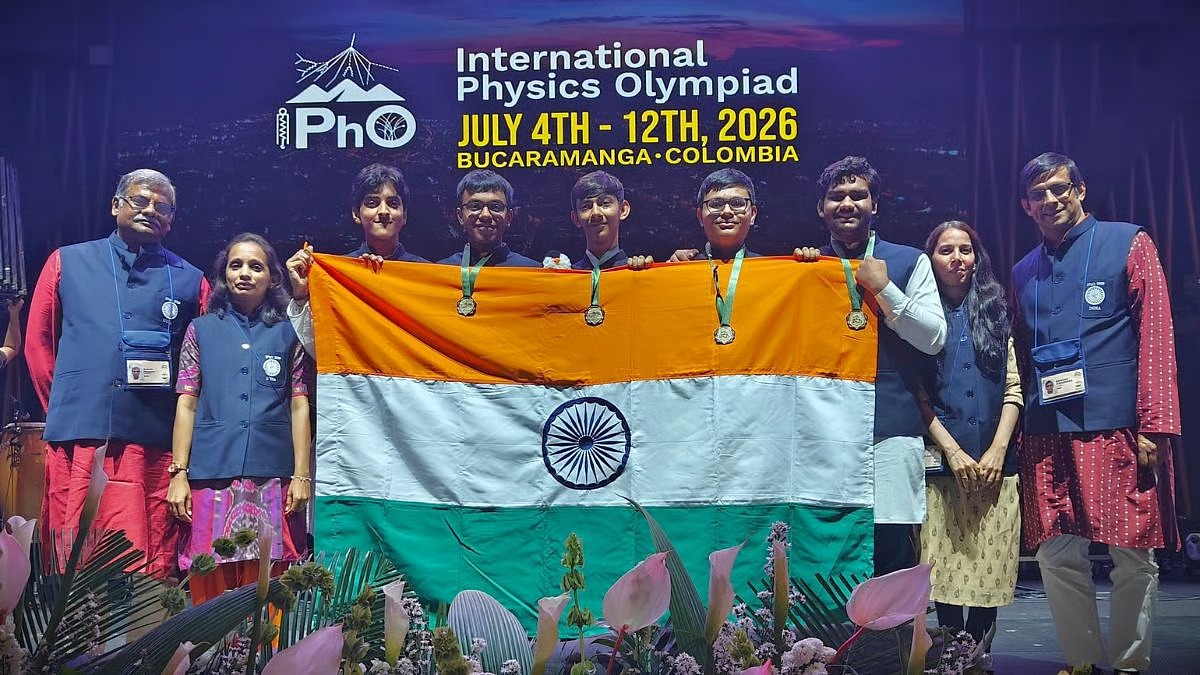
India achieved a historic clean sweep at the 56th International Physics Olympiad in Colombia, with all five team members winning gold medals. Sharing the joint World No. 1 rank with five other nations, the victory highlights the excellence of India’s national Olympiad programme and the country's growing scientific talent.
In a historic clean sweep, all five members of the Indian team secured gold medals at the 56th International Physics Olympiad (IPhO) in Colombia.
MUMBAI — India achieved a stellar result at the 56th International Physics Olympiad (IPhO) 2026, held in Bucaramanga, Colombia, from July 5 to July 12. All five members of the Indian contingent earned gold medals, propelling the nation to a joint World No. 1 rank alongside China, Kazakhstan, Russia, South Korea, and Taiwan.
This marks only the second time in India's history at the competition—following a similar feat in 2018—that every participant from the country has returned with the highest honor. The triumph comes after a rigorous selection and training process coordinated by the Homi Bhabha Centre for Science Education (HBCSE), a national centre of the Tata Institute of Fundamental Research (TIFR), under the Department of Atomic Energy (DAE).
A Performance of Global Caliber
The 2026 edition of the IPhO saw 381 students representing 87 countries compete in demanding five-hour theoretical and experimental examinations. The Indian gold medalists are:
Kanishk Jain (Pune, Maharashtra)
Riddhesh Anant Bendale (Indore, Madhya Pradesh)
Rishit Garg (Dwarka, New Delhi)
Shresth Suraiya (Mumbai, Maharashtra)
Svarit Joshi (Ahmedabad, Gujarat)
The students faced a complex series of challenges, including problems related to the thermodynamics of paramagnetic cooling, light reflection patterns, ozone photoionisation, and electron-positron dynamics. The experimental component of the exam tested participants on fluid thermodynamics and heat transfer, where the Indian team demonstrated exceptional precision.
Mentorship and Scientific Excellence
The Indian team was led by Prof. Anwesh Mazumdar of HBCSE-TIFR and Prof. Leena Joshi of St. Xavier's College, Mumbai. They were accompanied by scientific observers Prof. Ananda Dasgupta from the Indian Institute of Science Education and Research (IISER), Kolkata, and Nisha Kelkar of Gogate-Joglekar College, Ratnagiri.
The success is attributed to the sustained efforts of the national Olympiad programme, which identifies and nurtures talent through multi-stage selection processes, orientation camps, and intensive training. According to the Department of Atomic Energy, the programme aims to foster a scientific temperament among pre-university students, with every Indian participant over the past decade securing either a gold or silver medal.
Impact on the Nation’s Scientific Landscape
The performance has been hailed by the academic community as a major validation of India’s science education infrastructure. Dr. Ajit Kumar Mohanty, Secretary of the Department of Atomic Energy and Chairman of the Atomic Energy Commission, described the achievement as a matter of "immense pride for the nation."
"Securing five gold medals and jointly attaining the World No. 1 rank at the International Physics Olympiad is a testament to the talent, dedication, and scientific temperament of our students, as well as the unwavering commitment of the HBCSE-TIFR Olympiad programme," he stated.
Why It Matters
For students, this victory serves as a powerful incentive to pursue excellence in STEM (Science, Technology, Engineering, and Mathematics) fields. For the country, it reinforces India’s position as a rising hub for high-level scientific talent and innovation. The international recognition at this level not only opens doors for these young physicists at top-tier global institutions but also highlights the success of systematic, long-term talent cultivation programmes in India.
Key Facts at a Glance
Tournament Rank: India finished joint World No. 1, sharing the top spot with China, Kazakhstan, Russia, South Korea, and Taiwan.
Team Success: All five Indian participants earned gold medals, repeating the historic clean sweep last achieved in 2018.
Global Participation: The competition featured 381 students from 87 different nations.
Coordination: The team’s journey was spearheaded by the HBCSE, a constituent of the Tata Institute of Fundamental Research (TIFR).
FAQ
What is the International Physics Olympiad (IPhO)?
The IPhO is an annual international physics competition for pre-university students, testing them through rigorous theoretical and experimental examinations.
How does India prepare its participants?
Students are selected through a multi-stage process and receive intensive training, including orientation camps and laboratory practice, managed by the Homi Bhabha Centre for Science Education (HBCSE).
What makes this performance historic?
It is only the second time in India's 27 appearances at the Olympiad that every single team member has secured a gold medal in the same year.
Source: Homi Bhabha Centre for Science Education (HBCSE), Department of Atomic Energy (DAE), TIFR