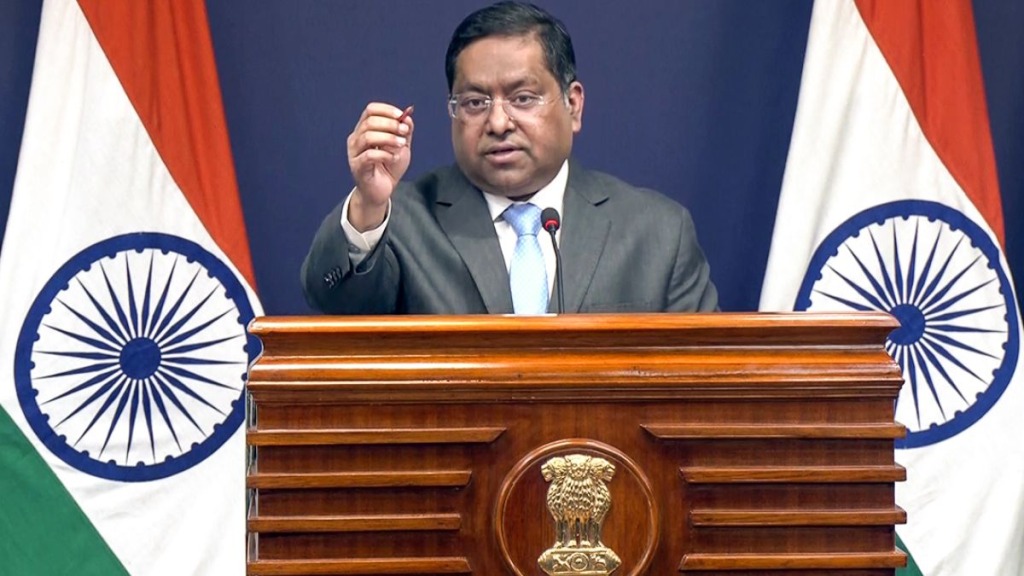
India has summoned U.S. Deputy Chief of Mission Jason Meeks to lodge a strong protest after a U.S. military strike killed three Indian seafarers aboard the tanker MT Settebello off Oman. U.S. Central Command confirmed it targeted the vessel's engine room for violating an ongoing maritime blockade against Iran.
The Indian government has formally summoned the United States’ Deputy Chief of Mission and Chargé d'Affaires in New Delhi, Jason Meeks, to lodge a "strong protest" following a targeted U.S. military strike on a commercial oil tanker off the coast of Oman.
The incident, which took place in the strategic waters of the Gulf of Oman, resulted in the deaths of three Indian seafarers. The diplomatic confrontation marks a highly unusual public fracture between New Delhi and Washington, highlighting growing international friction over the enforcement of unilateral maritime blockades in West Asia.
Escalation in the Gulf: The Strike on MT Settebello
According to official reports from the Ministry of External Affairs (MEA), the Palau-flagged chemical and oil products tanker, MT Settebello, was transiting international waters approximately 20 nautical miles northeast of Oman's Sohar port when it was struck by U.S. ordnance. The vessel carried a total crew of 28 personnel, including 24 Indian nationals.
The strike caused a severe fire to erupt inside the vessel's engine and steering compartments. While the Omani Navy successfully coordinated the evacuation and rescue of 21 Indian sailors, three Indian seafarers were initially reported missing.
India's Shipping Minister and the Forward Seamen’s Union of India (FSUI) subsequently confirmed that all three missing crew members had died. The deceased have been identified as Chief Engineer Patnala Suresh, Engine Fitter Shivanand Chaurasiya, and Deck Cadet Aditya Sharma.
US Central Command Cites Blockade Enforcement
The U.S. military’s Central Command (CENTCOM) formally acknowledged responsibility for disabling the vessel. According to a statement issued by American defense officials, the MT Settebello was targeted because it was actively transporting crude oil from Iran, violating an ongoing U.S. maritime blockade initiated on April 13 to cut off Iranian energy exports.
CENTCOM stated that a U.S. military aircraft deployed precision munitions directly into the tanker's engineering spaces after the ship's command "repeatedly failed to comply with lawful directions from American forces."
The incident marks the second time in less than three days that a vessel crewed by Indian mariners was disabled by U.S. naval assets. On June 8, a U.S. F/A-18 Super Hornet launched from the USS Abraham Lincoln similarly disabled another Palau-flagged tanker, the M/T Marivex, in the Gulf of Oman. While the crew of the Marivex survived without casualties, the escalation on the Settebello has forced a sharp diplomatic reaction from New Delhi.
Official Sources Section
The diplomatic actions, casualty figures, and military statements detailed in this report have been verified via official press briefings from the Ministry of External Affairs (MEA) India, formal combat logs distributed by U.S. Central Command (CENTCOM), and operational updates from the International Maritime Organization (IMO).
Quote Section
"According to officials within the Ministry of External Affairs, India's Additional Secretary for the Americas, Nagaraj Naidu, directly conveyed New Delhi's deep concern regarding the safety of its citizens. The ministry emphasized that the targeting of commercial shipping and civilian infrastructure is unacceptable and called for the early restoration of free, unimpeded commerce in compliance with international law."
Why It Matters
This development carries profound implications for global supply chains and maritime labor dynamics. India provides a substantial segment of the global seafaring workforce, meaning its nationals are uniquely vulnerable to geopolitical crossfire in vital energy corridors like the Strait of Hormuz.
Furthermore, the public diplomatic friction underscores the delicate balancing act facing Prime Minister Narendra Modi's administration, which seeks to preserve a critical strategic partnership with Washington while protecting the safety of nearly ten million Indian expatriates living and working across the wider Gulf region.
Key Facts at a Glance
Diplomatic Demarche: India summoned U.S. Deputy Chief of Mission Jason Meeks to protest the lethal military strike.
Casualties Confirmed: Three Indian seafarers died following a U.S. missile strike on the tanker MT Settebello.
U.S. Justification: U.S. Central Command stated it disabled the vessel for defying maritime instructions while transporting Iranian oil.
Repeated Incidents: This marks the second U.S. strike disabling an Indian-crewed commercial vessel within a three-day period.
Frequently Asked Questions (FAQ)
1. Why are U.S. forces attacking commercial tankers off the Oman coast?
The United States established a naval blockade in April to halt sea-bound oil exports from Iran. U.S. forces are actively tracking and intercepting vessels suspected of transporting Iranian petroleum products through the Gulf of Oman and the Strait of Hormuz.
2. What has been the international response to these maritime strikes?
The International Maritime Organization (IMO) has strongly condemned any actions that endanger civilian seafarers. IMO Secretary-General Arsenio Dominguez stated that targeting merchant shipping is entirely unacceptable, irrespective of the political motives involved.
3. What steps is the Indian government taking for the affected crew?
The Indian Embassy in Oman is collaborating with regional maritime authorities to ensure the medical care and immediate repatriation of the 21 rescued Indian sailors. Shipping ministry officials are also coordinating the return of the deceased crew members' mortal remains to their families.
Source: Ministry of External Affairs (MEA) India, U.S. Central Command Official Portal, The Hindu Diplomatic Bureau