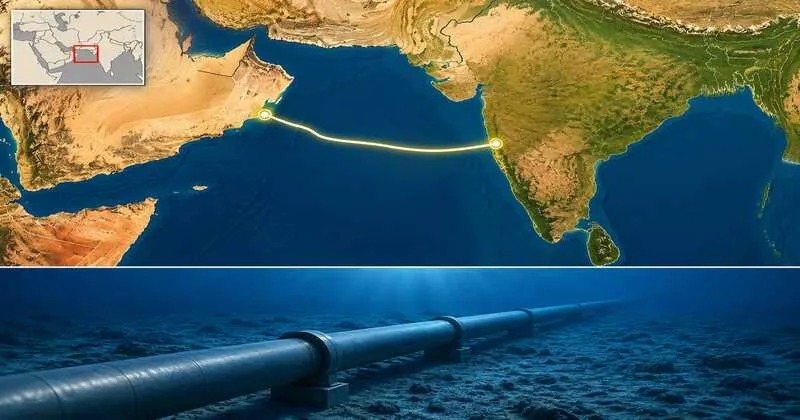
India's exports to West Asia recovered to last year's levels in May 2026, supported by an alternative shipping route via Oman to the UAE. While increased LPG imports from the United States kept the energy bill high, the country's services trade surplus reached a strong $17.7 billion, stabilizing the overall trade balance.
NEW DELHI — India’s trade infrastructure achieved a vital stabilization milestone in May 2026, as newly activated maritime shipping bypasses successfully restored outbound merchandise deliveries to West Asia back to historical levels. Senior trade officials confirmed today that the strategic execution of an alternate logistics corridor running via Oman has effectively counterbalanced intense regional security chokepoints, allowing high-volume exports to the United Arab Emirates (UAE) and neighboring Gulf Cooperation Council (GCC) markets to completely recover from steep spring contractions.
The structural rebound in goods shipments is strongly reinforced by the country's dominant knowledge-economy channels, with Reuters institutional calculations showing India's services trade surplus reaching a robust $17.7 billion for the month of May alone.
Oman Gateway Operationalized to Safeguard UAE Export Volume
According to detailed field statements from the Ministry of Commerce and Industry, India’s trade desks successfully bypassed the heavily disrupted Strait of Hormuz by routing critical food, perishables, and essential industrial components directly through the Omani ports of Sohar, Salalah, and Duqm. From these friendly transshipment bases outside the Persian Gulf, cargo is systematically trucked through the Hatta border crossing directly into Dubai and Abu Dhabi.
This alternative logistics pipeline successfully halted a steep 28 percent contraction recorded during previous months, effectively returning bilateral trade values to parity with last year's performance.
While outbound cargo tracking indicates a strong recovery, the nation's import bill remains elevated due to changing energy supply networks. Trade regulators noted that a significant volume of Liquefied Petroleum Gas (LPG) has been arriving from North American terminals throughout the April–May cycle. While this large-scale procurement from the United States provides essential energy security for domestic households and commercial chemical plants, it has temporarily widened short-term merchandise import values.
Services Surplus Hits $17.7 Billion to Counterbalance Goods Deficit
On the non-physical front, India’s core service exports continue to exhibit massive structural strength, helping insulate the broader current account from external shocks. Financial market calculations based on fresh data sets indicate that the services trade surplus for May 2026 reached an estimated $17.7 billion. This performance remains anchored by global capability centers (GCCs), specialized engineering solutions, and cross-border software services.
Data monitored by the Reserve Bank of India (RBI) shows that international corporate clients are continuously channeling capital into local technological centers to optimize operational costs. This ongoing institutional outsourcing trend has turned India's service economy into a reliable structural buffer, regularly absorbing the fiscal pressures generated by volatile international crude oil benchmarks and elevated maritime freight insurance premiums.
Official Briefing from Commerce Authorities
"According to trade officials closely monitoring the West Asian corridors, the activation of the India-Oman Comprehensive Economic Partnership Agreement (CEPA) has functioned as an indispensable strategic safety valve," stated regional trade desk administrators. "By creating a dependable alternative land-and-sea link that avoids regional bottlenecks, Indian manufacturers have successfully protected their core supply commitments across the wider Gulf region."
Why It Matters: Practical Impact on Businesses and Logistics
The rapid adjustments across India's foreign trade architecture carry clear practical implications for commercial operators:
For Agricultural Exporters: The operationalization of the Khor Fakkan and Oman port links protects perishable supply chains from severe delays, keeping export quality high.
For Energy Distributors: Sourcing larger volumes of LPG from the United States reduces reliance on single-region energy corridors, ensuring steady fuel supplies despite localized tensions.
For Global Tech Investors: A consistent $17.7 billion monthly services trade surplus confirms that the local tech ecosystem remains highly competitive, maintaining institutional confidence in the Indian rupee.
Key Facts at a Glance
Route Adaptation: India successfully normalized its West Asia exports in May by rerouting deliveries away from chokepoints via strategic Omani ports and the Hatta border.
LPG Sourcing: Inbound energy shipments rose through April and May due to a deliberate increase in LPG volumes arriving from the United States.
Services Strength: The country's monthly services trade surplus hit a solid $17.7 billion, helping counterbalance the structural merchandise trade gap.
Pact Execution: The successful trade recovery highlights the immediate benefits of the newly active free trade agreement with Oman.
Frequently Asked Questions (FAQs)
How is India bypassing trade disruptions in the Strait of Hormuz?
India has redirected a major portion of its Gulf-bound exports through alternative ports in Oman, such as Sohar and Salalah. From there, cargo is moved securely by land through the Hatta border directly into the UAE, avoiding volatile shipping lanes.
Why are LPG imports from the United States increasing this year?
To ensure energy security and diversify its resource base, India has scaled up its long-term LPG purchases from North American suppliers. This shift helps reduce dependency on traditional Middle Eastern chokepoints.
What does a $17.7 billion services trade surplus mean for the economy?
A strong services surplus shows that India exports far more high-value services (like IT, consulting, and engineering) than it imports. This steady financial inflow helps offset the trade deficit generated by importing raw materials like crude oil.
Which sectors are benefiting most from the new Oman trade route?
Exporters of perishable foods, agricultural commodities, textiles, and light engineering goods have benefited significantly, as the new land-sea route ensures faster delivery times and more stable freight costs.
Source: Official trade briefing archives from the Ministry of Commerce and Industry, international shipping data compiled by the Director General of Foreign Trade (DGFT), and balance of payment calculations monitored via Reuters.