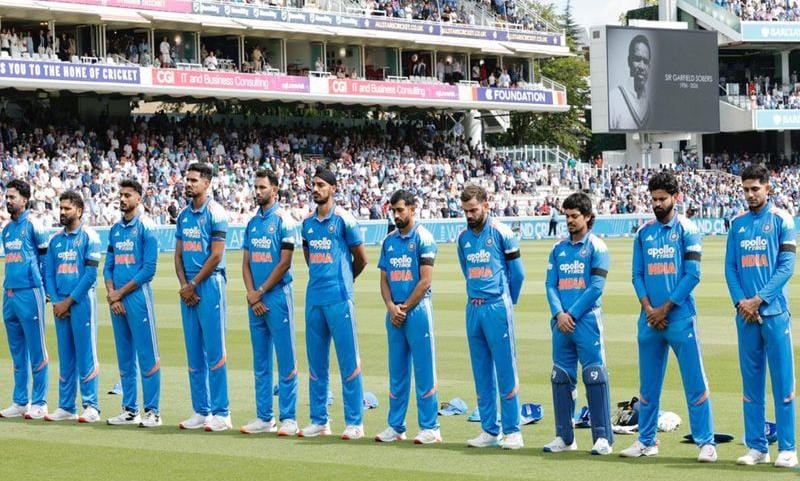
Team India and England wore black armbands and held a minute’s silence at Lord's to honour West Indies legend Sir Garfield Sobers, who passed away aged 89. The tribute coincided with a decisive third ODI, where India navigated key roster changes due to a Jasprit Bumrah knee injury.
LONDON — Players from the Indian national cricket team and England wore black armbands and observed a poignant minute of silence at the iconic Lord's Cricket Ground on Sunday, July 19, 2026. The formal demonstration of mourning was organized to honour the memory of West Indies cricket legend Sir Garfield Sobers, who passed away at his home in Barbados on Friday at the age of 89.
The visual tribute preceded the high-stakes, series-deciding third One Day International (ODI) between the two nations. With the three-match bilateral series deadlocked at 1-1, the solemn moment united players, match officials, and a packed London stadium in celebrating the enduring legacy of arguably the greatest all-rounder in the history of the sport.
Cricket World Unites for an Iconic Statesman
The decision to wear black armbands was coordinated as an emergency protocol between the Board of Control for Cricket in India (BCCI) and the England and Wales Cricket Board (ECB) following news of Sobers' passing. Before the traditional ringing of the Lord's five-minute bell—performed for this match by former Indian all-rounder Yuvraj Singh—both playing XIs lined up along the perimeter of the square.
Sir Garfield Sobers, whose international career spanned two decades from 1954 to 1974, fundamentally redefined the role of the multi-disciplinary cricketer. Scoring 8,032 runs at an elite average of 57.78 and claiming 235 wickets, Sobers remains a pillar of global sporting history. He famously became the first batsman to smash six consecutive sixes in a first-class over in 1968, playing for Nottinghamshire against Glamorgan.
Logistical Overhauls Shape the Decisive Lord's Clash
Beyond the pre-match commemorations, structural and physical challenges altered the compositions of both teams ahead of the final toss, which was won by England captain Harry Brook.
Bumrah Sidelined by Swelling: The BCCI Medical Team officially ruled out premier Indian fast bowler Jasprit Bumrah from selection for the series decider. Bumrah sustained an impact injury to his left knee while fielding during the second ODI in Cardiff, resulting in reactive swelling that required him to sit out.
India's Squad Reshuffle: In response to Bumrah’s absence and an injury to Washington Sundar, the Indian team management brought in left-arm seamer Arshdeep Singh and domestic standout Prince Yadav. Wicketkeeper-batsman KL Rahul also rejoined the starting lineup after recovering from a brief illness that kept him out of the second match.
Tactical Shifts on Pitch Conditions: Indian captain Shubman Gill noted at the toss that the team opted for a four-seamer configuration, recognizing that spinners have historically struggled to generate significant middle-over traction on the contemporary Lord's white-ball tracks.
Official Sources Section
The tribute actions and team lineups were validated via official declarations published by the Board of Control for Cricket in India (BCCI) and confirmed match rosters released through the England and Wales Cricket Board (ECB). Injury details regarding the Indian bowling department were verified directly by official statements from the BCCI Medical Team.
Quote Section
In an official public bulletin broadcast prior to the opening delivery, the Board of Control for Cricket in India stated:
"#TeamIndia is wearing black armbands to pay tribute to West Indies legend Sir Garfield Sobers following his passing on Friday."
Reflecting on the impact of Sobers on the modern game, England fast bowler Jofra Archer, a fellow Barbadian, shared:
"To the community of West Indies cricket, he is a legend, one of the greatest all-rounders ever. I saw him a couple of months ago when I was at home in Barbados and he said he was moving well for his age. I was very sad to hear the news."
Why It Matters
The collaborative display of respect at Lord's highlights the deep, cross-border cultural respect inherent to international cricket structure. While India and England are locked in an intense battle for critical ODI ranking points less than a year out from the ICC Men's Cricket World Cup, the pause demonstrates that foundational historical legacies transcend active competitive rivalries. For fans and broadcasters, the match remains an vital indicator of how tactical adjustments fare under heavy external pressure.
Key Facts at a Glance
Tribute Form: Black armbands and a stadium-wide minute of silence observed by both squads and match officials.
Series Context: The three-match ODI series is tied at 1-1, turning the Lord's fixture into an absolute winner-take-all final.
Key Absences: Indian pace spearhead Jasprit Bumrah was ruled out due to reactive swelling in his left knee.
Historical Milestone: Sobers remains one of only two players in Test history, alongside Jacques Kallis, to break the double barrier of 8,000 runs and 200 wickets.
FAQ Section
Q1: Why did both teams wear black armbands during the Lord's ODI?
A1: The players wore the armbands to collectively mourn and honor West Indies cricket icon Sir Garfield Sobers, who passed away on Friday at the age of 89.
Q2: What caused Jasprit Bumrah to miss this crucial series decider?
A2: Bumrah suffered an impact injury to his left knee while fielding during the second ODI in Cardiff, causing reactive swelling that made him unavailable for final match selection.
Q3: Who replaced the injured players in the Indian playing XI?
A3: Arshdeep Singh and Prince Yadav were drafted into the bowling attack, while KL Rahul returned to the side following an illness.
Source: Board of Control for Cricket in India Official Communications, England and Wales Cricket Board Match Center, Lord's Cricket Ground Media Bureau