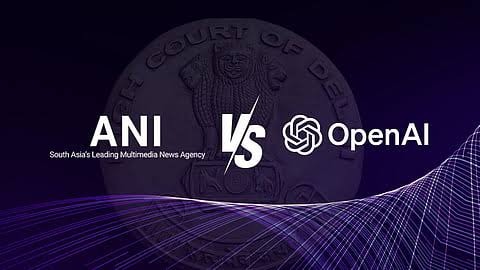
An Indian court ruled that OpenAI's use of news agency ANI's content for AI model training does not amount to copyright infringement. However, the court established that it holds territorial jurisdiction over the dispute, setting a major precedent for artificial intelligence, global tech platforms, and intellectual property in India.
NEW DELHI — An Indian court ruled on Friday, July 24, 2026, that artificial intelligence developer OpenAI’s use of news agency Asian News International’s (ANI) published content to train its generative AI models does not constitute copyright infringement under Indian law. However, the court firmly established that Indian judicial authorities hold territorial jurisdiction over global technology companies when copyright disputes involve content generated or accessed within national borders.
The ruling addresses a fundamental legal precedent regarding the intersection of intellectual property rights, fair dealing provisions, and generative artificial intelligence in India. The news agency ANI had initiated legal proceedings alleging that OpenAI utilized its copyrighted news articles, dispatches, and proprietary text databases without explicit licensing agreements to train the ChatGPT platform and underlying large language models.
Territorial Jurisdiction Affirmed Over Global AI Developers
A central legal question in the litigation involved whether Indian courts possess authority over foreign entities operating cross-border digital platforms. OpenAI argued that its primary operational infrastructure and server architecture reside outside Indian boundaries.
Rejecting this jurisdictional challenge, the Indian court affirmed that it maintains territorial jurisdiction over the copyright dispute between ANI and OpenAI. The bench noted that because the news content originates in India, targets domestic audiences, and causes alleged commercial impact within the country, Indian intellectual property frameworks govern the cause of action.
| Legal Parameter | Court Ruling Summary |
| Primary Issue | AI model training using copyrighted news text |
| Infringement Finding | No copyright infringement established |
| Jurisdictional Finding | Indian courts hold territorial jurisdiction |
| Parties Involved | Asian News International (ANI) vs. OpenAI |
| Applicable Law | Indian Copyright Act, 1957 |
Court Rationale on AI Training and Fair Use Principles
In ruling that OpenAI’s training processes do not constitute copyright infringement, the court distinguished between direct verbatim reproduction of proprietary work and the processing of data to analyze linguistic patterns and factual structures.
According to judicial observations detailed in the verdict, utilizing publicly available textual material to train algorithmic models falls within acceptable statutory parameters where the output generated does not directly substitute or plagiarize the original expressional form of the copyrighted news reports.
Industry Impact on Media and Artificial Intelligence Firms
The landmark ruling carries significant operational implications for news publishers, digital media organizations, and artificial intelligence developers operating across India:
For AI Developers: The decision provides legal clarity for artificial intelligence companies utilizing online text datasets within India, establishing that non-expressive algorithmic analysis does not inherently breach domestic copyright laws.
For News Publishers: Media outlets facing content scraping challenges may need to rely on technological barriers, direct licensing negotiations, or contractual paywalls rather than copyright infringement claims to secure compensation from AI platforms.
For Digital Policy Advocates: The affirmation of territorial jurisdiction establishes that foreign digital enterprises remain subject to Indian judicial oversight for acts affecting domestic rights holders.
Official Sources Section
Legal determinations and statements referenced in this report are based on official judicial records and regulatory documentation:
Court orders and official judgments published by the Delhi High Court.
Statutory provisions under the Ministry of Law and Justice and the Indian Copyright Act, 1957.
Official filings submitted by legal representatives of Asian News International and OpenAI.
Quote Section
According to official judicial records and court summaries:
"According to officials and court records, the bench held that Indian judicial bodies maintain clear territorial jurisdiction over the copyright dispute involving local news agency content. However, the court observed that the technical process of training artificial intelligence models on publicly available text does not amount to copyright infringement under existing statutory provisions."
Why It Matters
This judicial outcome establishes one of Asia's first major legal benchmarks on artificial intelligence training and intellectual property. By upholding territorial jurisdiction, Indian courts ensure that foreign technology companies must answer to local laws. Concurrently, by determining that AI training does not constitute copyright infringement, the judgment offers regulatory predictability for artificial intelligence research and development across the Indian digital economy.
Key Facts at a Glance
Copyright Infringement Ruling: Court ruled OpenAI's AI model training on ANI content is not copyright infringement.
Jurisdictional Precedent: Indian courts confirmed territorial jurisdiction over foreign AI firms in domestic copyright disputes.
Litigants: News agency Asian News International (ANI) and ChatGPT developer OpenAI.
Legal Context: Sets landmark intellectual property precedent for generative AI in India.
Frequently Asked Questions (FAQ)
What did the Indian court decide regarding OpenAI and ANI?
The court ruled that OpenAI using ANI’s news content to train artificial intelligence models does not constitute copyright infringement under Indian law.
Did the court accept OpenAI's argument regarding jurisdiction?
No. The court rejected jurisdictional challenges and affirmed that Indian courts hold territorial jurisdiction over copyright disputes affecting domestic content creators.
Why did the court rule that AI training is not copyright infringement?
The court observed that analyzing textual data to train machine learning algorithms differs from direct copying or unauthorized expressional reproduction.
Where can the official ruling be accessed?
Official court orders and listings are published on the website of the Delhi High Court.
Source: Official court records from the Delhi High Court and public filings made under the Ministry of Law and Justice.