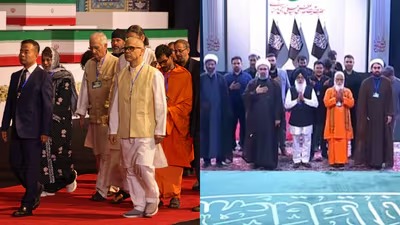
Indian political leaders Mehbooba Mufti and Salman Khurshid, alongside an official government delegation, have arrived in Tehran for the six-day funeral ceremonies of late Iranian Supreme Leader Ayatollah Ali Khamenei. The event, which began on July 3, 2026, draws dignitaries from nearly 100 nations during a fragile regional ceasefire.
Prominent Indian political figures, including Mehbooba Mufti and Salman Khurshid, have arrived in Tehran to attend the multi-day state funeral ceremonies for late Iranian Supreme Leader Ayatollah Ali Khamenei.
TEHRAN — The Islamic Republic of Iran began a series of high-level state funeral ceremonies on Friday, July 3, 2026, for late Supreme Leader Ayatollah Ali Khamenei. As the country prepares for a six-day mourning period, a delegation of Indian political and religious leaders has arrived in the capital to pay their final respects.
The funeral, which has drawn dignitaries from nearly 100 countries, marks a significant moment of diplomatic engagement during a fragile ceasefire between Iran, the United States, and Israel. The remains of Ayatollah Khamenei, who was killed in February 2026, were received at the Imam Khomeini Grand Mosalla in Tehran ahead of the official public ceremonies scheduled to commence on Saturday, July 4.
Indian Delegation Joins International Mourners
Among the notable Indian attendees seen in the first released visuals are People’s Democratic Party (PDP) president and former Jammu and Kashmir Chief Minister Mehbooba Mufti, and Congress leader Salman Khurshid, who heads the party’s foreign affairs department. Their presence in Tehran follows invitations extended by the Iranian government to various political leaders, religious scholars, and civil society representatives from across India.
The Indian government is officially represented by Minister of State for External Affairs Pabitra Margherita and Bihar Governor Lieutenant General Syed Ata Hasnain. Other prominent Indian figures in attendance include Bihar BJP president Nitin Nabin and several spiritual leaders, including representatives from the Art of Living and Jain scholar Acharya Lokesh Muni.
Context of the Funeral Proceedings
The funeral schedule, announced following months of regional volatility, is designed to be one of the most significant state events in Iran since the 1979 revolution. The body of the late Supreme Leader will be moved through a series of procession cities, including Qom and Mashhad in Iran, as well as the holy cities of Najaf and Karbala in Iraq, before the final burial at the shrine of Imam Reza in Mashhad on July 9, 2026.
According to Iranian state media, the Grand Mosalla in Tehran serves as the central venue for the initial phase of the mourning rites. Despite the high-profile nature of the event, officials confirmed that the late leader’s son, Mojtaba Khamenei, is not expected to appear at the ceremonies due to injuries sustained during the same strike that resulted in his father’s death.
Why It Matters
The participation of a diverse Indian delegation underscores the complex diplomatic ties between New Delhi and Tehran. As West Asia navigates a tenuous pause in hostilities, the attendance of political leaders from across the Indian spectrum is being viewed by analysts as a gesture of regional stability. For the families of the attendees and the Indian public, the event highlights the deep historical and cultural connections between the two nations, even as the global community watches the succession process within Iran.
Key Facts at a Glance
Funeral Timeline: The state funeral ceremonies began on July 3 and will culminate in a final burial in Mashhad on July 9, 2026.
Official Representation: The Indian government is represented by MoS for External Affairs Pabitra Margherita and Bihar Governor Lt. Gen. Syed Ata Hasnain.
Political Presence: Former J&K CM Mehbooba Mufti and Congress leader Salman Khurshid are leading the non-governmental political delegation from India.
Broad Attendance: Nearly 100 countries have sent delegations, including heads of state from Iraq, Tajikistan, and Armenia.
Frequently Asked Questions (FAQ)
1. Who are the primary Indian political figures attending the funeral?
The delegation includes PDP president Mehbooba Mufti, Congress leader Salman Khurshid, Bihar BJP president Nitin Nabin, and official government representatives including Pabitra Margherita.
2. Why was the funeral delayed until July 2026?
The funeral and burial were postponed for several months due to the ongoing conflict between Iran, the United States, and Israel that broke out earlier this year.
3. What is the route for the funeral procession?
The procession will travel through Tehran, Qom, and Mashhad in Iran, with stops in the Iraqi cities of Najaf and Karbala at the request of Iraqi officials.
4. Where will Ayatollah Ali Khamenei be buried?
The final burial is scheduled for July 9, 2026, at the shrine of Imam Reza in Mashhad, Iran.
Source: The Hindu, The Times of India, Anadolu Agency, The Federal