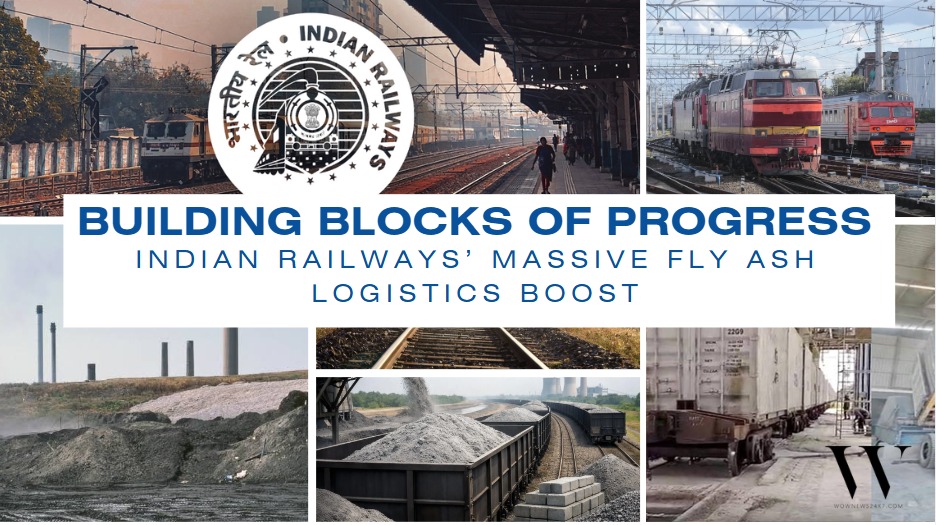
Indian Railways has launched a large-scale green logistics initiative to transport 340 million tonnes of fly ash annually. By utilizing specialized containers and dedicated rail corridors, the program aims to turn industrial coal waste into an affordable construction resource, supporting infrastructure growth and advancing circular economy objectives nationwide.
NEW DELHI — In a major move to advance circular economy goals, the Ministry of Railways has launched an ambitious green initiative to transport fly ash on a large scale across India. The program, announced on June 18, 2026, aims to transition the country’s thermal power by-product from an environmental burden into a valuable raw material for the construction industry.
The initiative, chaired by Union Minister for Railways Ashwini Vaishnaw, seeks to bridge the gap between coal-based power generation sites and the industrial hubs that utilize fly ash for cement manufacturing, brick production, and road embankment construction.
Bridging the Logistics Gap
Thermal power plants in India generate approximately 340 million tonnes of fly ash annually. Historically, much of this material has accumulated near power generation sites, creating significant ecological challenges. Currently, Indian Railways transports only about 13 million tonnes of fly ash per year—a small fraction of the total output.
To address this, the Railways is developing a dedicated logistics network. This system will utilize specialized containers and designated rail corridors to ensure the clean, dust-free, and efficient movement of the material from generation points to consumption hubs. By providing a reliable rail-based supply chain, the ministry intends to lower the cost of logistics, thereby making sustainable construction materials like fly ash-based bricks and cement more affordable for both urban and rural housing projects.
Official Sources and Implementation
The plan was finalized during a high-level review meeting attended by Union Ministers of State for Railways, V. Somanna and Ravneet Singh Bittu. According to the Press Information Bureau (PIB), the initiative is designed to be a "transformative" step for sustainable development.
"According to officials, this initiative embodies the principles of a circular economy by reframing a waste management challenge as an economic opportunity, where discarded ash becomes a valuable building block for India’s growing infrastructure needs."
Why It Matters
The practical implications of this green initiative are substantial for India's infrastructure and environmental targets. By scaling up the transportation of fly ash:
Environmental Impact: It significantly reduces the accumulation of industrial waste near power plants, mitigating soil and air pollution.
Economic Efficiency: It lowers the production costs of essential building materials, supporting affordable housing initiatives.
Circular Economy: It establishes a productive lifecycle for industrial by-products, aligning with national goals for resource efficiency.
Key Facts at a Glance
Annual Generation: India produces nearly 340 million tonnes of fly ash annually from coal-based thermal power plants.
Current Transport: Indian Railways currently moves approximately 13 million tonnes of fly ash annually.
Logistics Network: The new plan includes the deployment of specialized containers and dedicated rail corridors.
Infrastructure Use: The transported ash will be primarily used for cement, concrete, bricks, boards, and road construction.
Frequently Asked Questions (FAQ)
1. Why is fly ash considered an environmental challenge?
Fly ash is a fine residual particle from coal combustion. If not managed properly, its storage can lead to air pollution and soil contamination, making large-scale disposal or productive use essential.
2. How will this initiative make housing more affordable?
By lowering the cost of transporting fly ash to cement and brick manufacturing plants, the initiative reduces the raw material costs for these sectors, which can lead to lower prices for bricks and cement used in construction.
3. Will the transport of fly ash cause pollution during transit?
No. The Railways has specified that the material will be moved in sealed, specialized containers designed to prevent dust and contamination, ensuring clean transit across the rail network.
4. Where can I find more information on this initiative?
Updates and policy details are available through the official Ministry of Railways website and the Press Information Bureau.
Source: Press Information Bureau (PIB), Ministry of Railways, Construction World, Railways Year Book