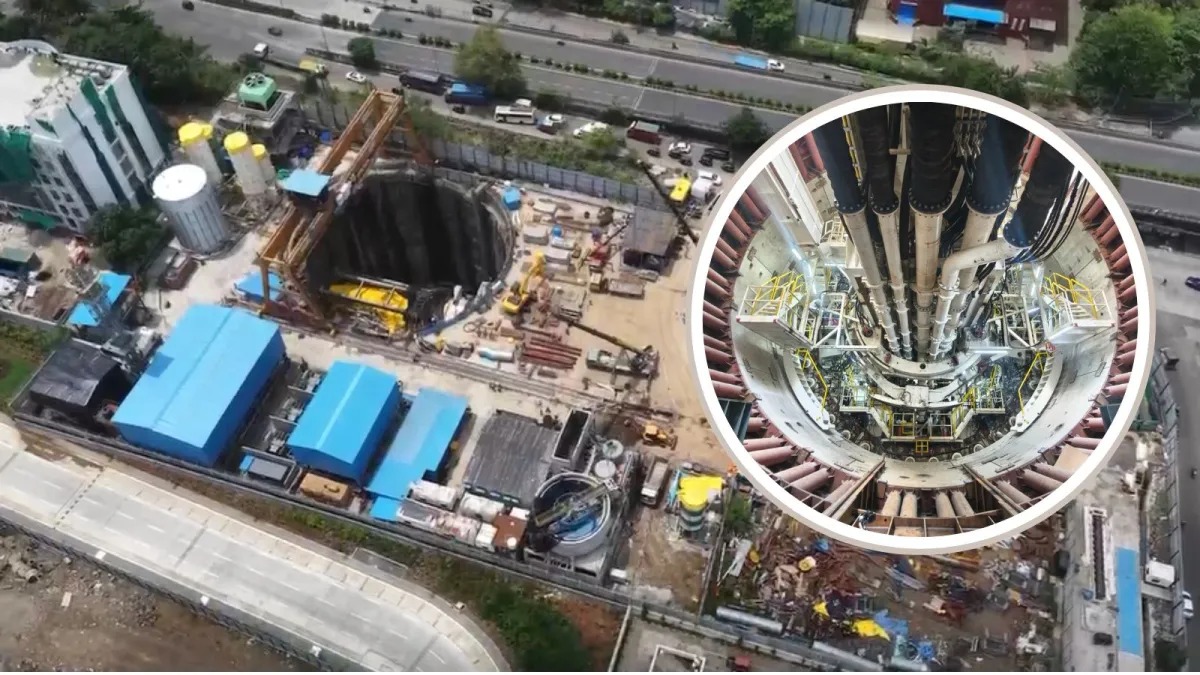
National High Speed Rail Corporation Limited (NHSRCL) has deployed its second Tunnel Boring Machine (TBM) to construct India's first undersea rail tunnel beneath Thane Creek. Operating from a 39-meter deep shaft in Sawli, the 3,200-tonne machine joins the 21-kilometer underground section of the Mumbai–Ahmedabad Bullet Train project.
MUMBAI, India — Construction on the Mumbai–Ahmedabad Bullet Train project reached a major milestone as the National High Speed Rail Corporation Limited (NHSRCL) launched its second Tunnel Boring Machine (TBM) to excavate India's first undersea rail tunnel beneath Thane Creek.
The 3,200-tonne machine began its drive from a 39-meter-deep launch shaft constructed at Sawli in Ghansoli, heading toward Vikhroli. This deployment follows the launch of the first TBM on July 5, which began boring from Vikhroli toward the Bandra-Kurla Complex (BKC). The two machines will construct the 16-kilometer TBM-driven section of a 21-kilometer underground corridor connecting BKC and Thane, which features a 7-kilometer undersea stretch under Thane Creek.
Technical Features of the Undersea Tunnel Boring Machine
The Mixshield-type TBM deployed for the project ranks among the largest ever utilized for rail tunnel construction in India.
The Mixshield system employs a pressurized liquid bentonite slurry circuit to stabilize the tunnel face during excavation through high-pressure marine strata beneath Thane Creek. Integrated with a Semi-Continuous Advance (SCA) system, the machine performs ring-building operations and tunnel excavation simultaneously, optimizing construction efficiency while preventing ground settlement in urban Mumbai.
Breakdown of the 21-Kilometer Underground Corridor
The underground section forms a key part of the 508-kilometer high-speed rail corridor linking Mumbai and Ahmedabad.
While 16 kilometers are being excavated using TBMs, the remaining 5-kilometer portion has already been excavated using the New Austrian Tunnelling Method (NATM). To protect the marine environment and ensure structural durability, double-layer EPDM gaskets are being deployed to keep the undersea tunnel completely watertight.
Official Sources Section
Project milestones and technical specifications were officially released via press statements by the National High Speed Rail Corporation Limited (NHSRCL) and published through the Press Information Bureau (PIB), with project oversight handled by the Ministry of Railways.
Quote Section
"According to officials in press statements released by the National High Speed Rail Corporation Limited, the deployment of the second Mixshield TBM from the Sawli shaft accelerates excavation on the 16-kilometer subterranean section, ensuring controlled face stabilization for India's first undersea rail tunnel beneath Thane Creek."
Why It Matters
For High-Speed Rail Infrastructure: Advances execution on the most complex engineering segment of India's flagship bullet train corridor.
For Urban Commuters: Connects Mumbai's central business district at BKC to suburban hubs without disturbing surface infrastructure or dense urban settlements.
For Domestic Engineering: Demonstrates advanced slurry-shield tunneling capabilities under seabed water pressure in Indian transport projects.
Key Facts at a Glance
Milestone: Second TBM launched from 39-meter deep Sawli shaft in Ghansoli.
Undersea Length: 7 kilometers beneath the seabed of Thane Creek.
Machine Size: 13.6-meter cutterhead diameter weighing 3,200 tonnes.
Executing Agency: National High Speed Rail Corporation Limited (NHSRCL).
Frequently Asked Questions (FAQ)
How long is the undersea section of the Bullet Train tunnel?
The undersea section beneath Thane Creek stretches across 7 kilometers, forming part of a larger 21-kilometer underground network between BKC and Shilphata.
What technology is used to bore beneath the seabed?
NHSRCL is using semi-automatic, Mixshield slurry-type Tunnel Boring Machines (TBMs) that utilize pressurized bentonite slurry to stabilize the tunnel face and withstand high water pressure beneath Thane Creek.
When did the first TBM start its excavation drive?
The first TBM began its 6-kilometer tunneling drive from Vikhroli toward the Bandra-Kurla Complex (BKC) on July 5, 2026.
Source: Official press releases issued by the Press Information Bureau (PIB), operational updates from the National High Speed Rail Corporation Limited (NHSRCL), and technical coverage from Economic Times Infra.