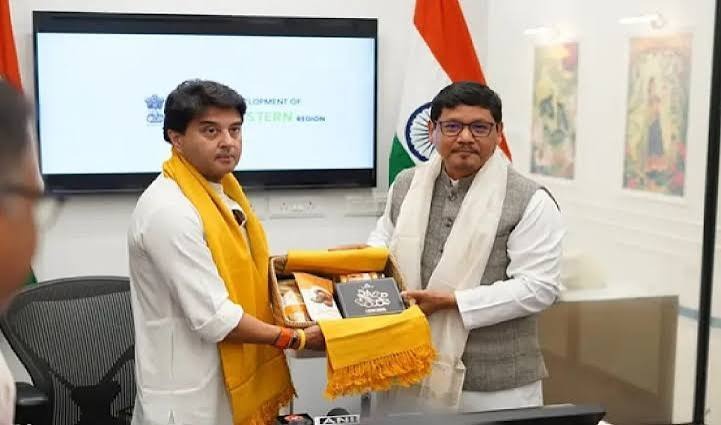
The Union Government and Meghalaya launched the ₹175.45-crore "Mission Golden Spice" initiative to transform GI-tagged Lakadong turmeric into a global brand. The five-year project aims to expand cultivation to 7,000 hectares, double farmer earnings, build modern processing infrastructure, and boost exports to international markets.
NEW DELHI — Union Minister for Development of North Eastern Region (DoNER) Jyotiraditya M. Scindia, along with Meghalaya Chief Minister Conrad K. Sangma, launched "Mission Golden Spice," a ₹175.45-crore convergence-led initiative aimed at positioning Meghalaya’s GI-certified Lakadong turmeric as a globally competitive brand. The five-year roadmap (2025–2030) was officially unveiled during a ceremony at Sanchar Bhavan in New Delhi, with regional stakeholders from Shillong joining via video conference.
The program addresses long-standing structural bottlenecks across the agricultural supply chain, focusing on post-harvest processing, value addition, and international marketing for more than 17,500 smallholder growers.
Infrastructure Scaling and Production Targets
Cultivated predominantly in the West and East Jaintia Hills districts, Lakadong turmeric is widely recognized for its naturally high curcumin content—ranging between 7% and 12%, which is nearly four times the global average of roughly 2% to 3%. Despite this quality advantage, small farmers have historically faced low price realization due to limited local processing capacity, weak market linkages, and post-harvest spoilage.
| Mission Parameter | Current Status | 2030 Target | Primary Objective |
| Cultivation Area | ~2,500 hectares | 7,000 hectares | Expanding production footprint |
| Annual Output | ~10,000 metric tonnes | 49,400 metric tonnes | Industrial-scale supply capacity |
| Farmer Realization | ₹30–₹40 per kg | ₹80 per kg | Doubling agricultural income |
| Beneficiary Coverage | Local farming pockets | >17,500 growers | Gender-inclusive rural growth |
To address infrastructural deficits, the mission will set up the region's largest integrated organic processing and curcumin extraction facility alongside cold-chain storage networks. Funding is shared jointly across DoNER (contributing 50%), the North Eastern Council (NEC), the Ministry of Agriculture and Farmers Welfare, and the state government of Meghalaya.
Phased Implementation and Global Strategy
The mission will be executed across two distinct phases:
Phase I (Value Chain Strengthening): Establishing commercial-scale processing units, improving post-harvest handling, implementing structured Geographical Indication (GI) monetization, and building direct market channels.
Phase II (Expansion & Scale-Up): Expanding global trade footprints into target export markets including the United States, European Union, Japan, and the Gulf nations.
Officials noted that women—who perform up to 99% of processing, harvesting, and institutional enterprise activities—will be placed at the core of new farmer-producer organizations (FPOs) and processing cooperatives created under the scheme.
Official Sources Section
Details regarding funding allocations, execution targets, and regulatory mechanisms are drawn directly from official press releases issued by the Ministry of Development of North Eastern Region (MDoNER), notifications from the Press Information Bureau (PIB), official briefings by the Government of Meghalaya, and project frameworks released by the North Eastern Council (NEC).
Quote Section
"According to officials, the mission provides an integrated roadmap to convert Meghalaya's GI-tagged Lakadong turmeric from a raw commodity into a high-value global brand, doubling farmer incomes while creating robust processing and export infrastructure."
Why It Matters
The rollout of "Mission Golden Spice" carries economic and practical implications across the agricultural and consumer landscape:
For Farmers & Rural Communities: Direct price realizations are projected to nearly double to ₹80 per kg, protecting growers from distress sales through structured buyback and processing centers.
For Agricultural Exporters: Establishes a verified, organic, high-curcumin supply chain tailored to satisfy international nutraceutical and gourmet food standards.
For Global Consumers: Increases availability of certified, high-curcumin organic turmeric with full origin traceability.
For Women Entrepreneurs: Formalizes female leadership in local processing institutions, driving economic empowerment across tribal districts in the Jaintia Hills.
Key Facts at a Glance
Project Allocation: Total funding of ₹175.45 crore approved for five years (2025–2030).
Production Expansion: Targeted growth from 2,500 hectares to 7,000 hectares, yielding 49,400 metric tonnes annually.
Curcumin Advantage: Lakadong turmeric contains 7–12% natural curcumin compared to global averages of 2–3%.
Target Markets: Export expansion focused on the United States, European Union, Japan, and the Gulf countries.
Frequently Asked Questions (FAQ)
What is Mission Golden Spice?
Mission Golden Spice is a ₹175.45-crore central and state convergence scheme launched to build a comprehensive value chain, processing facilities, and export channels for Meghalaya's Lakadong turmeric.
What makes Lakadong turmeric unique?
Lakadong turmeric possesses a naturally high curcumin concentration of 7% to 12%, making it highly valuable for culinary, pharmaceutical, and nutraceutical applications.
How will the mission benefit local farmers?
The program aims to double farmer earnings from ₹30–₹40 per kg to approximately ₹80 per kg by establishing local cold-chain storage, commercial processing, and direct buyer linkages.
Which regions in Meghalaya produce Lakadong turmeric?
The crop is primarily cultivated in the unique agro-climatic conditions of the West Jaintia Hills and East Jaintia Hills districts.
Source: Official project launch announcements and press documentation published by the Ministry of Development of North Eastern Region, the Press Information Bureau, the Government of Meghalaya, and the Ministry of Agriculture and Farmers Welfare.