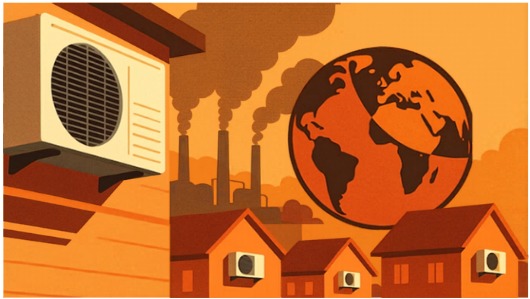
India’s rising demand for air conditioners is creating a paradox: while cooling homes and offices, it is simultaneously heating the planet. With sales projected at 11–11.5 million units in FY2026 despite short-term dips, the vicious AC loop highlights how climate change and consumer demand are locked in a cycle.
India’s air conditioner (AC) market is booming, driven by rising temperatures, urbanization, and growing middle-class aspirations. Yet, this surge in cooling demand is intensifying the country’s climate challenge. As more households install ACs, electricity consumption spikes, leading to higher carbon emissions from coal-dependent power grids.
Short-Term Market Trends
According to ICRA, India’s room air-conditioner industry is expected to see a 10–15% decline in FY2026 volumes, dropping to 11–11.5 million units from a record 12.5–13 million in FY2025. The slowdown is attributed to extended unseasonal rains that reduced heatwave days in North and Central India. However, forecasts of a hotter summer in 2026 suggest demand will rebound in the second half of the year.
The Climate Paradox
This cycle illustrates a paradox: climate change drives AC demand, and AC demand worsens climate change. Rising heatwaves push consumers to buy more cooling devices, but the increased electricity use contributes to greenhouse gas emissions, further warming the planet. India’s reliance on coal for power generation amplifies this vicious loop.
Government Policies And Industry Response
To address sustainability, the government has reduced GST on ACs below two tonnes from 28% to 18%, making them more affordable. At the same time, new Star label efficiency norms effective January 2026 will raise prices slightly but encourage adoption of energy-efficient models. The industry is also expanding capacity by 40–50% over the next two years, with ₹4,500–5,000 crore in planned investments. The Production-Linked Incentive (PLI) scheme is expected to boost indigenization of AC components to 70–75% by FY2028, reducing import dependence.
Long-Term Implications
India’s AC penetration remains relatively low compared to global averages, meaning demand will continue to rise. Without a shift to renewable energy and efficient cooling technologies, the vicious cycle will deepen. Experts warn that unchecked AC growth could strain power grids, increase emissions, and worsen urban heat islands.
Key Highlights
- India’s AC sales expected to dip 10-15% in FY2026 due to unseasonal rains
- Demand rebound likely in H2 FY2026 with hotter summer forecasts
- GST cut to 18% makes ACs more affordable, boosting pre-buying
- New Star label norms effective January 2026 to enforce efficiency standards
- Industry capacity to expand 40-50% in two years with ₹4,500-5,000 crore capex
- PLI scheme to raise indigenization of AC components to 70-75% by FY2028
- Rising AC demand risks worsening climate change through higher emissions
Mindful Usage Of ACs And Other Appliances
- Set air conditioners to an optimal temperature (around 24-26°C) instead of extreme cooling
- Use energy-efficient appliances with high star ratings to reduce electricity consumption
- Switch off ACs, fans, and lights when not in use
- Ensure regular maintenance and cleaning of appliances for better efficiency
- Improve insulation and use curtains or blinds to minimize heat indoors
- Rely on natural ventilation whenever possible to reduce dependence on cooling devices
- Unplug idle devices to avoid phantom energy consumption
- Replace traditional bulbs with LED lighting for lower energy use
- Adopt smart timers or sensors to control appliance usage automatically
- Practice conscious consumption to lower bills and reduce carbon emissions, helping slow climate change
Sources: ICRA Limited, ET Retail, Tribune India