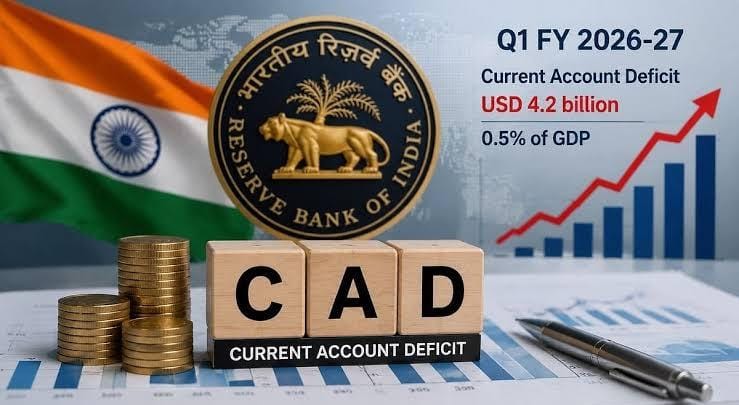
The Reserve Bank of India reported that India's current account deficit widened to $4.2 billion, or 0.5% of GDP, in the first quarter of 2026-27 as merchandise trade deficits grew, while foreign exchange reserves decreased by $22.5 billion due to capital outflows and valuation losses.
Balance of Payments and Current Account Dynamics
The Reserve Bank of India (RBI) released preliminary balance of payments (BoP) data for the first quarter (April-June) of 2026-27, showing that India's current account deficit stood at US$ 4.2 billion (0.5 per cent of GDP), compared to US$ 3.4 billion (0.4 per cent of GDP) in the corresponding period of the previous year. The widening deficit was primarily influenced by a larger merchandise trade deficit, which rose to US$ 86.1 billion in Q1:2026-27 from US$ 68.9 billion in Q1:2025-26.
Offsetting part of the merchandise trade imbalance, net services receipts grew to US$ 51.6 billion, up from US$ 47.9 billion a year ago, supported by rising exports in computer services, transportation, and business services. Furthermore, personal transfer receipts from overseas remittances increased substantially to US$ 42.9 billion from US$ 33.2 billion, while net outgo on the primary income account decreased to US$ 10.5 billion.
Financial Account Flows and Foreign Exchange Reserves
Within the financial account, foreign direct investment (FDI) registered a net inflow of US$ 6.1 billion, improving upon the US$ 5.2 billion recorded in the same quarter last year. However, foreign portfolio investment (FPI) recorded a significant net outflow of US$ 9.6 billion, reversing from a net inflow of US$ 1.6 billion in Q1:2025-26. Non-resident Indian (NRI) deposits recorded net inflows of US$ 2.8 billion, while external commercial borrowings (ECBs) brought in net inflows of US$ 3.3 billion.
Consequently, foreign exchange reserves depleted by US$ 8.1 billion on a BoP basis during the April-June 2026 quarter, contrasting with an accretion of US$ 4.5 billion a year earlier. In nominal terms—incorporating valuation effects—reserves decreased by US$ 22.5 billion, driven by a US$ 14.4 billion valuation loss stemming from lower gold prices and the appreciation of the US dollar against major global currencies.
Impact on Domestic Markets and Investors
The wider current account deficit and sharp portfolio outflows underscore broader external sector adjustments amid shifting global monetary conditions and currency valuations. For domestic businesses, manufacturers, and importers, higher merchandise trade gaps highlight sustained domestic demand for petroleum, oil, and lubricants (POL) alongside core industrial inputs.
For institutional investors and macroeconomic analysts, the steady influx of resilient FDI and high personal remittances provide vital cushioning against volatile portfolio outflows. The central bank's detailed accounting of reserve variations offers clear transparency regarding how valuation changes and capital account shifts impact national liquidity buffers.
Official Sources and Statements
According to official data released by the Reserve Bank of India (RBI) from its central office in Mumbai, the preliminary balance of payments statistics are compiled and published in accordance with statutory reporting standards.
"According to officials, foreign exchange reserves depleted by US$ 8.1 billion on a BoP basis during April-June 2026, while nominal reserves decreased by US$ 22.5 billion after accounting for valuation losses."
Key Facts at a Glance
Current Account Deficit: Stood at US$ 4.2 billion (0.5% of GDP) for Q1:2026-27.
Merchandise Trade Deficit: Reached US$ 86.1 billion, compared to US$ 68.9 billion in Q1:2025-26.
Net Services Receipts: Increased to US$ 51.6 billion, driven by computer and business services.
Foreign Direct Investment: Recorded a net inflow of US$ 6.1 billion during the quarter.
Foreign Exchange Reserves Change: Depleted by US$ 8.1 billion on a BoP basis and US$ 22.5 billion in nominal terms.
Frequently Asked Questions
What was India's current account deficit in the first quarter of 2026-27?
The current account deficit stood at US$ 4.2 billion, representing 0.5 percent of GDP.
How did merchandise trade perform during April-June 2026?
The merchandise trade deficit widened to US$ 86.1 billion compared to US$ 68.9 billion in the same period of the previous year.
What was the status of foreign direct and portfolio investments?
FDI recorded a net inflow of US$ 6.1 billion, whereas portfolio investments registered a net outflow of US$ 9.6 billion.
What caused the decline in foreign exchange reserves?
Reserves decreased due to a BoP depletion of US$ 8.1 billion alongside US$ 14.4 billion in valuation losses driven by lower gold prices and US dollar appreciation.
Source: Reserve Bank of India Balance of Payments Press Release, Reserve Bank of India Foreign Exchange Reserves Variation Data