Student term insurance policies allow young adults aged 18 to 25 to secure pure-risk life cover before entering the workforce. While ultra-low premiums make early buying attractive, financial advisors emphasize that coverage should strictly depend on genuine liabilities like education loans rather than affordability alone.
Backed by recent financial product launches, retail markets are introducing pre-career life insurance options targeted at young adults navigating higher education.
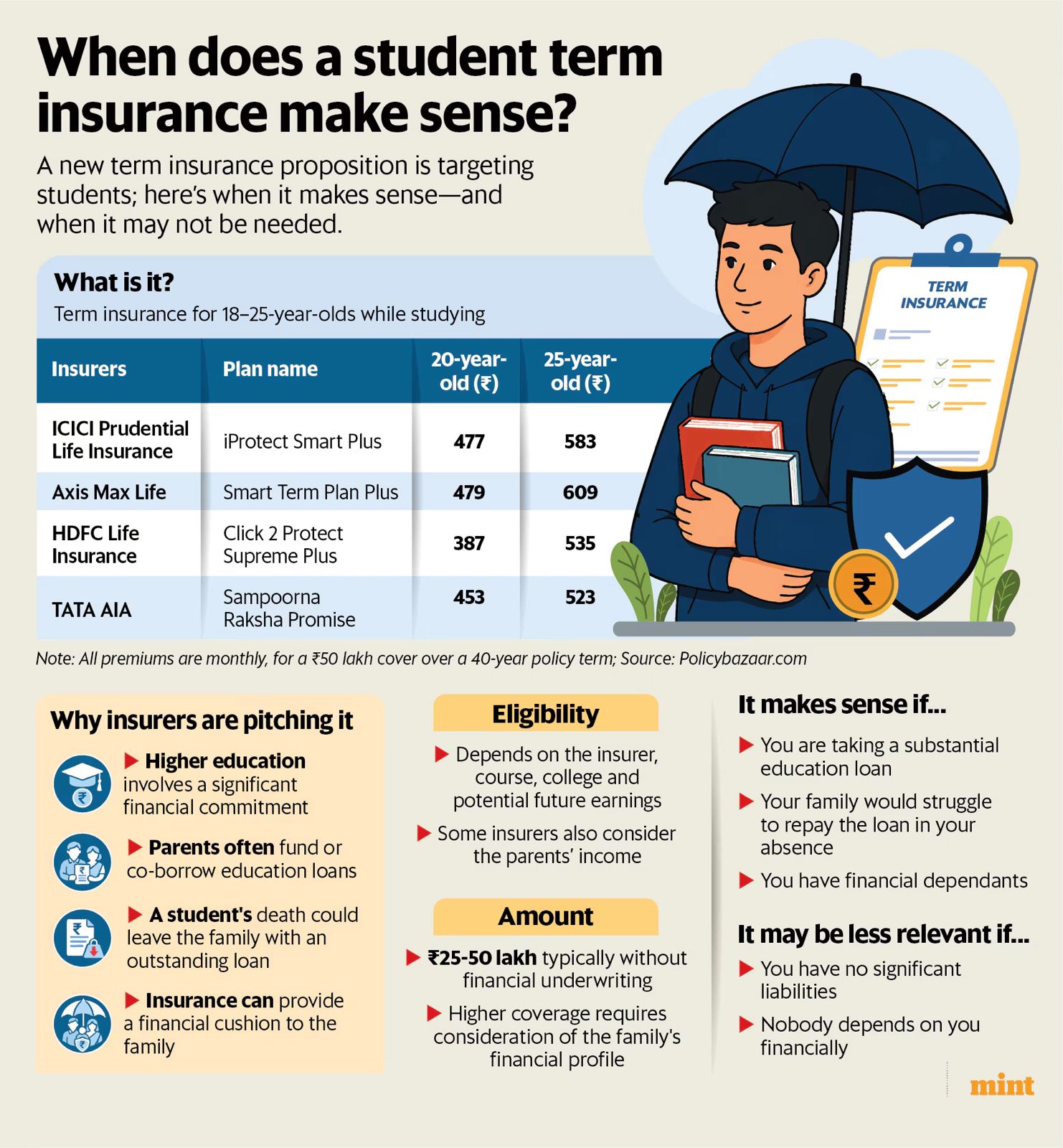
Expanding traditional financial products into pre-career demographics, major insurance providers and digital distributors like Policybazaar have rolled out specialized Student Term Plans aimed at individuals aged 18 to 25. Traditionally reserved for working professionals with active financial dependents, these pure-risk policies offer life cover starting from ₹25 lakh with policy terms spanning 30 to 40 years.
While monthly rates can start as low as ₹388 for a ₹50 lakh cover for a healthy 18-year-old non-smoker, industry experts stress that affordability should not be the sole driver for purchasing coverage before entering the formal workforce.
Evaluating Liabilities, Loan Protections, and Eligibility Criteria
Analyzing the operational framework of student-focused life policies reveals specific structural triggers that justify early coverage. According to market analyses and platform disclosures published in September 2026, key parameters governing these policies include:
Education Loan Protection: The primary catalyst for student term insurance is high-value higher education debt, where parents often act as co-borrowers or guarantors. In the event of a student's untimely demise, the payout helps families clear outstanding institutional liabilities.
Income-Free Underwriting: Because students typically lack regular salary slips, insurers evaluate applications based on educational stream, institution reputation, future earning potential, and parents' financial capacity.
Lock-In Pricing Advantage: Securing a policy at age 18 or 20 locks in lower mortality risk pricing, yielding cheaper long-term premiums compared to buying equivalent coverage mid-career.
Rider Customization: Policies frequently permit optional add-ons, including accidental death and critical illness riders, though these incrementally raise the baseline premium commitment.
Why It Matters
The practical implications of student term insurance affect middle-class families leveraging education loans to fund higher studies. For students with no debt, no dependents, and no regular income, purchasing a multi-decade life policy may represent an unnecessary recurring expense. However, for families carrying substantial education debt where parents are co-borrowers, an affordable term policy acts as a vital financial safety net against tragic contingencies.
Key Facts at a Glance
Target Age Group: 18 to 25 years.
Minimum Cover Offered: Generally starts from ₹25 lakh.
Policy Tenures: Long-term contracts spanning 30 to 40 years.
Primary Trigger: Co-signed education loans and family liability protection.
FAQ Section
When does a student actually need to buy term insurance?
A student should consider term insurance primarily if they have a large education loan with parents as co-borrowers, or if they already support financial dependents.
Is income proof mandatory to buy student term insurance?
No. Insurers often evaluate student applications based on educational credentials, academic courses, or the financial standing of the parents instead of traditional salary slips.
Why are premiums cheaper for students?
Term insurance pricing depends heavily on age and health risk; younger policyholders present a statistically lower mortality risk, allowing them to lock in lower baseline rates.
Should students buy a policy if they have no loans or dependents?
If a student has zero financial liabilities and no one depending on their income, financial advisors generally recommend waiting to purchase term insurance until entering the workforce.
Source: Mint Money, Business Standard, Policybazaar, Axis Max Life