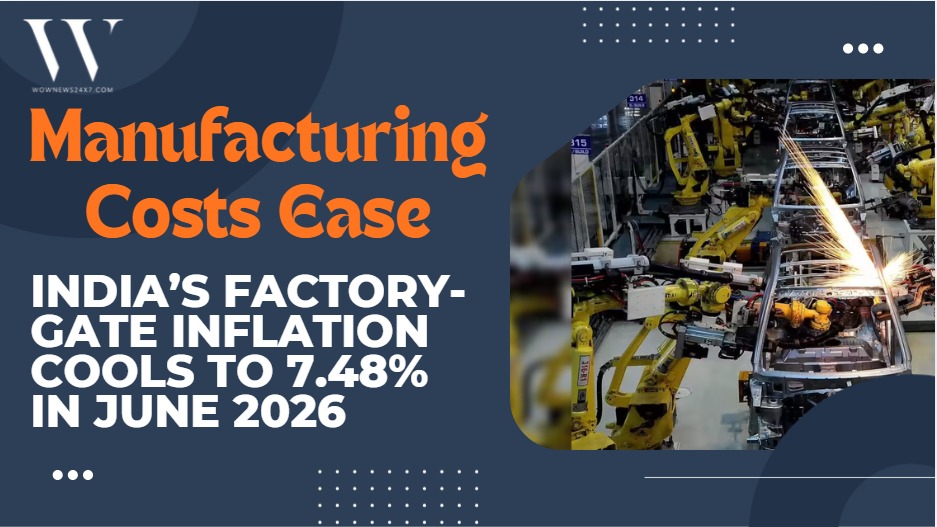
India's manufacturing inflation for June 2026 reached 7.48% year-on-year, reflecting ongoing industrial price dynamics. Published by the Ministry of Commerce and Industry, this wholesale price data is a vital indicator for businesses and policymakers monitoring factory-gate costs and their potential future impact on retail inflation and industrial demand.
The wholesale price index for manufactured goods shows a cooling trend, reflecting shifting dynamics in India's industrial sector as broader economic indicators stabilize.
NEW DELHI — India’s manufacturing inflation, a critical gauge of industrial price pressures, recorded a year-on-year increase of 7.48% for the month of June 2026, according to the latest data released by the Ministry of Commerce and Industry. This figure provides a vital snapshot of the cost environment for producers and reflects the ongoing stabilization of input costs across the nation's manufacturing sector.
The June data follows a period of heightened volatility, offering businesses and policymakers a clearer view of inflationary trends as the economy navigates complex global supply chain conditions and fluctuating raw material costs.
Industrial Cost Trends
The manufacturing sector, which accounts for the largest weight in India's Wholesale Price Index (WPI), remains a primary focus for analysts tracking the "factory gate" cost of goods. While the 7.48% figure highlights ongoing price adjustments, it is being closely scrutinized alongside other major indices—such as the Primary Articles and Fuel & Power groups—to assess the cumulative impact of industrial demand on the broader economy.
According to government figures, the Office of the Economic Adviser within the Department for Promotion of Industry and Internal Trade (DPIIT) compiles these indices to provide a comprehensive look at wholesale price movements. The moderation in specific segments of manufactured products is viewed by market participants as a potential signal that some of the inflationary pressures observed earlier in the year may be beginning to temper.
Context and Economic Impact
For citizens and consumers, wholesale manufacturing inflation serves as a leading indicator for retail prices. When production costs rise at the wholesale level, they often eventually permeate through the supply chain, affecting the final price of consumer goods ranging from textiles and chemicals to processed food products and basic metals.
Investors and businesses are currently utilizing this data to recalibrate their outlook for the coming quarters. By monitoring the pace of price growth in the manufacturing sector, firms can better anticipate shifts in consumer demand and adjust their inventory and pricing strategies accordingly. The government's continued focus on data transparency—through the timely release of these indices—is essential for informed decision-making in the industrial landscape.
Official Data and Methodology
The Ministry of Commerce and Industry publishes these figures monthly, utilizing a structured methodology to ensure accuracy and consistency. The data release for June 2026 aligns with the government's commitment to maintaining a robust economic monitoring framework, enabling stakeholders to track the health of India's manufacturing capabilities in real-time.
"The wholesale price indices reflect price changes at the first stage of transaction, providing a clear picture of the cost pressures faced by the industrial sector," according to officials from the Department for Promotion of Industry and Internal Trade.
Why It Matters
The 7.48% manufacturing inflation rate is a pivotal metric for understanding India's industrial stability. Practical implications of this data include:
Pricing Power: Businesses use these figures to determine their ability to pass on costs to consumers.
Monetary Policy: While the Reserve Bank of India (RBI) primarily targets retail inflation, wholesale trends offer critical context regarding the strength of economic recovery.
Operational Planning: Manufacturers analyze these indices to manage supply chain logistics and procurement schedules effectively.
Key Facts at a Glance
Manufacturing Inflation: Stood at 7.48% year-on-year for June 2026.
Reporting Authority: Ministry of Commerce and Industry, Government of India.
Economic Significance: Serves as a key indicator of industrial cost pressures and factory-gate price trends.
Sector Weight: Manufactured products comprise the largest portion of the All-India Wholesale Price Index.
FAQ Section
What is manufacturing inflation?
Manufacturing inflation measures the percentage change in the wholesale prices of manufactured goods, reflecting the cost pressures faced by industrial producers.
Why is this data important for consumers?
While wholesale data doesn't directly measure the price at the grocery store, high manufacturing inflation can lead to higher retail prices over time as production costs are passed along the supply chain.
How is this different from retail (CPI) inflation?
Retail inflation (CPI) measures the cost of a basket of goods bought by households, while wholesale inflation (WPI) measures the cost of goods at the wholesale level before they reach the retailer.
Where can the official data be accessed?
The Ministry of Commerce and Industry releases these reports through the Office of the Economic Adviser’s official portal.
Source:
Ministry of Commerce and Industry, Government of India
Office of the Economic Adviser (WPI)
Trading Economics - India WPI Manufacturing