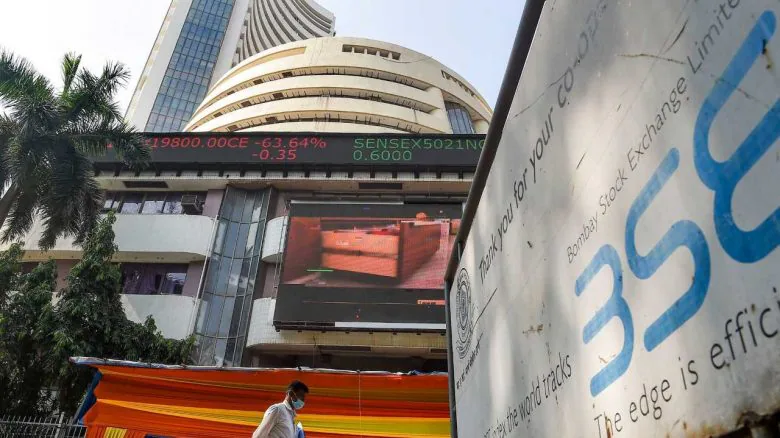
India's benchmark indices, the NSE Nifty 50 and BSE Sensex, both advanced over 0.5% on Wednesday, extending their rally into a fourth consecutive session. Driven by a major 16% drop in Brent crude prices to under $80 per barrel, the market successfully pushed past key technical resistance levels.
MUMBAI — India's benchmark equity indices, the NSE Nifty 50 and the BSE Sensex, extended their robust winning streak on Wednesday, each climbing more than 0.5% during active market trading. This marks the fourth consecutive session of gains for Dalal Street, propelled by a sharp contraction in international crude oil prices and stabilizing global sentiments following progress on a proposed US-Iran peace accord.
The upward movement underscores a sustained return of domestic buying confidence, driving the 50-share NSE Nifty 50 firmly above the psychologically vital 24,000 mark. Concurrently, the 30-share BSE Sensex expanded its gains to cross 77,100 points during intraday trade, tracking a steady reduction in net foreign institutional investor outflows and a noticeable strengthening of the Indian Rupee.
Crude Oil Capitulation Drives Macro Optimism
A primary structural catalyst for Wednesday’s market advance is the sudden correction in global energy markets. Brent crude futures slipped below the critical threshold of $80 per barrel, marking a sharp decline of approximately 16% over a five-day trailing period. For an import-dependent economy like India, which relies on overseas sources for more than 80% of its petroleum needs, the decline provides substantial macroeconomic relief.
Market data reveals that the drop to around $78.6 per barrel directly mitigates pressing concerns regarding India's balance of payments (BoP) deficit. Lower energy bills reduce corporate input expenses across logistics, automobile manufacturing, and chemical processing sectors, sparking immediate buying interest across multiple domestic sectors.
Sectoral Performance and Institutional Activity
The IT sector emerged as a principal engine of Wednesday's rally. Financial exchange updates highlighted the Nifty IT index gaining more than 1% in early hours, led by prominent institutional demand for large-cap tech majors following new enterprise artificial intelligence partnerships. Heavyweight consumers and consumer goods indices also maintained a positive bias.
According to provisional data released by the National Stock Exchange of India, the structural makeup of capital flows is shifting:
Foreign Institutional Investors (FIIs): Net outflows have substantially tapered down to a marginal Rs 749.18 crore in the preceding session, signaling a pause in aggressive foreign selling.
Domestic Institutional Investors (DIIs): Local funds have countered global volatility by absorbing supply, maintaining continuous net positive configurations over the four-day trading block.
Currency Support: The Indian National Rupee opened higher against the US Dollar at 94.45, appreciating from its previous close of 94.56, further incentivizing foreign capital retention.
However, the rally was partially checked by localized profit-booking in capital-intensive sectors. The Nifty Metal and Nifty Auto indices saw slight corrective dips, as investors reassessed the impact of early-season deficient monsoon patterns on rural purchasing power and food inflation.
Expert Insights and Strategic Outlook
Financial analysts emphasize that the concurrent alignment of cooling energy prices and the prospective easing of geopolitical frictions in West Asia has created a highly favorable near-term matrix for Indian equities.
"There are two factors that are likely to influence the market trend in the near term. One is positive; the other is negative. The positive factor is the steady and sharp decline in crude prices," stated Dr. VK Vijayakumar, Chief Investment Strategist at Geojit Financial Services. "The negative factor is the deficient monsoon which is causing concerns, particularly about food inflation. But the monsoon may pick up in the coming days, reducing anxiety."
Technical analysts noted that the momentum indicators have turned structurally supportive, with derivatives data exhibiting strong put writing near the 24,000 zone, establishing it as a reliable base for the current settlement cycle.
Official Sources Section
The financial statistics, regulatory market data, and sector developments compiled in this report are strictly attributed to official market operators and clearing houses:
Why It Matters
For individual retail investors and pension funds, the market's progression past historic resistance lines builds wealth portfolios and reinforces structural faith in equity savings schemes. For everyday consumers, the sharp drop in oil prices is highly practical, as it cushions the economy against immediate transport fuel hikes, keeping a lid on wholesale logistical overheads.
For international market participants, the strengthening rupee combined with the tapering of foreign outflows portrays India as a resilient investment destination amidst broader economic shifts across Asian markets.
Key Facts at a Glance
Index Progress: The NSE Nifty 50 rose 0.5% to break above 24,000 points, while the BSE Sensex advanced over 0.51% to trade above 77,100.
Energy Catalyst: Brent crude plunged 16% in five days to slide below $80 a barrel, alleviating India's import balance concerns.
Sector Leader: The Nifty IT index gained over 1%, establishing itself as a key sectoral driver alongside FMCG.
Currency Action: The Indian Rupee strengthened to open at 94.45 against the US Dollar, aiding the deceleration of foreign fund outflows.
FAQ Section
Q1: What caused the Indian stock market to rise today?
The rise was primarily driven by a substantial 16% drop in global Brent crude oil prices below $80 a barrel and positive sentiment tied to global geopolitical de-escalation, lowering economic risk for India.
Q2: Why is the 24,000 level important for the Nifty 50?
The 24,000 mark is a psychologically important milestone. Sustaining above this level indicates a strong technical breakout and builds bullish investor sentiment for near-term trading.
Q3: How does lower crude oil benefit Indian companies?
India imports the vast majority of its crude oil. Lower oil prices lower input costs, minimize logistical expenses, improve profit margins for manufacturing companies, and reduce national inflation risks.
Q4: Are foreign investors still pulling money out of India?
While Foreign Institutional Investors (FIIs) have been net sellers recently, their outflows have tapered significantly, with a strengthening rupee expected to encourage them to turn into buyers.
Source: National Stock Exchange of India (NSE), BSE Limited, Geojit Financial Services Research, Reserve Bank of India (RBI).