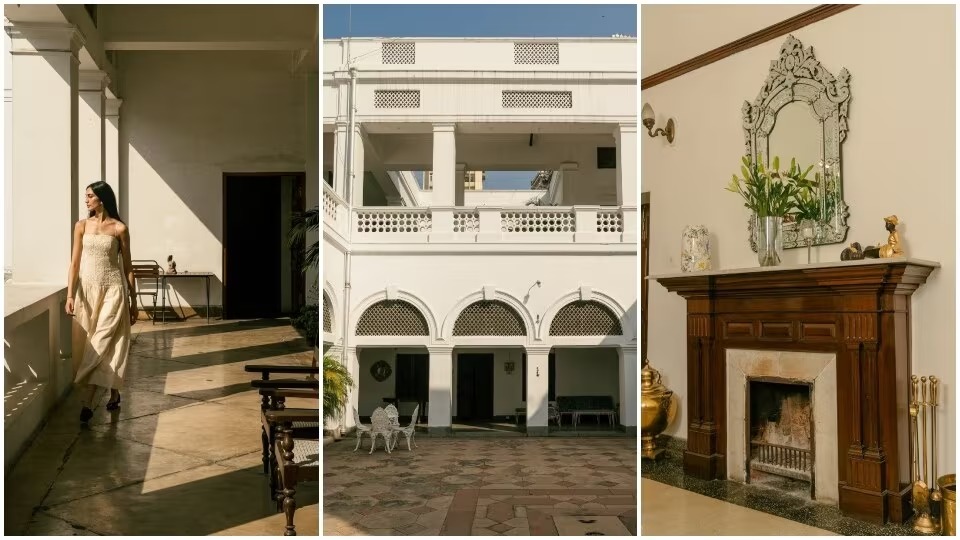
Indian supermodel Avanti Nagrath has unveiled her family’s 94-year-old, 11,000-square-foot bungalow in New Delhi. Built in 1932, the estate elegantly blends neoclassical design with modern enhancements, featuring a stunning central courtyard, Burmese teakwood interiors, and historic heirlooms that have beautifully accommodated five generations of family history.
NEW DELHI — In a major celebration of spatial heritage and architectural conservation, international supermodel Avanti Nagrath has opened the doors to her family's historic estate in the national capital. Built in 1932 by her great-grandfather, the sprawling 11,000-square-foot Anglo-Indian bungalow represents a calculated balance between neoclassical proportions, colonial layout schemes, and highly modern functional upgrades. The architectural unveiling, documented by design authorities, highlights a rising global appreciation for preserved domestic monuments amidst New Delhi's rapidly modernizing real estate landscape.
A Neoclassical Marvel in the Capital’s Historic Core
The multi-generational property stands as an institutional archive of New Delhi’s evolving design vernacular. The building's structural footprint features a pristine white facade, purposefully echoing the iconic colonnade aesthetic found throughout nearby Connaught Place.
According to spatial design registers, the home's external envelope preserves foundational elements typical of mid-20th-century residential masterworks. These include hand-carved, double-panelled hardwood doors, geometric jalis (perforated stone screens) configured for passive air cooling, and expansive open verandahs supported by symmetrical columns.
The home successfully balances historical preservation with contemporary living, proving that heritage layouts can naturally adapt to modern domestic routines without losing their structural narrative.
The Central Courtyard: Training Ground for Global Runways
At the structural core of the double-story residence lies its most celebrated spatial feature: an open-air central courtyard paved completely with weathered octagonal tiles. Framed by a mature, blooming bougainvillaea canopy that introduces natural organic texture to the geometry, the space centers around a traditional built-in havan kund (sacred fire pit) used for ancestral family ceremonies.
The space holds significant meaning for the supermodel, who made fashion history as the first Indian model to open a Versace runway show at Milan Fashion Week. Nagrath confirmed that the geometric perimeter of this private enclosure served as her original practice runway, where she perfected her signature walk beneath the open sky long before walking for houses like Dior, Hermès, and Burberry.
Burma Teak and Baroque Interiors Balance Eras
Connecting the active courtyard to the private residential quarters on the second floor is a monumental staircase. The architectural feature is bordered by a masterfully preserved balustrade crafted from authentic Burmese teakwood, set against a ceramic-tiled feature wall adorned with heavily detailed Victorian-style mirrors.
The internal dining room, which functions as the social heart of the estate, integrates distinct stylistic eras:
Baroque Chandeliers: Ornate glass assemblies provide warm, focused overhead illumination.
Burma Teak Fireplace: A carved historic hearth serves as the main focal point of the room.
Global Accents: Import marble tabletops sit alongside animal sculptures sourced from Bangkok and legacy brass vessels.
The Ancestral Bar: A 40-year-old entertainment counter made of solid character-rich wood, decorated with framed archival photographs tracing five generations of family lineage.
Official Sources Section
According to architectural portfolios released by Architectural Digest India (AD India) on June 8, 2026, the property represents one of the few surviving private estates from the capital's early-1930s expansion that has resisted modern multi-story redevelopment. Urban planning databases indicate that maintaining single-family estates of this scale preserves critical low-density green footprints within urban Delhi.
Quote Section
The curation of the home focuses entirely on honoring ancestral footprints while accommodating contemporary personal life.
"According to officials, the preservation of the 94-year-old bungalow highlights the structural viability of classic Indian-Colonial residential layouts when maintained with original building materials."
Design specialists stated that the integration of family heirlooms with modern amenities creates an authentic lifestyle template that counters the generic minimalism of current residential designs.
Why It Matters
The meticulous upkeep of the Nagrath bungalow offers an important lesson for urban heritage conservation across metropolitan India. In an era where historic private properties are routinely demolished to make way for high-density luxury apartments, this estate proves that classic craftsmanship—like Burmese teak joinery and passive ventilation jalis—can be preserved for contemporary living. It demonstrates that true luxury lies in architectural continuity and deep roots, offering inspiration for historic property owners nationwide.
Key Facts at a Glance
Historical Milestone: The private residential bungalow was constructed in 1932 and has housed five generations of the Nagrath family.
Spacious Design: The estate spans an 11,000-square-foot urban plot featuring a white facade inspired by Connaught Place.
Core Centerpiece: An open-air, octagonal-tiled central courtyard with an integrated havan kund serves as the building's heart.
Elite Materiality: The interiors showcase original Burmese teakwood craftsmanship, Baroque chandeliers, and family antique collections.
Frequently Asked Questions
When was Avanti Nagrath's New Delhi family bungalow built?
The estate was constructed in 1932 by Avanti Nagrath’s great-grandfather, making it a 94-year-old architectural landmark as of 2026.
What architectural styles are featured inside the historic home?
The bungalow blends neoclassical Anglo-Indian architecture with traditional Indian design elements, incorporating colonial verandahs, Burma teakwood balustrades, and intricate ventilation jalis.
How does the supermodel use the historic courtyard space?
In addition to hosting family events, the central open-air courtyard served as Nagrath’s private training ground where she practiced her runway walks before debuting on global stages in Milan and Paris.
Source: Architectural Digest India Design Archive, Hindustan Times Art and Culture Desk.