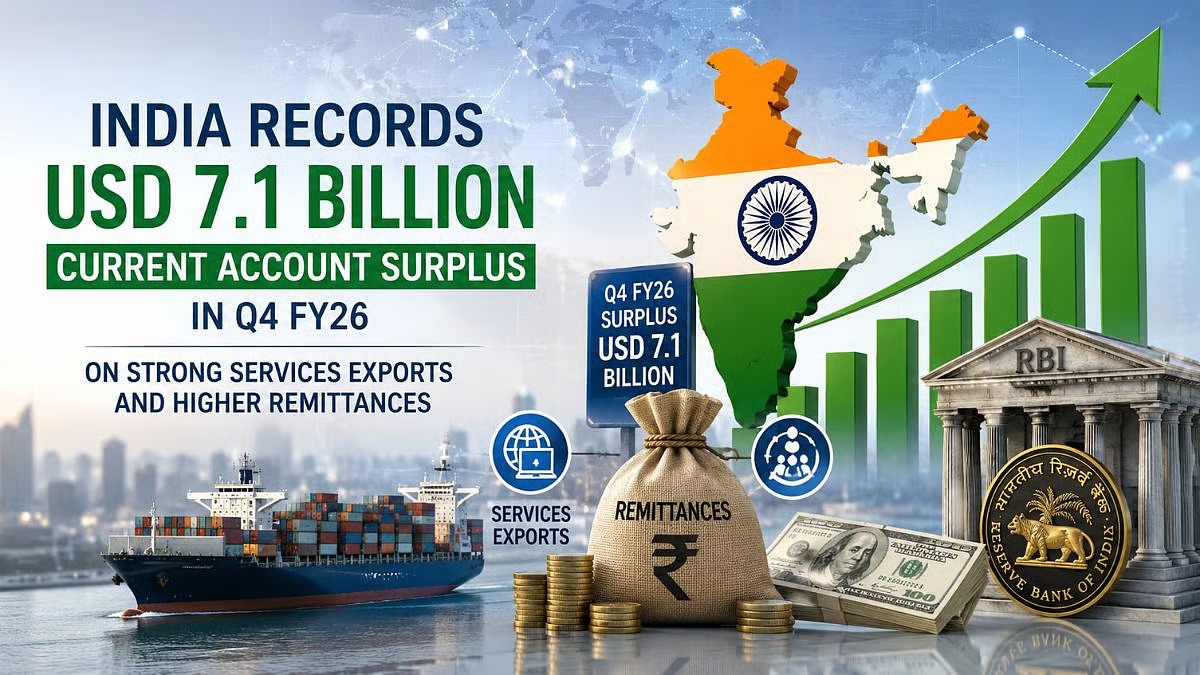
India’s current account hit a $7.1 billion surplus (0.7% of GDP) in the January-March quarter, driven by a surge in net service receipts to $60.4 billion. According to the Reserve Bank of India, strong tech and software exports successfully cushioned the broader economy against a widening $83.4 billion merchandise trade deficit.
MUMBAI, India — India recorded a current account surplus of $7.1 billion, or 0.7% of gross domestic product (GDP), for the January-March quarter. Data released by the central bank on Monday shows that robust invisible receipts from software, technology, and commercial business services successfully offset an expanding domestic merchandise trade gap during the final quarter of the fiscal year.
This macro-stability print arrives at a critical juncture today. While global supply chains grapple with the economic spillover of the ongoing US-Iran geopolitical conflict, India’s external sector demonstrates underlying structural resilience, providing the Reserve Bank of India (RBI) with a vital foreign exchange buffer to manage localized currency volatility.
Service Exports Counter Widening Merchandise Trade Deficit
The latest statistical release on the developments in India's Balance of Payments reveals a dual-track economic narrative for the final quarter of the 2025-26 fiscal year. While the core merchandise trade deficit expanded heavily to $83.4 billion from $59.3 billion in the corresponding year-ago period, the gap was substantially mitigated by international inbound cash flows from service agreements.
According to the central bank's statistical bulletin, net services receipts accelerated to $60.4 billion in the January-March period, climbing from $53.3 billion during the same timeframe in the preceding fiscal year. The primary growth engines remained concentrated within cross-border computer processing services, digital enterprise platforms, and global professional consulting consultancies.
Balance of Payments and Full-Year Deficit Trajectory
On an absolute basis, India's overall Balance of Payments (BoP) recorded a net surplus of $7.2 billion for the January-March quarter, reinforcing international reserves held at institutional clearing desks. However, the quarterly positive print did not fully erase the structural trade imbalances accumulated during the prior three quarters.
For the full annual financial cycle spanning April to March, the country’s cumulative current account deficit concluded at $25.2 billion, representing 0.6% of total GDP. This marks a marginal absolute increase from the $22.9 billion deficit logged over the previous annual cycle, though the percentage share relative to total economic output remained fixed at 0.6%, highlighting stable economic pacing despite severe commodity price fluctuations worldwide.
Official Sources Section
All macroeconomic variables, trade metrics, and percentage calculations cited in this report are sourced explicitly from the official statistical release issued by the Reserve Bank of India (RBI), under its scheduled publication series covering national balance sheets.
Additional systemic context regarding wider fiscal parameters and index inclusion mechanisms correlates with public financial statements archived by the Ministry of Finance and institutional data streams processed by the National Stock Exchange of India.
Executive and Analytical Interpretations
The central bank's leadership emphasized the underlying health of India's cross-border commercial transactions during recent executive assessments.
"According to officials, services exports registered resilient year-on-year growth across all major global outsourcing segments, including computer programming services and other critical business services."
Independent financial analysts noted that the incoming data should ease near-term pressure on local financial markets, offering temporary breathing room for currency trade desks navigating complex international shifts.
Why It Matters
The absolute performance of the current account surplus carries real-world implications across several key areas of the domestic and international marketplace:
For Currency Markets: A positive quarterly buffer improves structural liquidity, shielding the Indian rupee from abrupt depreciation against major global reserve currencies.
For Corporate Investors: Sustained strength within high-value business services reassures foreign institutional entities that India remains a highly competitive tech outsourcing hub.
For Policymakers: The positive external print provides baseline economic security, giving fiscal planners room to prioritize large-scale infrastructure projects even as regional energy costs fluctuate.
Key Facts at a Glance
Surplus Target Met: The January-March current account surplus reached 0.7% of national GDP, totaling $7.1 billion.
Services Acceleration: Total net services receipts rose by over 13% year-on-year, concluding at $60.4 billion.
Trade Deficit Headwinds: The domestic merchandise trade gap widened significantly to $83.4 billion, driven by sustained industrial import demand.
Annual Deficit Steady: The full-year current account deficit settled comfortably at 0.6% of GDP, aligning with long-term institutional stability forecasts.
Frequently Asked Questions (FAQ)
What is the difference between a current account surplus and a trade deficit?
A trade deficit occurs strictly when a nation imports more physical goods than it exports. A current account surplus looks at the broader picture, combining that goods trade with service exports, digital software income, and foreign worker remittances.
Why did India's merchandise trade deficit widen this quarter?
The merchandise gap grew to $83.4 billion due to increased domestic demand for foreign raw industrial materials, coupled with fluctuating global energy pricing structures.
How does a service sector surplus help the average consumer?
By bringing foreign currency into the domestic banking system, a strong service sector stabilizes the broader economy, protects employment across tech sectors, and helps keep import costs predictable.
Source: Reserve Bank of India, Ministry of Finance, National Stock Exchange of India