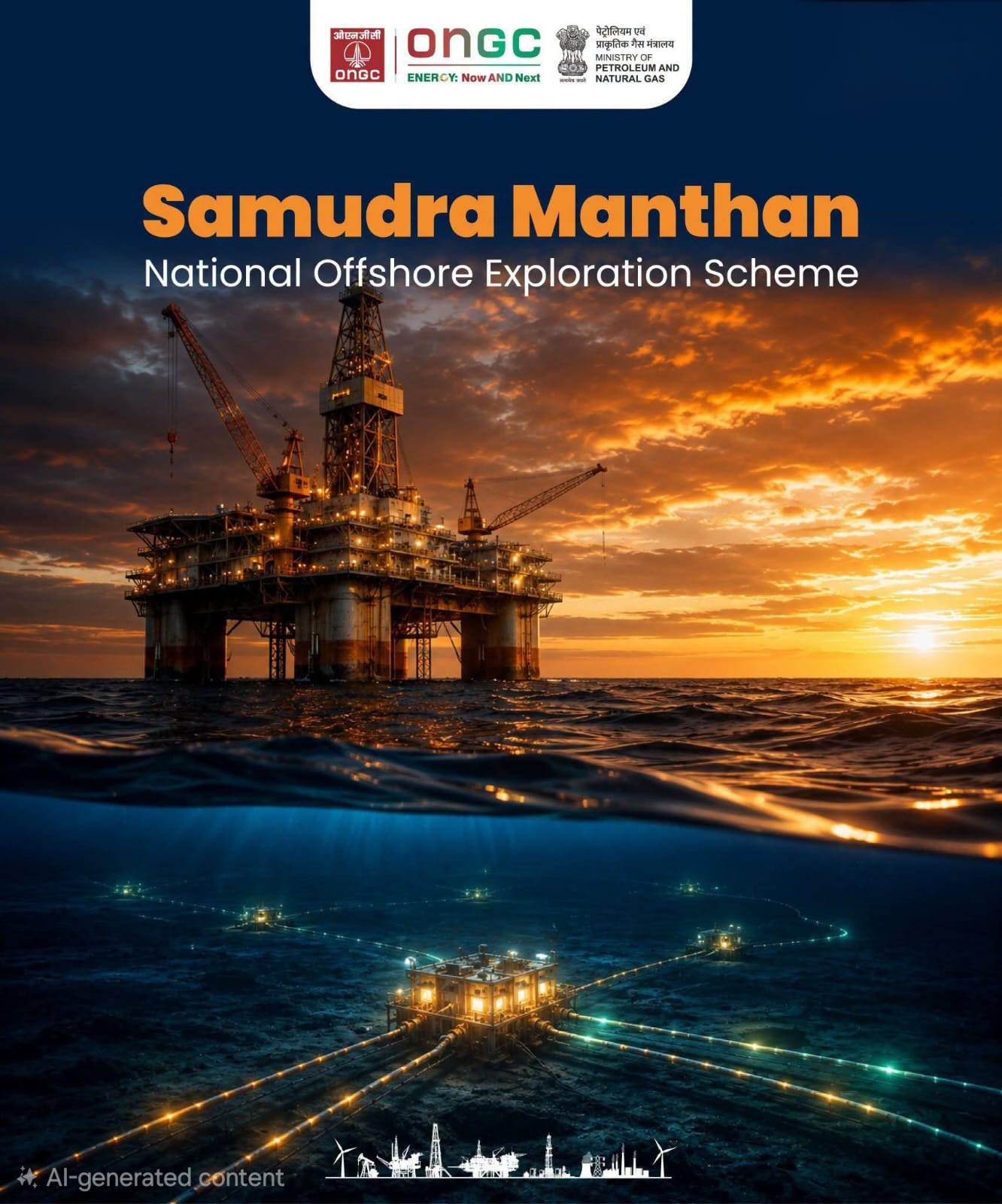
Inside 'Samudra Manthan': What ONGC's 150-well deepwater drill means for India's offshore future is an ₹84,084 crore strategic initiative to tap 5,600 MMTOE of deepwater hydrocarbon potential. Led by ONGC's specialized DeepX team, the seven-year campaign seeks to curb India's 89% crude import dependency through high-impact offshore exploration.
NEW DELHI — State-run energy major Oil and Natural Gas Corporation (ONGC) unveiled its ambitious seven-year operational roadmap under the Union Cabinet-approved ₹84,084 crore National Offshore Exploration Scheme, named 'Samudra Manthan'. Under the scheme announced on July 31, 2026, ONGC plans to drill 150 deepwater and ultra-deepwater exploratory wells through FY2030-31 across India’s offshore sedimentary basins. The initiative marks India’s largest and most heavily capitalized offshore exploration push to date, aiming to tap an estimated 5,600 million tonnes of oil equivalent (MMTOE) in hydrocarbon potential and secure the nation's long-term energy requirements.
Technical Scope and the 'DeepX' Operational Task Force
The multi-year campaign is engineered to accelerate hydrocarbon discovery and development across India's exclusive economic zone. To execute the mission, ONGC has established DeepX, a specialized mission-mode unit comprising over 30 domain experts. Operating on a "One Company, One Data" platform, DeepX will collaborate with global technology providers to deploy advanced seismic imaging, high-resolution subsurface modeling, and autonomous deepwater drilling rigs.
The initial phase of the campaign focuses on near-field prospects where prior geological data provides higher confidence. Drilling officially commenced on July 25, 2026, with the spudding of well MN-DW18-1-H-D in the Mahanadi Offshore Basin, located roughly 23 nautical miles off the coast of Konark, Odisha. The basin has already yielded the Utkal and Konark discoveries, proving the presence of viable petroleum systems in the region's deepwater fan structures.
| Program Metric | Allocation / Parameter | Operational Objective |
| Total Outlay | ₹84,084 Crore ($10 Billion) | Seismic surveys, drilling, & shared infrastructure |
| Program Duration | FY2026-27 to FY2030-31 (7 Years) | Comprehensive offshore coverage |
| Target Wells | 150 Exploratory Deepwater Wells | High-impact exploratory & scientific drilling |
| Resource Potential | ~5,600 MMTOE | Unlocking frontier & ultra-deepwater basins |
| First Spudded Well | MN-DW18-1-H-D (Mahanadi Basin) | Target depth reaching up to 3,000 meters |
Targeting Frontier Basins: From Mahanadi to Andaman
Beyond the Mahanadi Basin, the 150-well program expands into the Cauvery Offshore Basin and the frontier waters of the Andaman Sea. In September 2025, preliminary testing in the Andaman deepwater region confirmed high-purity natural gas deposits yielding up to 87% methane. However, historical commercialization in the zone was hindered by a lack of high-density 3D seismic data.
Inside 'Samudra Manthan': What ONGC's 150-well deepwater drill means for India's offshore future is a systematic deployment of ₹28,534 crore specifically earmarked for advanced 2D and 3D seismic acquisition. By mapping subsurface salt structures and reservoir trap geometry prior to spudding, ONGC aims to reduce the steep financial risks associated with deepwater wells, which typically cost between $50 million and $200 million per well.
Macroeconomic Drivers and Energy Security Context
India currently imports nearly 89% of its crude oil requirements, leaving the domestic economy vulnerable to global supply disruptions and geopolitical conflicts in West Asia. Domestic crude production has declined steadily over the past decade, falling to 28.7 million tonnes in FY2024-25.
By underwriting up to 50% of exploration costs for high-risk deepwater wells, the government's scheme aims to reverse this trend. Official projections indicate that success across the target basins could add over 600 MMTOE to national reserves, generating an incremental annual output of 10 to 15 MMTOE and saving billions in foreign exchange reserves.
Official Sources Section
Information cited in this report is sourced from official Cabinet briefings, corporate disclosures, and regulatory notifications:
Quote Section
In an official statement detailing the mission, ONGC stated:
"The Samudra Manthan programme represents a decisive shift in India's offshore exploration capability. By combining advanced seismic data, international expertise, and a dedicated deepwater unit, we aim to unlock new reserves, accelerate discoveries, and build indigenous deepwater operational excellence."
According to government officials from the Ministry of Petroleum & Natural Gas, "Underwriting exploration risks through shared infrastructure and financial support is critical to attracting capital and ensuring domestic energy security amidst global supply volatility."
Why It Matters
The rollout of 'Samudra Manthan' carries significant economic and strategic implications:
For Consumers and Businesses: Higher domestic crude and natural gas production stabilizes domestic fuel prices and shields industries from international price shocks.
For Energy Investors: Government cost-sharing caps exploration risk, creating incentives for global oilfield service providers and offshore engineering firms.
For National Defense and Economy: Foreign exchange savings from reduced oil imports strengthen the Indian Rupee and bolster fiscal stability.
Key Facts at a Glance
Budget & Scale: Total outlay of ₹84,084 crore ($10 billion) allocated through FY2030-31.
Drilling Target: 150 deepwater and ultra-deepwater exploratory wells over seven years.
Dedicated Execution: Spearheaded by ONGC's newly created 'DeepX' task force.
First Operation: Well MN-DW18-1-H-D spudded in the Mahanadi Offshore Basin, 23 nautical miles off Konark.
Reserve Goal: Projected addition of 600+ MMTOE in recoverable hydrocarbon reserves.
Frequently Asked Questions
What is the 'Samudra Manthan' scheme?
'Samudra Manthan' is India's National Offshore Exploration Scheme, an ₹84,084 crore government initiative aimed at accelerating deepwater oil and gas discovery across Indian offshore basins through 2031.
How many deepwater wells will ONGC drill under this mission?
ONGC plans to drill 150 deepwater and ultra-deepwater exploratory wells over a seven-year period across priority offshore basins.
Where is the first well being drilled?
The first well, designated MN-DW18-1-H-D, was spudded on July 25, 2026, in the Mahanadi Offshore Basin, located approximately 23 nautical miles off the coast of Konark, Odisha.
Why is deepwater drilling crucial for India's energy future?
With India importing nearly 89% of its crude oil, tapping deepwater reserves estimated at 5,600 MMTOE is vital to reducing import dependency, conserving foreign exchange, and ensuring national energy security.