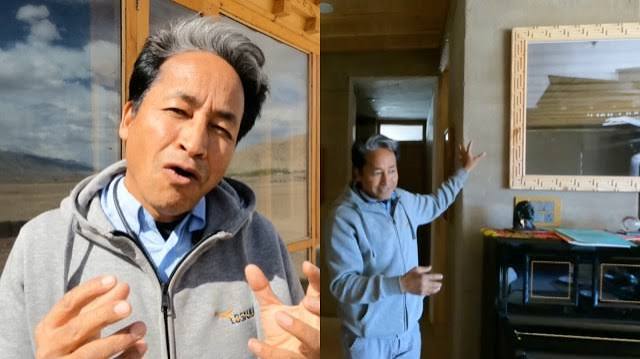
Sonam Wangchuk's Ladakh earth home utilizes a waterless, urine-diverting composting toilet instead of a conventional flush system. Designed to operate in sub-zero Himalayan winters, the system conserves scarce local water, prevents frozen pipes, and converts human waste into nutrient-rich organic fertilizer for regional agriculture.
LEH, India — Engineer, education reformer, and climate activist Sonam Wangchuk’s sustainable residence in the high-altitude desert of Ladakh operates without a conventional flush toilet. Technical details and video demonstrations from Wangchuk, the Students' Educational and Cultural Movement of Ladakh (SECMOL), and the Himalayan Institute of Alternatives Ladakh (HIAL) showcase an ecological sanitation framework—specifically a urine-diverting dry composting toilet—designed to eliminate water waste in one of India's most ecologically sensitive zones. The decision underscores an effort by regional environmental engineers to preserve fragile groundwater tables while demonstrating scalable sanitation solutions for arid, sub-zero regions.
Technical Mechanics of the Ecological Sanitation System
The waterless sanitation system installed at Wangchuk's home replaces waterborne sewage disposal with an odorless, source-separating composting toilet. The architectural setup separates solid waste and liquid urine at the point of drop.
Following each use, carbon-rich organic material—such as dry sawdust, ash, crushed leaves, or powdered clay—is deposited down the chute instead of water. This dry cover material absorbs moisture, prevents odor formation, and creates the ideal carbon-to-nitrogen ratio necessary for aerobic decomposition. The solid waste is collected in an ventilated composting chamber beneath the structure, where microbial activity processes the material into nutrient-rich organic fertilizer over several months.
| Sanitation Parameter | Conventional Flush Toilet | Wangchuk's Eco-Composting Toilet |
| Water Requirement | 6 to 12 liters per flush | Zero liters |
| Sub-Zero Performance | High risk of frozen pipes & burst septic lines | Fully functional down to -20°C |
| Environmental Output | Blackwater sewage requiring treatment plants | Nitrogen & phosphorus-rich organic manure |
| Odor Prevention | Water-trap seal | Sawdust, dry clay, & external air vent stacks |
| Impact on Water Table | High risk of contamination & groundwater depletion | Zero wastewater runoff or local contamination |
Environmental and High-Altitude Winter Challenges
The rejection of conventional wet sanitation in Ladakh addresses two severe regional environmental constraints: low annual precipitation and prolonged sub-zero temperatures. Receiving less than 100 millimeters of rainfall annually, Ladakh relies heavily on seasonal glacier melt for its freshwater supply. Operating flush toilets consumes thousands of liters of potable water per household annually, placing unsustainable demand on sparse local aquifers.
Furthermore, during Himalayan winters when ambient outdoor temperatures plunge to -20°C, conventional flush toilets fail as water inside supply pipes, cistern traps, and subterranean drainage networks freezes and ruptures the plumbing infrastructure. The dry composting system functions independently of fluid transport, remaining operational throughout severe freeze cycles.
Agricultural Benefits and Soil Regeneration
By preventing human waste from entering local waterways, the ecological sanitation model recovers essential plant nutrients that would otherwise be lost. The nitrogen, phosphorus, and potassium (NPK) contained in human waste are converted through controlled composting into organic fertilizer.
In cold desert regions where soil organic matter is sparse, returning composted waste to agricultural fields improves soil structure, enhances moisture retention, and reduces reliance on chemical fertilizers. This closed-loop agricultural model reflects centuries of traditional Himalayan land management, updated with modern ventilation and hygienic separation standards.
Official Sources Section
Technical descriptions, architectural parameters, and environmental data regarding the waterless sanitation system were compiled from technical briefings published by the Himalayan Institute of Alternatives Ladakh (HIAL) and documentation from the Students' Educational and Cultural Movement of Ladakh (SECMOL). Additional context on high-altitude eco-construction was cross-referenced with public research releases from the Ministry of Environment, Forest and Climate Change (MoEFCC).
Official Quote Section
According to official briefings and public demonstrations detailing the ecological architecture of the residence, Wangchuk emphasized that waterborne sanitation models are unsuitable for cold arid zones.
Sonam Wangchuk stated during a technical demonstration: "Water toilets are unsustainable in a cold desert like Ladakh. Flush systems consume scarce drinking water, contaminate groundwater, and freeze during winter. Our dry composting toilets preserve water, eliminate pipe freezing, and return valuable nutrients back to the soil as natural fertilizer."
Why It Matters
The implementation of waterless composting toilets in high-altitude earth homes proves that modern hygienic standards can be achieved without depleting local water reserves. As rapid urbanization and expanding tourism increase pressure on water resources across sensitive mountain ecosystems, adopting decentralized dry sanitation offers a practical path toward climate resilience and sustainable infrastructure.
Key Facts at a Glance
Water Conservation: Wangchuk's home uses a dry composting toilet that requires zero water for flushing.
Sub-Zero Reliability: The dry sanitation setup operates continuously in temperatures as low as -20°C without freezing.
Waste Conversion: Human waste is hygienically processed with sawdust and clay to produce organic fertilizer for local agriculture.
Modern Integration: Engineered by SECMOL and HIAL, the modern dry toilet design eliminates odors through proper ventilation and sawdust application.
Frequently Asked Questions (FAQ)
Why doesn't Sonam Wangchuk's home use a standard flush toilet?
Wangchuk's home avoids flush toilets to conserve scarce drinking water in Ladakh's cold desert environment and to prevent plumbing pipes from freezing during sub-zero winters.
How does the dry composting toilet prevent bad odors?
Odor is prevented by separating urine from solid waste and adding carbon-rich cover material like sawdust, ash, or dry clay after each use, combined with external air ventilation stacks.
What happens to the waste collected in the dry toilet?
The collected solid waste undergoes aerobic decomposition in a lower collection chamber over several months, converting into sterile, nutrient-rich organic compost used in agriculture.
Where can citizens inspect sustainable building guidelines from HIAL?
Official research papers, building designs, and educational resources are available directly on the official portal of the Himalayan Institute of Alternatives Ladakh (HIAL).
Source: Technical papers and public releases published by the Himalayan Institute of Alternatives Ladakh (HIAL), educational archives from SECMOL, and public policy documentation from the Ministry of Environment, Forest and Climate Change (MoEFCC).