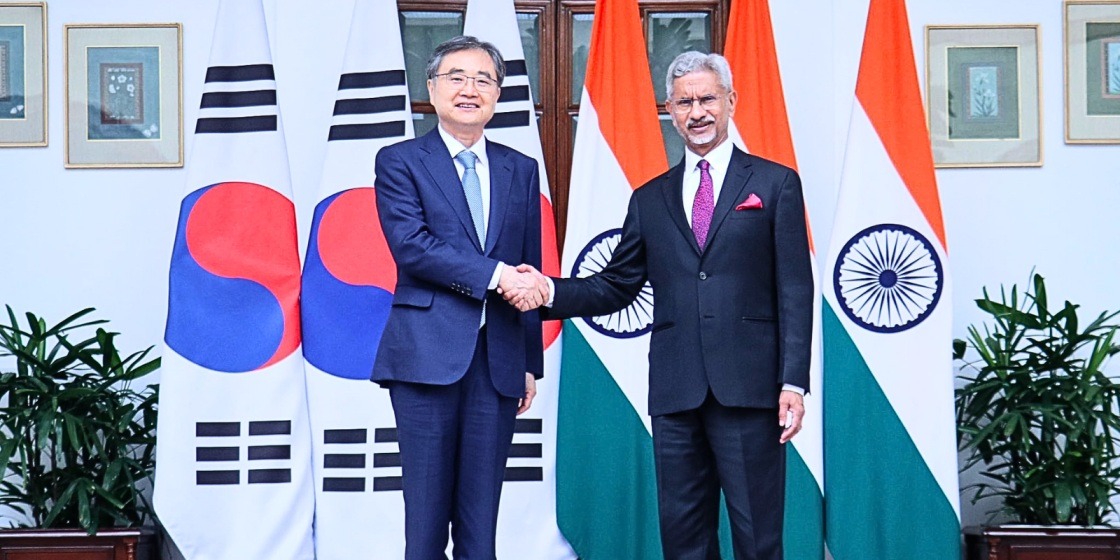
During the 10th Joint Commission Meeting in Seoul on June 24, 2026, Indian External Affairs Minister S. Jaishankar called for stronger India-South Korea cooperation. The talks focused on upgrading the bilateral trade agreement, securing semiconductor supply chains, and expanding joint defense production to navigate escalating global geopolitical tensions.
SEOUL — India's External Affairs Minister S. Jaishankar formally called for a strategic expansion of India-South Korea cooperation during bilateral deliberations in Seoul on Wednesday, June 24, 2026. Addressing a high-level delegation at the 10th India-Republic of Korea Joint Commission Meeting, Jaishankar emphasized that reinforcing critical manufacturing lines and diplomatic alignment is essential to navigate a highly "complex global environment." The diplomatic drive focuses heavily on semiconductor manufacturing, green energy transition, and defense co-production to stabilize Indo-Pacific trade corridors.
Redefining the Strategic Partnership Amid Geopolitical Friction
Strengthening Technology and Economic Corridors
The bilateral dialogue between New Delhi and Seoul takes place against a backdrop of evolving global trade dynamics, fragmented technology ecosystems, and maritime security challenges across the Indo-Pacific region. Jaishankar met with his South Korean counterpart, Cho Tae-yul, to review the Comprehensive Economic Partnership Agreement (CEPA), which both nations aim to upgrade to remove persistent non-tariff barriers.
According to ministerial briefings, the core of the newly proposed framework centers on high-technology resilience. India is positioning itself as a reliable partner for South Korea's advanced electronics sector, specifically pitching financial incentives under its modified Semiconductor Production Linked Incentive (PLI) scheme. By diversifying manufacturing nodes away from historically concentrated hubs, both nations seek to insulate consumer technology supply lines from sudden regulatory or geopolitical shocks.
Defense Infrastructure and Regional Security Alignments
A primary sector driving the updated partnership is defense industrial cooperation. Building on the successful deployment of the K9 Vajra-T self-propelled howitzers—developed through a technology transfer partnership between South Korea's Hanwha Aerospace and India’s Larsen & Toubro—the two countries discussed secondary licensing expansions. Under the "Make in India" initiative, discussions advanced toward joint research and development in naval shipbuilding, unmanned aerial systems (UAS), and aerospace components.
Impact on Global Supply Chains, Businesses, and Investors
Enhancing Corporate and Industrial Security
The push for deeper India-South Korea cooperation directly influences international supply chain management, impacting tech manufacturers, automotive conglomerates, and retail investors. Major South Korean conglomerates, including Hyundai Motor Group, Samsung Electronics, and LG Electronics, have already expanded their capital footprints within India. Hyundai, for instance, recently finalized plans to list its Indian subsidiary to fund local electric vehicle (EV) manufacturing facilities.
Opportunities for Skilled Professionals
For consumers and job-seekers, the formal alignment on clean technology and digital infrastructure creates a steady pipeline of engineering and manufacturing employment. Additionally, the planned simplification of professional visa frameworks under the upgraded CEPA will likely ease cross-border mobility for software engineers, research scientists, and technical specialists moving between the two tech-driven economies.
Official Sources Section
The official outcomes, trade parameters, and defense agreements outlined during the Joint Commission Meeting were compiled from official press statements published by the Ministry of External Affairs, India and parallel administrative briefings issued by the Ministry of Foreign Affairs, Republic of Korea.
Quote Section
"According to officials from the Ministry of External Affairs, the discussions in Seoul emphasized that contemporary bilateral ties must transcend traditional trade metrics. Leaders from both nations expressed a shared commitment to building reliable, transparent, and redundant supply chains in critical sectors like semiconductors, cybersecurity, and green hydrogen to withstand macroeconomic instabilities."
Why It Matters
In a volatile international landscape, strategic partnerships between major democracies provide a stabilizing anchor for global markets. Deeper India-South Korea cooperation ensures that two of Asia's largest industrial economies can co-develop defensive and technological counterweights. For businesses operating across these regions, the partnership mitigates the risk of sudden export bans or critical mineral shortages by creating a legal and institutional safety net.
Key Facts at a Glance
High-Level Dialogue: External Affairs Minister S. Jaishankar co-chaired the 10th Joint Commission Meeting in Seoul to deepen India-South Korea cooperation.
Tech Focus: The strategic agenda prioritizes semiconductor diversification, green hydrogen, and electric vehicle infrastructure.
Trade Upgrades: Negotiators are actively working to modernize the existing bilateral CEPA to eliminate non-tariff trade barriers.
Defense Expansion: The nations are expanding their defense footprint beyond the K9 Vajra howitzer program into naval and aerospace technology.
FAQ Section
Q1: What is the main objective of Minister Jaishankar's visit to South Korea? A1: The primary goal is to co-chair the 10th India-ROK Joint Commission Meeting to expand bilateral cooperation in defense, critical technology, and supply chain management within a complex global environment.
Q2: What sectors stand to benefit the most from this cooperation? A2: The semiconductor, automotive, renewable energy, and aerospace industries are positioned to benefit from increased cross-border investment and streamlined joint production frameworks.
Q3: How does the bilateral CEPA factor into these talks? A3: Both governments are working to upgrade the Comprehensive Economic Partnership Agreement (CEPA) to address trade deficits and simplify market access for businesses in both nations.
Source: Ministry of External Affairs, India, Ministry of Foreign Affairs, Republic of Korea