Krishna Janmashtami 2026 will be celebrated across India on Friday, September 4. Astronomical calculations set the vital Nishita Kaal midnight worship window between 11:57 PM and 12:44 AM in Delhi NCR. Devotees observe day-long fasting rules, perform midnight abhishek rituals, and break fasts following midnight prayers or morning parana.
NEW DELHI — Religious bodies and panchang authorities have released official auspicious timeframes for Krishna Janmashtami, confirming that the festival will be observed on Friday, September 4, 2026. Devotees across India and globally are preparing for the annual celebration of Lord Krishna's birth, characterized by day-long fasting, devotional singing, and late-night worship.
The core observance centers around the Nishita Kaal—the specific astronomical midnight window when Lord Krishna is believed to have been born. According to the Hindu calendar (Panchang), Ashtami Tithi begins at 02:25 AM on September 4 and concludes at 12:13 AM on September 5, while Rohini Nakshatra remains active through the late hours of September 4. Because the timing of Nishita Kaal depends on local sunset and sunrise variations, exact puja windows differ slightly by city.
City-Wise Krishna Birth Puja Muhurat
Panchang calculations confirm the following local timeframes for the midnight Nishita Kaal puja across major North and Central Indian urban centers:
New Delhi: 11:57 PM (Sep 4) to 12:43 AM (Sep 5)
Noida: 11:57 PM (Sep 4) to 12:42 AM (Sep 5)
Gurugram: 11:58 PM (Sep 4) to 12:44 AM (Sep 5)
Jaipur: 12:03 AM (Sep 5) to 12:49 AM (Sep 5)
Chandigarh: 11:59 PM (Sep 4) to 12:45 AM (Sep 5)
Kolkata: 11:13 PM (Sep 4) to 11:59 PM (Sep 4)
Mumbai: 12:14 AM (Sep 5) to 01:01 AM (Sep 5)
Astrologers note that the minor differences in local times account for longitude variations relative to Indian Standard Time (IST).
Janmashtami Vrat Rules and Worship Guidelines
Traditional observances involve strict fasting protocols (vrat) and dedicated ritual steps (puja vidhi):
Fasting Directives: Fasting begins at sunrise on September 4. Practitioners abstain from consuming grains, pulses, onions, and garlic. Permitted consumption includes milk products, fruits, water, and specialized fast-friendly ingredients such as buckwheat (kuttu) and sago (sabudana).
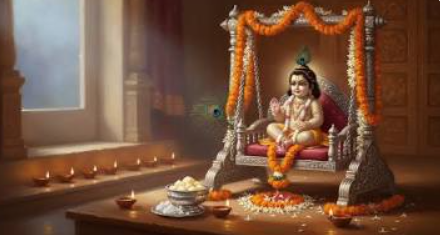
Midnight Rituals (Abhishek): At the arrival of Nishita Kaal, the idol of infant Krishna (Laddu Gopal) undergoes a ritual bath (abhishek) using Panchamrit—a mixture of milk, curd, honey, ghee, and sugar—followed by clear water or Gangajal.
Offerings (Bhog): Following the bath, the deity is dressed in new attire, adorned with a peacock feather, and placed in a swing (jhula). Traditional offerings include fresh white butter (makhan), rock sugar (mishri), coriander panjiri, and sweets, always served with fresh Tulsi leaves.
Fast Breaking (Parana): According to standard astrological references, official Parana occurs after sunrise on September 5 (after 06:02 AM in Delhi), following the conclusion of Ashtami Tithi and Rohini Nakshatra. However, many domestic traditions allow breaking the fast immediately after the midnight aarti with consecrated food (prasad).
Official Sources
According to official updates from Drik Panchang and major temple administration trusts—including the Banke Bihari Temple in Vrindavan and the Sri Krishna Janmabhoomi Trust in Mathura—the primary temple rituals and public celebrations are slated for the night of September 4, 2026, followed by Nandotsav observances on September 5.
Quote Section
"According to officials and temple priests in Mathura and Vrindavan, all major midnight rituals, deity consecrations, and public darshans will take place on the night of September 4, strictly adhering to the calculated Nishita Kaal timings."
Why It Matters
The release of uniform city-wise muhurat timings allows millions of devotees and local temple authorities to organize public processions, security arrangements, and home-based rituals efficiently. Standardized timing rules reduce confusion regarding fasting protocols and coordinate transit schedules for massive gatherings near major pilgrimage sites.
Key Facts at a Glance
Primary Festival Date: Friday, September 4, 2026
Nishita Kaal Window (Delhi NCR): ~11:57 PM to 12:44 AM
Ashtami Tithi Start/End: 02:25 AM (Sep 4) to 12:13 AM (Sep 5)
Primary Offerings: Panchamrit, Makhan-Mishri, Dhaniya Panjiri, Tulsi
Official Parana Time: Post-sunrise, September 5 (after 06:02 AM)
Frequently Asked Questions
Why does the Nishita Kaal timing vary between cities?
Nishita Kaal represents the exact midpoint between local sunset and the following morning's sunrise. Because cities sit at different longitudes, local sunset times shift, creating minor minute differences across geographical locations.
Can devotees break their fast right after midnight?
While orthodox rules suggest waiting until sunrise after Ashtami Tithi concludes, prevailing domestic tradition permits breaking the fast using prasad immediately following the midnight aarti and worship service.
What items are prohibited during the Janmashtami fast?
Devotees refraining from food must avoid regular table salt, wheat, rice, lentils, onions, garlic, and non-vegetarian food, opting instead for rock salt (sendha namak) and permitted fast foods.
Source: Drik Panchang Official Almanac, Sri Krishna Janmabhoomi Trust Releases, and Shri Banke Bihari Temple Administration Bulletins.