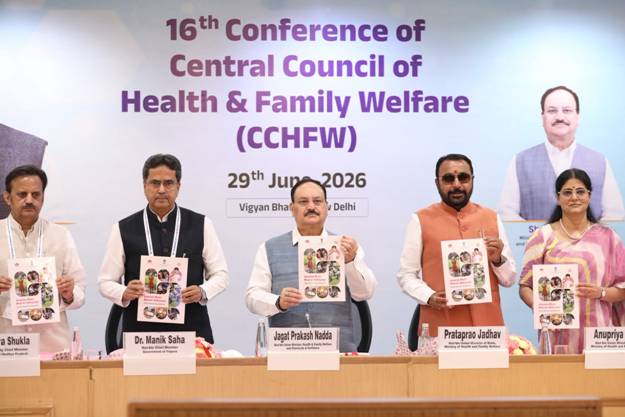
Union Health Minister Shri Jagat Prakash Nadda launched three major public health initiatives at the 16th CCHFW meeting. These include C-DAC’s affordable eSushrut@clinic HMIS for small practices, an upgraded 7x7x7 therapeutic framework for the Anemia Mukt Bharat Abhiyaan, and the SUMAN Roadmap 2030 targeting critical maternal mortality reductions across India.
NEW DELHI — In a major push to reform India’s public healthcare infrastructure, Union Health Minister Shri Jagat Prakash Nadda unveiled three landmark national health initiatives during the 16th Conference of the Central Council of Health and Family Welfare (CCHFW) held at Vigyan Bhawan, New Delhi on June 29, 2026. The high-level conference served as a vital platform for the Centre and States to collaborate on critical public health policies. The newly launched initiatives—the eSushrut@clinic portal, the revamped Anemia Mukt Bharat Abhiyaan operational guidelines, and the comprehensive "SUMAN Roadmap 2030"—are designed to bridge the digital gap in rural healthcare, introduce therapeutic clinical interventions, and radically lower maternal and infant mortality rates nationwide.
The developments underscore a significant shift toward technology-enabled, preventative, and patient-centric healthcare delivery as India targets sustainable health goals over the next decade.
C-DAC Introduces eSushrut@clinic for Small Healthcare Outpatient Units
To tackle the operational inefficiencies and manual paperwork burdens currently faced by small medical practices, Union Health Minister Shri Jagat Prakash Nadda officially launched eSushrut@clinic. Developed by the Centre for Development of Advanced Computing (C-DAC), this lightweight, cloud-based Hospital Management Information System (HMIS) is specifically tailored for small outpatient clinics, government primary health centers (PHCs), health and wellness centers (HWCs), and private practitioners.
Prior to this rollout, smaller healthcare facilities struggled with the high costs and technical complexities associated with commercial healthcare software. According to official ministry data, over 800 health facilities have already been onboarded onto the cloud platform, successfully generating more than 680 digital health records during its initial testing phase.
To accelerate adoption across rural and semi-urban areas, the National Health Authority (NHA) has formalized a Memorandum of Understanding (MoU) with C-DAC. Under this agreement, C-DAC will oversee the application maintenance and continuous software upgrades, while the NHA provides financial subsidies and administrative support. The platform is priced at an affordable base rate of ₹499 per month for five concurrent users. However, under the NHA’s promotional framework, an ongoing discount reduces the effective subscription cost to ₹299 per month, with the first three months offered entirely free of charge to newly registered clinics.
Anemia Mukt Bharat Transitions to an Advanced 7x7x7 Therapeutic Framework
Addressing systemic nutritional deficiencies, Union Health Minister Shri Jagat Prakash Nadda released the revised operational guidelines for the Anemia Mukt Bharat Abhiyaan. Marking eight years of continuous programmatic execution, the campaign has officially evolved from a baseline prophylactic iron supplementation drive into a comprehensive, technology-driven therapeutic framework.
The updated guidelines expand the legacy "6x6x6" health matrix into an intensified "7x7x7" strategic system. The framework introduces several critical additions:
Seventh Beneficiary Group: Low Birth Weight (LBW) infants aged 0 to 6 months are now integrated into the scheme to arrest the intergenerational cycle of anemia at the earliest stage of development.
Seventh Core Intervention: The "Eating Right" initiative has been introduced to institutionalize the daily consumption of iron-rich, culturally diverse local diets through behavioral change.
Seventh Institutional Mechanism: A robust digital monitoring and evaluation ecosystem driven by real-time data collection.
Under the new guidelines, the programmatic philosophy shifts from "Test, Treat, Talk" (T3) to "Test, Treat, Talk, and Track" (T4). Clinical interventions for severe anemia among pregnant and lactating women will now incorporate intravenous iron therapies, specifically Ferric Carboxymaltose (FCM) and Iron Sucrose. Patient data will be strictly monitored via converged pipelines: hemoglobin tracking for pregnant women will be synchronized through the JANANI portal, while pediatric data will populate the Rashtriya Bal Swasthya Karyakram (RBSK) and U-WIN systems, all feeding directly into a unified Anemia Mukt Bharat Abhiyaan Portal.
SUMAN Roadmap 2030 Aims to Cut Maternal Mortality Below 70
To secure long-term developmental metrics, Union Health Minister Shri Jagat Prakash Nadda launched the "SUMAN Roadmap 2030." Formulated by the Maternal Health Division of the Ministry of Health and Family Welfare under the broader RMNCHA+N framework, this multi-dimensional strategic blueprint aims to drop India's Maternal Mortality Ratio (MMR) below 70 per 100,000 live births by 2030, in alignment with the United Nations Sustainable Development Goals (SDGs).
The strategic map targets 130 high-burden districts spread across 13 focus states, including Assam, Bihar, Chhattisgarh, Haryana, Jharkhand, Karnataka, Madhya Pradesh, Odisha, Punjab, Rajasthan, Uttar Pradesh, Uttarakhand, and West Bengal. In these high-priority zones, the policy mandates the implementation of the SUMAN Package for Pregnant Women to enforce early pregnancy registration, comprehensive antenatal assessments, and mandatory post-partum institutional observation.
Community-level outreach will be driven by Accredited Social Health Activists (ASHAs), who will conduct bi-weekly home visits during the final two months of pregnancy to screen for high-risk clinical danger signs. Furthermore, the roadmap integrates advanced technological layers, such as artificial intelligence (AI)-enabled labor monitoring tools, the introduction of Non-Pneumatic Anti-Shock Garments (NASG) to combat postpartum hemorrhage, and the launch of the JANANI portal for streamlined digital reporting.
Official Sources Section
The information detailed in this report is based on official press releases issued by the Press Information Bureau (PIB), statutory declarations made at the 16th Conference of the Central Council of Health and Family Welfare, and the published programmatic guidelines from the Ministry of Health and Family Welfare, Government of India.
Quote Section
"According to officials present at the 16th CCHFW Conference, these integrated policies represent a unified national strategy to build a resilient, equitable, and digital-first public health ecosystem. The administrative shift from basic prophylactic care to structured therapeutic tracking is expected to profoundly improve maternal, newborn, and rural healthcare outcomes across the country."
Why It Matters
For citizens and everyday consumers, these updates translate to safer maternal care, free community-level screening, and highly subsidized clinical treatments for nutritional deficiencies. For private practitioners and small medical businesses, the eSushrut@clinic platform slashes the financial barrier to digital adoption, allowing small clinics to effortlessly integrate with the Ayushman Bharat Digital Mission (ABDM) architecture for less than one rupee per day.
Key Facts at a Glance
eSushrut@clinic Subsidies: Developed by C-DAC; effective monthly subscription slashed to ₹299 for five users under NHA guidelines, featuring a 3-month zero-cost trial.
The 7x7x7 Anemia Architecture: Introduces Low Birth Weight infants as a primary beneficiary group and scales clinical protocols to the T4 (Track) mechanism.
SUMAN Roadmap Targets: Sets a definitive national target to lower the MMR to below 70 per 100,000 live births by the year 2030 across 130 high-focus districts.
Infrastructure Convergence: Integrates medical records from separate platforms like U-WIN, RBSK, and JANANI into unified, centralized national health dashboards.
FAQ Section
Q1: Who can sign up for the new eSushrut@clinic software? A: The platform is universally open to government primary health centers (PHCs), health and wellness centers (HWCs), sub-centers, and private standalone outpatient clinics.
Q2: What is the main difference between the old anemia program and the new Abhiyaan? A: The new framework shifts from a simple iron-pill distribution model to an active therapeutic system ("T4") that utilizes intensive testing, tracking, and clinical intravenous iron therapies for severe cases.
Q3: Which states are heavily targeted under the SUMAN Roadmap 2030? A: The strategy heavily focuses on 13 states showing persistent maternal health gaps: Assam, Bihar, Chhattisgarh, Haryana, Jharkhand, Karnataka, Madhya Pradesh, Odisha, Punjab, Rajasthan, Uttar Pradesh, Uttarakhand, and West Bengal.
Q4: Is the eSushrut@clinic platform compliant with national digital mandates? A: Yes, the software is fully Ayushman Bharat Digital Mission (ABDM) enabled, allowing seamless creation of interoperable digital health records.
Source: Ministry of Health and Family Welfare, Press Information Bureau, National Health Authority