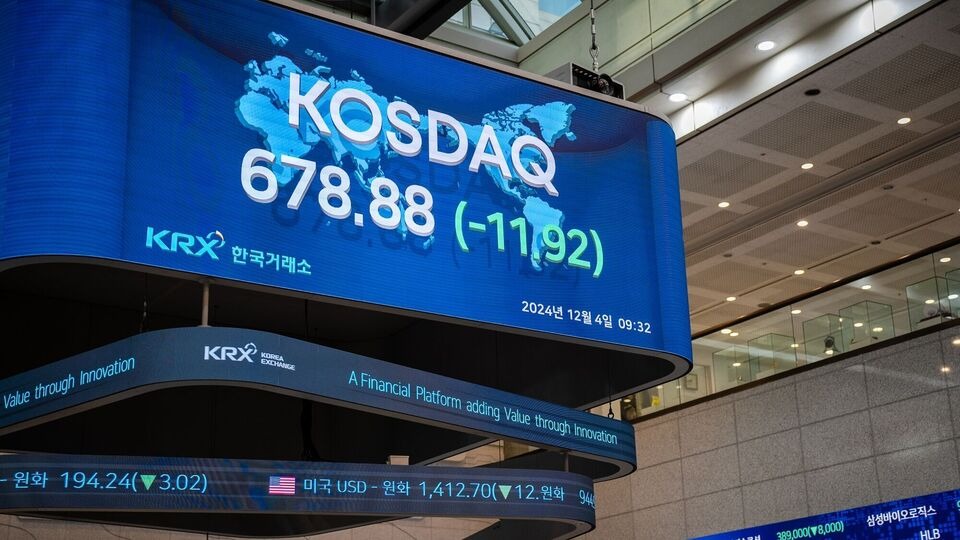
Following an 8% plunge in the KOSDAQ index, the Korea Exchange implemented a 20-minute trading halt on June 8, 2026. This emergency measure, as seen in image_0426de.jpg, aims to mitigate panic-driven sell-offs caused by regional economic headwinds, weak U.S. data, and a sharp decline in key semiconductor stocks.
SEOUL — The Korea Exchange (KRX) activated emergency circuit breakers on the KOSDAQ market on Monday, June 8, 2026, temporarily suspending all trading after the index plummeted by more than 8%. The move, designed to curb panic selling and restore orderly market conditions, marks a significant moment of instability in South Korean financial markets, which have been among the world's top performers this year.
The trading halt, which lasted 20 minutes, was necessitated by a sharp equity rout that saw tech-heavy indices suffer steep losses in early Monday trading. The volatility was largely driven by a combination of weak U.S. economic data, fears regarding global semiconductor demand, and a broader sell-off in technology stocks that has impacted markets across Asia.
Market Volatility and Investor Sentiment
The sudden decline has disrupted what had previously been a year of record-breaking growth for South Korean markets. Analysts suggest that the sell-off is a reaction to mounting concerns over global interest rate trajectories and the potential for a "peak-out" in the semiconductor sector, which serves as a core engine for the nation's export-dependent economy.
The market pressure was exacerbated by heavy selling from foreign investors and the influence of program trading algorithms, which amplified the downward momentum across both the KOSPI and KOSDAQ markets. Following the resumption of trade, market participants remained in a state of high alert, closely monitoring for signs of stabilization or further deterioration.
Official Response and Regulatory Measures
According to officials at the Korea Exchange, the circuit breaker mechanism is a standard regulatory tool used to provide a necessary cooling-off period during extreme market stress. By halting trading for a set duration, the exchange aims to allow information to flow more effectively and provide investors the time to reassess their positions, thereby preventing a total collapse of liquidity.
The Korea Exchange confirmed that the halt was a direct response to the index breaching the predetermined threshold of an 8% decline from the previous day's closing value. In addition to the circuit breaker, other measures, including the suspension of certain program trading sell orders (known as a "sidecar"), were also deployed to manage the rapid volatility throughout the morning session.
Why It Matters
The activation of circuit breakers in the KOSDAQ market underscores the fragility of investor sentiment in an environment characterized by high geopolitical and macroeconomic uncertainty. For businesses, the volatility highlights the risks associated with the current dependence on a narrow set of tech-heavy assets. Investors are now forced to navigate a "risk-off" environment, with many institutional players pulling capital from semiconductor-exposed sectors, potentially affecting liquidity and adoption rates in related financial products.
Key Facts at a Glance
Trading Halt Duration: The Korea Exchange enforced a 20-minute suspension of all trading on the KOSDAQ index.
Trigger Threshold: Circuit breakers were automatically activated after the index fell by 8% or more compared to the previous day’s closing price.
Market Context: The decline occurred amidst a broader Asian equity rout and concerns regarding semiconductor demand and U.S. economic data.
Safety Mechanism: These halts serve as a "safety valve" designed to stop panic-driven selling and allow for more rational, informed decision-making.
FAQ Section
Q: What is a circuit breaker in the context of the Korea Exchange?
A: A circuit breaker is a regulatory safety mechanism that automatically pauses trading on an exchange when an index experiences a rapid, significant decline, providing a cooling-off period for market participants.
Q: Why was the circuit breaker activated today?
A: The Korea Exchange activated the breaker because the KOSDAQ index dropped more than 8% from the previous day’s close, necessitating an immediate intervention to prevent further panic selling.
Q: Does a circuit breaker halt mean the market is closed for the day?
A: No. In this instance, trading was halted for 20 minutes. After the pause, the market resumed operations, typically following a brief call auction session to establish a new equilibrium price.
Q: Is this common in the South Korean market?
A: While these measures are essential for market stability, they are reserved for periods of extreme volatility. Historical data shows that these triggers are relatively infrequent but serve as a critical indicator of severe market stress.
Source: Korea Exchange, The Irish Times, 24/7 Wall St., CryptoRank, BusinessKorea