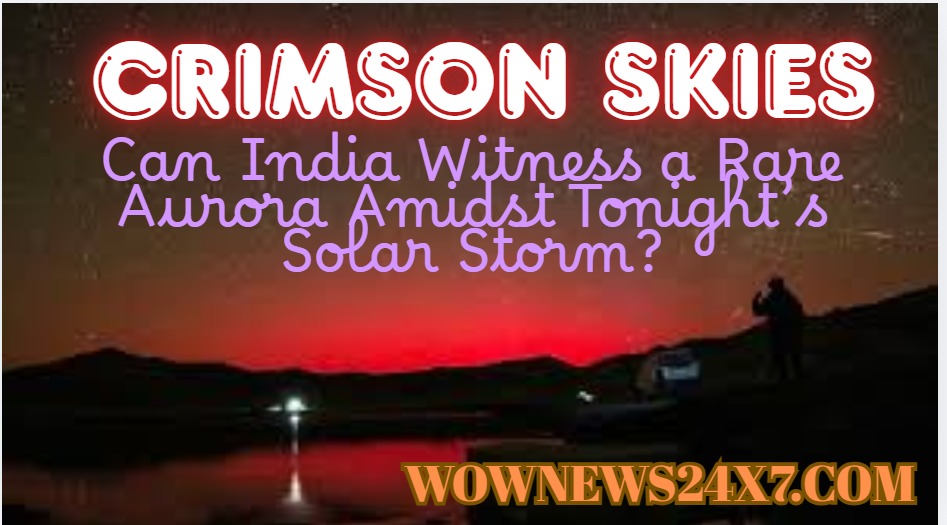
A massive solar storm is currently impacting Earth following an intense geomagnetic eruption on the Sun. The storm, triggered by a coronal mass ejection (CME) that launched a billion-tonne cloud of magnetized plasma into space at 1,400 kilometers per second, reached our planet on June 8, 2026. Forecasters at the Space Weather Prediction Center have issued a G3 (strong) geomagnetic storm watch, with the potential for brief periods of G4 (severe) activity as the storm peaks between 11:30 PM IST tonight and 2:30 AM IST on Tuesday, June 9.
The Science of Auroras at Low Latitudes
While auroras—commonly known as the northern lights—are typically confined to polar regions, extreme geomagnetic events can push these displays toward the equator. The phenomenon occurs when charged solar particles collide with gases in Earth's upper atmosphere.
Red Hues: Unlike the common green auroras seen at the poles, the displays visible from lower latitudes like India often appear as a distinct crimson or red glow.
High-Altitude Interaction: This red light is produced when solar particles excite oxygen atoms at altitudes exceeding 300 kilometers, a phenomenon more easily observed from southern regions during intense solar activity.
Potential Infrastructure Impacts
Beyond the visual spectacle, the solar storm poses challenges for modern technology. The intense geomagnetic disturbance can disrupt critical systems, including:
Communication: High-frequency radio systems may experience signal degradation or blackouts.
Satellite Networks: Orbiting satellites face increased drag and potential operational interference.
Power Grids: Severe geomagnetic storms can induce currents in surface power grids, potentially affecting stability.
Official Monitoring and Surveillance
Space agencies and researchers are closely monitoring the situation. According to officials, the eruption originated from Active Region 4461, which released a highly volatile core filament of ionized plasma. India's Aditya-L1 solar mission continues to provide critical data on the compression of the magnetosphere, helping experts better understand these space weather events.
Why It Matters
For citizens and enthusiasts, this event is a rare opportunity to witness a celestial display that has only been observed in India a handful of times. However, it also serves as a stark reminder of the planet's vulnerability to solar weather. As the Sun approaches the "Solar Maximum"—the peak of its 11-year activity cycle—such powerful storms are expected to become more frequent, necessitating increased vigilance for India's growing satellite and communication infrastructure.
Key Facts at a Glance
Storm Strength: A G3 (strong) geomagnetic storm watch is in effect, with potential for G4 (severe) periods.
Peak Viewing Time: The storm is expected to peak between 11:30 PM IST (June 8) and 2:30 AM IST (June 9).
Visibility: High-altitude locations, particularly in Ladakh (such as Hanle), are considered the most likely spots for potential sightings.
Cause: A fast-moving coronal mass ejection (CME) from Active Region 4461 slammed into Earth's magnetic shield.
FAQ Section
Q: Can auroras be seen from anywhere in India?
A: Sightings are extremely rare and generally limited to high-altitude, dark-sky regions like Ladakh, where there is minimal light pollution and high elevation.
Q: Are solar storms dangerous to humans on the ground?
A: No, Earth's magnetic field and atmosphere provide a robust shield, protecting humans on the ground from the direct effects of solar radiation.
Q: Why does the aurora appear red in India?
A: Observers in lower latitudes see the "upper curtain" of the aurora, where solar particles excite oxygen at very high altitudes, producing a red glow rather than the green light typical of polar regions.
Source: Space Weather Prediction Center (NOAA), Ministry of Education, India Today
Rare Solar Storm Auroras