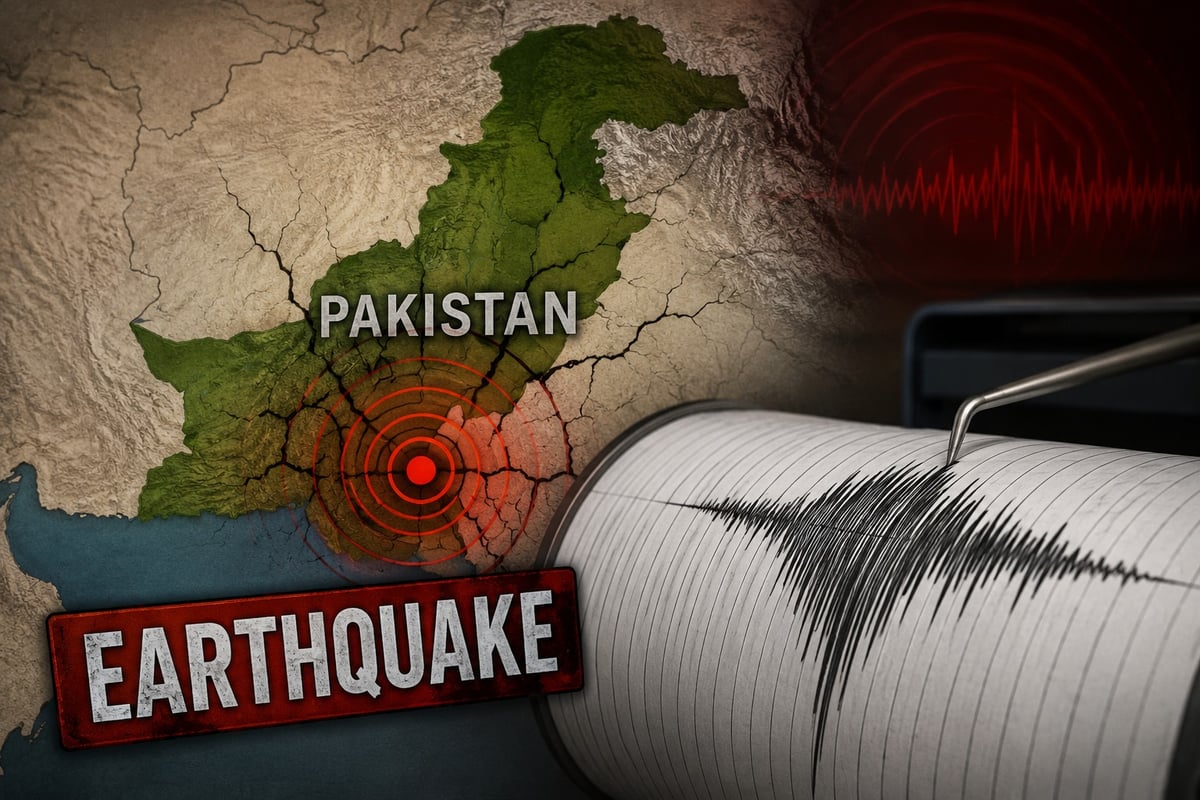
A moderate 5.4 magnitude earthquake jolted Pakistan early Saturday near Barkhan, Balochistan, marking the second tremor to hit the nation in under 24 hours. Official reports from global seismological agencies confirm no immediate casualties or infrastructural damage occurred, though the events underscore the country's vulnerability to active tectonic plate movements.
Second moderate tremor in less than 24 hours hits the region, highlighting ongoing seismic vulnerabilities across South Asia.
ISLAMABAD, Pakistan — A moderate 5.4 magnitude earthquake jolted Pakistan in the early hours of Saturday, June 27, 2026, causing brief panic among residents but resulting in no immediate reports of casualties or structural damage. The seismic event, which struck at 3:06 a.m. local time, represents the second significant tremor to hit the country within a 24-hour window, following a 5.3 magnitude quake recorded on Friday evening.
[A close-up image of a digital seismograph monitor displaying real-time seismic wave spikes and fault line mappings inside a modern geological research center.]
Tectonic Shift Near Barkhan Triggers Early Morning Tremors
According to data released by the U.S. Geological Survey (USGS), the epicenter of Saturday’s earthquake was located approximately 63 kilometers north-northeast of Barkhan in the Balochistan province, and about 102 kilometers northwest of Dera Ghazi Khan in Punjab. The tremor originated at a shallow depth initially measured between 10 to 35 kilometers, allowing waves to ripple across multiple urban centers.
The European-Mediterranean Seismological Centre (EMSC) confirmed that while the midnight shaking woke up citizens in parts of Balochistan and neighboring Punjab provinces, the vibrations subsided quickly. Emergency response teams and local provincial disaster management personnel were deployed immediately to inspect vulnerable historical structures and municipal infrastructure, finding no significant structural breaches.
Second Seismological Event Within 24 Hours
The June 27 event has heightened public anxiety across the region because it directly followed a 5.3 magnitude earthquake that shook Pakistan on Friday, June 26, at 5:18 p.m. local time. The National Center for Seismology (NCS) mapped Friday's tremor at a depth of 75 kilometers, indicating a deep-crust subduction movement.
Geological experts note that Pakistan is exceptionally prone to seismic activity because it occupies a major tectonic collision zone. The country sits atop the convergent boundaries where the Indian, Eurasian, and Arabian tectonic plates grind against each other. This continuous geological pressure makes regions like Balochistan, Khyber Pakhtunkhwa, and Gilgit-Baltistan frequent epicenters for minor to catastrophic earthquakes.
Civil Impact and Infrastructure Preparedness
For citizens and local businesses, the back-to-back tremors served as a stark reminder of the region’s natural hazards. No transport networks, flight operations, or cellular services were interrupted during or after the shaking. However, local real estate investors and consumer groups are increasingly tracking these events amid ongoing calls from urban planners to enforce stricter, earthquake-resistant building codes in rapidly growing metropolitan areas.
Official Sources Section
According to official bulletins published by international monitoring agencies including the USGS and the EMSC, the parameters of the earthquake have been verified. Regional disaster management authorities in Punjab and Balochistan reported that all primary medical facilities and rescue units remain on high alert, though no emergency dispatches were required.
Quote Section
"According to officials from the provincial emergency response teams, monitoring systems have not detected any catastrophic anomalies in public utilities following the late-night tremor. Municipal inspectors have confirmed that transit bridges and utility grids remain fully operational across the affected districts."
Why It Matters
When a 5.4 magnitude earthquake jolts Pakistan, it tests the limits of local civic infrastructure. Because the region frequently experiences destructive quakes, tracking these moderate tremors allows seismologists to assess pressure accumulation along active fault lines, which ultimately helps local governments refine disaster preparedness strategies and save lives.
Key Facts at a Glance
The Event: A 5.4 magnitude earthquake jolted Pakistan on Saturday morning, marking the second moderate tremor within 24 hours.
Epicenter Location: The quake struck 63 kilometers north-northeast of Barkhan, Balochistan, near the border with Punjab.
No Losses: Official monitoring agencies report zero casualties and no major structural damage across the impacted towns.
Tectonic Context: Pakistan remains vulnerable due to its positioning at the active intersection of the Indian, Arabian, and Eurasian tectonic plates.
FAQ Section
Q1: Exactly when and where did the 5.4 magnitude earthquake hit Pakistan? A1: The earthquake occurred at 3:06 a.m. local time on Saturday, June 27, 2026. The epicenter was located near Barkhan in Balochistan, at a depth of roughly 10 to 35 kilometers.
Q2: Was there any damage or casualties reported from this event? A2: No. According to local administrative and disaster management authorities, there have been no immediate reports of injuries, deaths, or major property destruction.
Q3: Is this earthquake related to the tremor that happened on Friday? A3: Both quakes are a result of the ongoing tectonic shifting along the fault lines where the Indian and Eurasian plates meet, though seismologists treat them as separate instances of regional pressure release.
Source: U.S. Geological Survey (USGS), European-Mediterranean Seismological Centre (EMSC), National Center for Seismology (NCS)