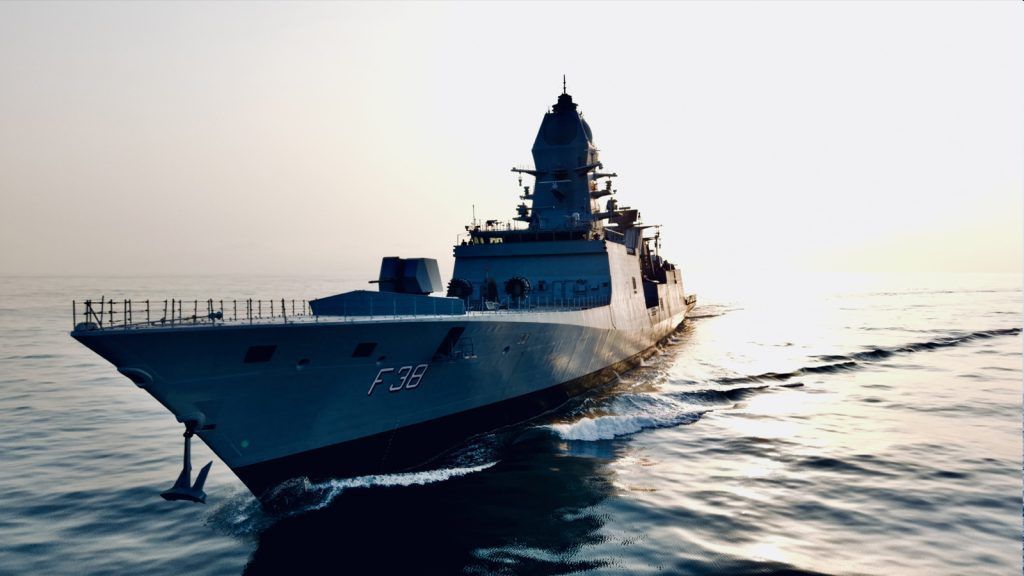
The Indian Navy commissioned INS Mahendragiri, its sixth Project 17A stealth frigate, on July 11, 2026, in Visakhapatnam. Presided over by Defence Minister Rajnath Singh, the induction of this 75% indigenous warship marks a major step in India’s maritime self-reliance and its strategic capability to secure the Indo-Pacific region.
The commissioning of the advanced stealth frigate INS Mahendragiri at Visakhapatnam marks a significant milestone in India's journey toward total maritime self-reliance.
VISAKHAPATNAM — The Indian Navy officially inducted its sixth Project 17A indigenous stealth frigate, INS Mahendragiri (F38), into the Eastern Fleet during a grand ceremony held on July 11, 2026. The event, presided over by Union Defence Minister Rajnath Singh at the Naval Dockyard in Visakhapatnam, signals a major enhancement in India’s blue-water capabilities and its strategic posture in the Indian Ocean Region (IOR).
Designed in-house by the Indian Navy's Warship Design Bureau (WDB) and constructed by Mumbai’s Mazagon Dock Shipbuilders Limited (MDL), the vessel is a flagship example of the government’s Aatmanirbhar Bharat (Self-Reliant India) initiative.
A Technological Marvel on the High Seas
INS Mahendragiri is engineered for the full spectrum of naval operations, including anti-air, anti-surface, and anti-submarine warfare. With over 75 percent indigenous content, the frigate features cutting-edge stealth technology that significantly reduces its radar cross-section, making it a formidable challenge for adversaries.
The warship’s arsenal is as diverse as it is lethal. According to official government releases, the vessel is equipped with:
Offensive Systems: Supersonic surface-to-surface BrahMos cruise missiles and indigenous rocket launchers.
Defensive Suites: Advanced electronic warfare capabilities, a Close-In Weapon System (CIWS), and an Integrated Anti-Submarine Defence System.
Aviation Prowess: A dedicated deck and hangar to embark and operate multi-role helicopters, extending its reconnaissance and strike reach far beyond the horizon.
"According to officials," the frigate’s Combined Diesel or Gas (CODOG) propulsion system allows for both high-speed pursuit and long-endurance patrols, ensuring the Navy can maintain a "mission-primed" presence across the Indo-Pacific.
Strengthening Maritime Sovereignty
During the ceremony, Defence Minister Rajnath Singh underscored the strategic necessity of such platforms, stating that while the future of warfare may increasingly rely on Artificial Intelligence, the ultimate victory rests on national resolve and credible military power. He highlighted the Navy's recent role as a "First Responder" in the IOR, noting that indigenous warships like Mahendragiri are essential to safeguarding India's economic and security interests.
The commissioning of INS Mahendragiri is the sixth such induction in just 18 months, following the successful commissioning of INS Nilgiri, INS Udaygiri, INS Himgiri, INS Taragiri, and INS Dunagiri. This rapid pace of induction highlights the maturation of India’s naval-industrial ecosystem and its growing capacity to deliver state-of-the-art platforms on schedule.
Why It Matters
For citizens and regional stakeholders, the induction of INS Mahendragiri is more than just a military upgrade; it is a symbol of India's evolution into a global hub for sophisticated warship manufacturing. By fostering a vast network of Indian industries and MSMEs, the project has not only boosted defense capabilities but has also generated substantial domestic employment and technological expertise, reinforcing India’s status as the "Preferred Security Partner" in the Indo-Pacific.
Key Facts at a Glance
Vessel Name: INS Mahendragiri (F38).
Class: Sixth Project 17A indigenous stealth frigate.
Displacement: Approximately 6,670 tonnes.
Indigenous Content: Over 75%.
Strategic Role: Fleet air defense, maritime interdiction, and humanitarian assistance.
FAQ
What makes INS Mahendragiri a 'stealth' frigate?
It features a special design and materials that significantly reduce its radar, infrared, and acoustic signatures, making it difficult for enemy sensors to detect.
What is the significance of the name ‘Mahendragiri’?
The ship is named after the Mahendragiri mountain range in the Eastern Ghats, symbolizing strength and resilience. It is the first Indian Naval warship to bear this name.
Where will the frigate be based?
INS Mahendragiri has been inducted into the Eastern Fleet of the Indian Navy and will operate out of the Eastern Naval Command in Visakhapatnam.
How does this boost the 'Aatmanirbhar Bharat' initiative?
With more than 75% of its components sourced and designed within India, the frigate reduces dependence on foreign defense imports and strengthens the domestic defense industrial base.
Source: Ministry of Defence (PIB), The Hindu, GKToday