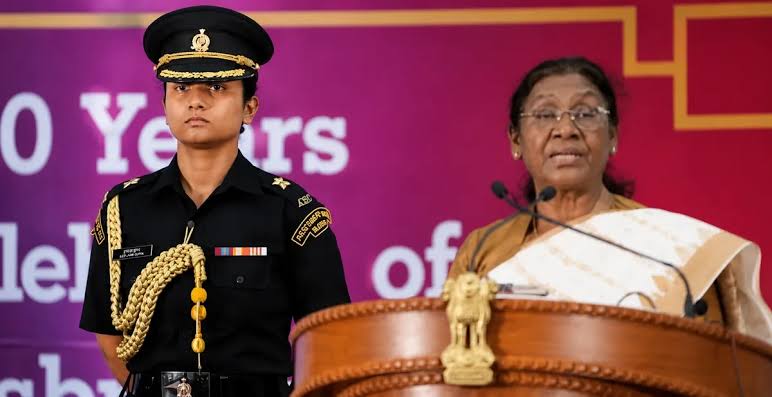
Major Navya Shekhawat from Rajasthan has been appointed Aide-de-Camp (ADC) to President Droupadi Murmu, becoming the first woman Indian Army officer to hold the role. Commissioned into the Army Service Corps in 2021, she manages military and state protocol at Rashtrapati Bhavan alongside the tri-services presidential military contingent.
NEW DELHI — In a historic milestone for India’s armed forces, Major Navya Shekhawat becomes Indian Army's first woman ADC to the President, taking charge of military protocol, official coordination, and ceremonial management at Rashtrapati Bhavan. Originating from Rajasthan's Shekhawati region, Major Shekhawat joins the close military entourage serving President Droupadi Murmu, the supreme commander of India's armed forces. The appointment marks a defining moment in the gradual integration of women officers into high-visibility, traditional military appointments that have long been reserved exclusively for male personnel.
From Sikar District to the Presidential Residence
Hailing from Kerpura village in the Sikar district of Rajasthan—a region renowned for contributing generations of soldiers to India's military—Major Shekhawat entered the defense services through the Combined Defence Services (CDS) examination conducted by the Union Public Service Commission (UPSC).
Securing her placement through the CDS (I) 2020 merit list, Shekhawat joined the Short Service Commission (Women Non-Technical) Course at the Officers Training Academy (OTA) in Chennai. Following rigorous training in leadership, weapons handling, and tactical field craft, she was commissioned in mid-2021 into the Army Service Corps (ASC), the operational backbone responsible for overland supplies, heavy transport movements, mechanical transport logistics, and unit replenishment across active fronts.
Demonstrating professional distinction during initial postings, Shekhawat completed operational tenures and advanced to the rank of Major in roughly five years. Her posting as Aide-de-Camp (ADC) places her directly in the executive secretariat supporting the head of state.
The Strategic Role and Operational Duties of an ADC
While frequently viewed by the public during national ceremonies and state visits, the Aide-de-Camp is a critical functional post requiring exact adherence to military and diplomatic protocol. The President of India maintains a dedicated contingent of five ADCs—traditionally three drawn from the Indian Army, one from the Indian Navy, and one from the Indian Air Force.
An ADC serves as the primary military liaison officer to the President, executing high-responsibility operational duties:
Ceremonial Protocols: Coordinating guard-of-honor inspections, presentation of credentials by foreign ambassadors, and national investiture ceremonies.
State Liaison: Managing communication and real-time coordination between Rashtrapati Bhavan, the Ministry of Defence, military service headquarters, and foreign diplomatic delegations.
Transit and Security Movements: Accompanying the President during domestic state visits, operational military base inspections, and overseas tours.
Executive Support: Assisting the Supreme Commander during formal state banquets, high-level diplomatic dialogues, and national defense reviews.
The posting demands immaculate discipline, tactical awareness, and deep familiarity with state ceremonial procedures.
Gender Integration Across India's Armed Forces
While Major Navya Shekhawat becomes Indian Army's first woman ADC to the President, she represents the second woman officer across the tri-services to hold the appointment. The milestone was initiated in 2025, when Lieutenant Commander Yashasvi Solanki of the Indian Navy was inducted as the first woman presidential ADC in independent India's history.
Major Shekhawat's appointment follows three decades of deliberate policy evolution regarding women in uniform. Since women were first inducted under the Short Service Commission (SSC) in 1992, institutional barriers have steadily receded. The landmark 2020 Supreme Court judgment in the Secretary, Ministry of Defence vs. Babita Puniya case mandated that eligible women SSC officers must receive equal consideration for Permanent Commission (PC).
Following the ruling, the Ministry of Defence opened Permanent Commission avenues across 10 Army arms and services, including the Army Service Corps, Army Ordnance Corps, Signals, Intelligence, and Engineers. In subsequent years, the National Defence Academy (NDA) in Khadakwasla opened its doors to women cadets, while combat arms such as Artillery and aviation units began commissioning female officers. Major Shekhawat’s induction into Rashtrapati Bhavan further cements this transformation within core protocol assignments.
Institutional Impact Across Stakeholder Groups
The official appointment carries wide-ranging resonance across defense and civilian circles:
For Aspiring Defense Cadets: Her journey from rural Rajasthan to the corridors of Rashtrapati Bhavan provides tangible validation for thousands of women preparing for CDS and NDA entrance exams.
For the Indian Army: Reinforces meritocratic personnel placement, proving that female officers are deployed on parity across operational units and prestigious staff appointments.
For Rashtrapati Bhavan: Reflects modern institutional representation within the personal military staff attending to India’s second woman President.
For the Logistics Cadre: Brings national visibility to the Army Service Corps, highlighting the integral contributions of logistical commands alongside combat arms.
Official Sources
Institutional records, service commissions, and merit rosters were verified through official bulletins maintained by the President of India Secretariat, personnel registries from the Indian Army, selection listings issued by the Union Public Service Commission, and operational updates from the Ministry of Defence.
Quote Section
"The appointment of an Aide-de-Camp to the President requires an impeccable service record, sharp operational acumen, and an absolute mastery of diplomatic and military protocol," according to officials familiar with defense appointments. "Major Navya Shekhawat's selection underscores the institutional shift ensuring that merit and capability alone define critical military staff postings."
Why It Matters
Military appointments at Rashtrapati Bhavan carry profound national and international symbolism. For decades, the personal staff of the head of state remained an exclusively male enclave.
As Major Navya Shekhawat becomes Indian Army's first woman ADC to the President, the transition demonstrates that gender neutrality is reaching every level of the armed forces—from border outposts and mechanized units to the apex ceremonial seats of government. This shift changes the public visual representation of India's military leadership, aligning traditional protocol with modern diversity principles.
Key Facts at a Glance
Historic Assignment: Major Navya Shekhawat becomes Indian Army's first woman ADC to the President, serving President Droupadi Murmu.
Overall Representation: Second woman officer from the Indian military to hold the position, following Navy Lieutenant Commander Yashasvi Solanki in 2025.
Background: Native of Kerpura village in Sikar, Rajasthan; commissioned into the Army Service Corps in 2021 through OTA Chennai.
Contingent Structure: The President's personal military staff traditionally includes five ADCs—three from the Army, one from the Navy, and one from the Air Force.
Frequently Asked Questions
Who is Major Navya Shekhawat?
Major Navya Shekhawat is an Indian Army officer commissioned into the Army Service Corps in 2021 who became the first female Army officer to serve as Aide-de-Camp to the President of India.
What are the primary responsibilities of a presidential Aide-de-Camp?
An ADC assists the President during official duties, manages ceremonial protocol, coordinates with government ministries and foreign dignitaries, and accompanies the head of state during official visits.
Is Major Shekhawat the first woman to ever serve as an ADC to the President?
She is the first woman from the Indian Army, but the second woman overall. Lieutenant Commander Yashasvi Solanki of the Indian Navy was appointed as the first female presidential ADC in 2025.
Source: Official releases from the President of India Secretariat, personnel and deployment data from the Indian Army, and examination notifications from the Union Public Service Commission.