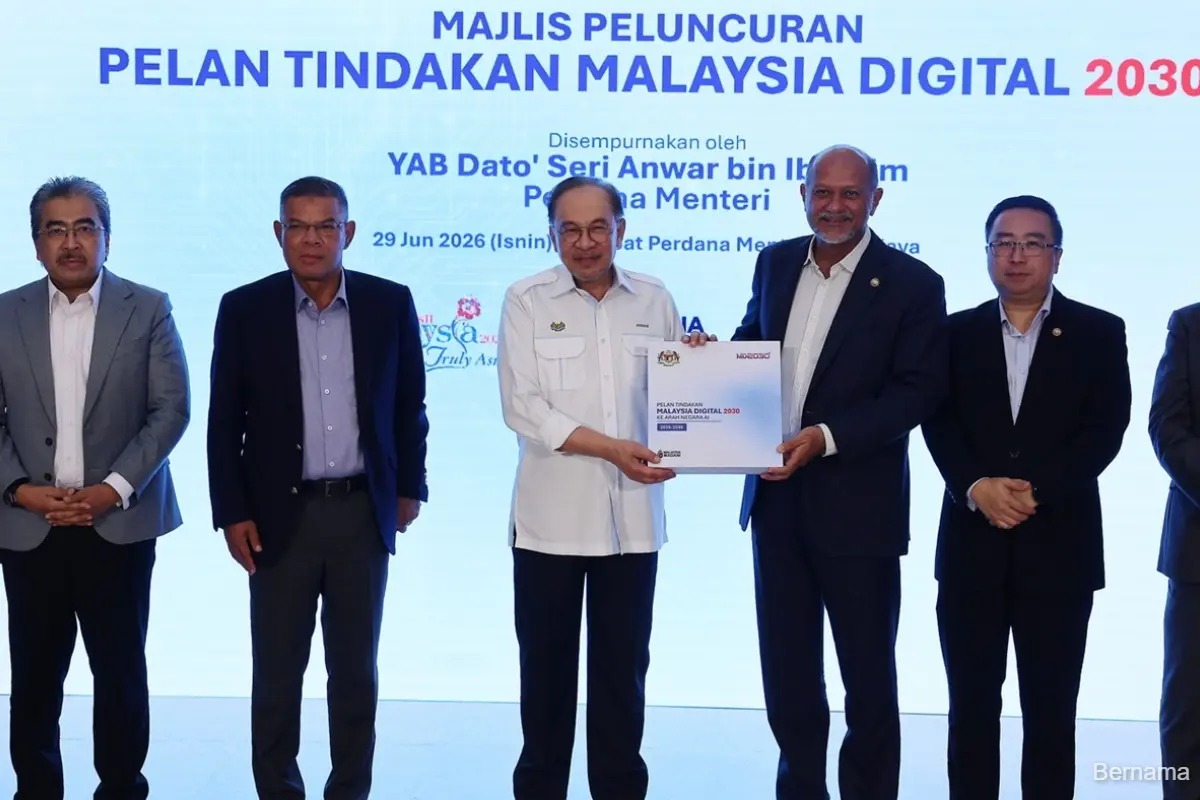
Malaysia has formally institutionalized the National AI Office (NAIO) and enacted the Malaysia Digital Action Plan 2030 (MD2030). Spearheaded by Prime Minister Anwar Ibrahim and the Ministry of Digital, the comprehensive technology transformation agenda aims to position Malaysia as a regional AI hub, targeting a 30% digital economy GDP contribution by 2030.
KUALA LUMPUR — Prime Minister Anwar Ibrahim and Digital Minister Gobind Singh Deo have officially launched the Malaysia Digital Action Plan 2030 (MD2030) and institutionalized the National AI Office (NAIO) as a dedicated statutory agency.
The comprehensive policy package, unveiled in Cyberjaya, establishes a centralized governance framework designed to transition Malaysia from a consumer of imported technology into a regional producer of artificial intelligence solutions. The blueprint sets binding targets for 2030, including driving the digital economy's contribution to 30% of national gross domestic product (GDP) and creating 500,000 high-value tech opportunities across public and private sectors.
Mandate of the National AI Office and Strategic Pillars
The newly institutionalized National AI Office (NAIO) serves as the central authority coordinating Malaysia’s artificial intelligence ecosystem under the Ministry of Digital.
The agency is tasked with executing the detailed AI Technology Action Plan 2026–2030, establishing ethical AI governance frameworks, and managing cross-sector adoption across manufacturing, finance, health, and public administration. The umbrella MD2030 framework operates across seven primary pillars—government, economy, infrastructure, talent, society, trust and security, and innovation.
Enterprise Grants, Tax Incentives, and Workforce Development
To ensure widespread commercial adoption, the federal government linked the AI action plan to immediate fiscal and structural support mechanisms for micro, small, and medium enterprises (MSMEs).
Eligible businesses can access matching digital grants alongside a 50% additional tax deduction on accredited AI and cybersecurity workforce training courses through the MyMahir program. Furthermore, the government is introducing an AI Governance Bill to establish a risk-based regulatory environment, ensuring data safety, privacy protections, and standardized compliance across industrial supply chains.
Official Sources
According to official policy blueprints and announcements released by the Ministry of Digital Malaysia and operational directives published by the National AI Office (NAIO), the national AI agenda is aligned with the MADANI Economy framework and the Thirteenth Malaysia Plan. Additional economic oversight and digital trade policies are managed via the Ministry of Investment, Trade and Industry (MITI).
Official Statement
"According to officials, the institutionalization of the National AI Office and the launch of the 2030 action plan mark a decisive shift from technology consumption to domestic innovation, ensuring equitable digital economic growth for all citizens."
Why It Matters
Establishing a dedicated AI agency and structured action plan provides regulatory certainty for foreign technology investors, data center operators, and enterprise software developers. For local businesses and workers, the national strategy offers structured funding, workforce upskilling incentives, and enhanced digital infrastructure to maintain competitiveness across ASEAN commercial markets.
Key Facts at a Glance
Central Authority: Institutionalization of the National AI Office (NAIO) under the Ministry of Digital.
Economic Target: Expand digital economy contribution to 30% of Malaysia's GDP by 2030.
Workforce Goal: Creation of 500,000 high-value digital and AI sector jobs.
Regulatory Governance: Introduction of an AI Governance Bill and risk-based regulatory framework.
Frequently Asked Questions (FAQ)
What is the primary role of Malaysia's National AI Office (NAIO)?
The National AI Office (NAIO) acts as the central authority for coordinating national AI strategies, setting ethical governance frameworks, driving adoption, and managing AI ecosystem investments.
What are the main economic targets of the Malaysia Digital Action Plan 2030?
The plan targets a 30% contribution to national GDP from the digital economy, the creation of 500,000 digital jobs, and RM4.5 billion in public sector efficiency savings.
Are there specific incentives for Malaysian businesses adopting AI?
Yes, MSMEs can access matching digital grants and claim an additional 50% tax deduction on accredited AI and cybersecurity training programs.
Where can official information on Malaysia's AI policies be accessed?
Official policy texts, program details, and guidelines are available on the portals of the Ministry of Digital Malaysia and the National AI Office (NAIO).
Source: Official press releases from the Ministry of Digital Malaysia, governance documentation from the National AI Office (NAIO), trade policy updates from the Ministry of Investment, Trade and Industry, and strategic publications from MyDIGITAL Corporation.