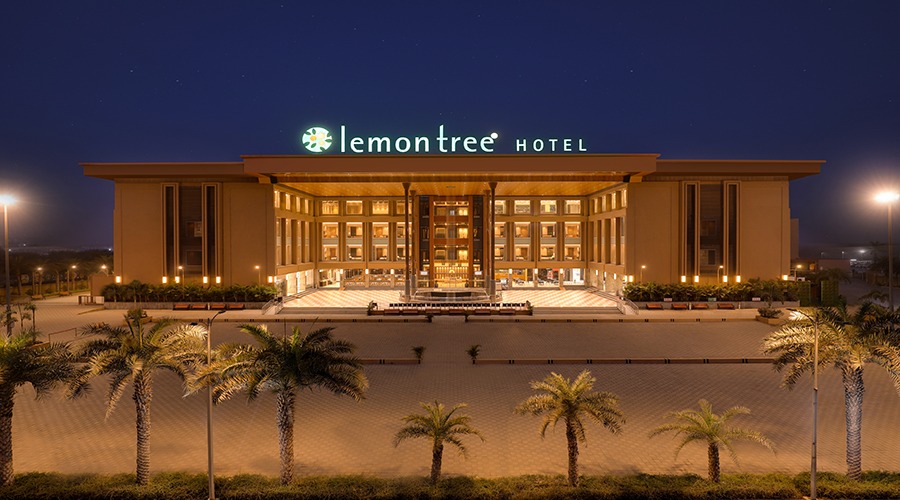
Mid-cap hospitality player Lemon Tree Hotels is trading at a 40% valuation discount to Tata’s IHCL despite delivering a stronger 52% operating margin and a 19.4% Return on Equity. Both companies are adopting asset-light management models to drive growth, making Lemon Tree a highly efficient corporate alternative for value investors.
MUMBAI — Financial market tracking on Monday, June 22, 2026, reveals that mid-cap hospitality player Lemon Tree Hotels Limited is trading at a notable 40% valuation discount relative to the Tata Group’s flagship Indian Hotels Company Limited (IHCL). Corporate regulatory filings and exchange performance indicators show that despite global geopolitical friction slowing down international arrival volumes across South Asia over the past two quarters, Lemon Tree Hotels has maintained an asset-light expansion momentum. Backed by a structural 52% operating margin, the mid-cap enterprise has outpaced larger luxury peers in fundamental capital efficiency metrics.
Evaluating Operating Efficiency and Capital Returns
According to structural corporate disclosures analyzed on Monday, the defining divergence between the two prominent hospitality chains lies in their operational cost management and capital returns. Lemon Tree Hotels has locked in an operating profit margin of 52%, a metric driven by structural focus on mid-market and premium-affordable urban clusters. This operating performance outpaces the consolidated operating profit margins of IHCL, which hovered at approximately 35% during its last reported structural earnings period.
Institutional research indicators outline that the higher margin structure directly fuels Lemon Tree's Return on Equity (RoE). The mid-cap entity reported an RoE of 19.4%, contrasting with IHCL’s long-term RoE of 14.2%. Financial analysts note that while IHCL commands premium luxury pricing power via its global Taj brand portfolio, Lemon Tree's lean operating architecture extracts higher net utility per unit of invested equity capital, positioning it as an alternative for value-driven institutional allocations.
The Strategic Shift to Asset-Light Management Contracts
Public corporate filings on the National Stock Exchange of India indicate that both hospitality chains are executing parallel strategic transitions toward management-contract-driven corporate models. Under this operational architecture, companies avoid heavy capital expenditures linked to real estate acquisition and structural construction. Instead, they operate third-party-owned properties in exchange for long-term management fees.
Data from regulatory filings indicate:
IHCL Portfolio Realignment: Elevated its managed portfolio to encompass roughly 53% of its active room keys, relying on sub-brands like Vivanta and SeleQtions to absorb capital-light demand.
Lemon Tree Scaling: Rapidly expanded its geographic footprint into tier-2 and tier-3 domestic corridors via its customized managed inventory brands, enabling agility during macro-economic travel disruptions.
Market analysts suggest that this asset-light framework limits structural downside risk during localized economic corrections while expanding operating leverage when consumer occupancy patterns stabilize.
Comparative Market Valuations and Capitalization Profiles
The primary metric capturing public market interest remains the divergence in price-to-earnings and price-to-book structures. Shares of Lemon Tree Hotels trade at an estimated 40% valuation discount relative to IHCL's enterprise value multiples. Currently, IHCL commands a consolidated market capitalization crossing ₹1,03,000 crore, positioning it firmly within the large-cap domain with a trailing price-to-earnings (P/E) ratio exceeding 51x.
In contrast, Lemon Tree Hotels maintains a compact mid-cap valuation profile with an active market capitalization hovering near ₹8,955 crore. Asset managers emphasize that the 40% discount provides a significant margin of safety for retail and institutional portfolios attempting to gain direct exposure to India's domestic tourism and corporate hospitality recovery cycle without paying the premium multiple associated with mega-cap consumer equities.
Official Sources Section
Operational data, equity returns, and market capitalization statistics cited across this analysis are derived from official financial disclosures submitted to the Bombay Stock Exchange, consolidated corporate financial earnings reports from Lemon Tree Hotels Limited, and the investor relations portal of The Indian Hotels Company Limited.
Quote Section
"According to officials tracking corporate hospitality allocations, the structural valuation gap between mid-tier focus models and luxury operators highlights an absolute pricing disconnect. While large luxury groups command distinct brand equity premiums, lean operational parameters and superior asset returns place lower-tier operators in an optimal position as corporate spending patterns rotate toward premium efficiency."
Why It Matters
The structural discount and operational divergence have direct implications for retail investors, capital market funds, and commercial property developers. Investors gain a calculated mechanism to trade high-efficiency capital metrics at a discount to historical market premiums. For corporate consumers and business travelers, the continuous expansion of mid-tier managed properties ensures standardized inventory availability across non-metropolitan trade hubs, lowering corporate travel overheads nationwide.
Key Facts at a Glance
Margin Outperformance: Lemon Tree Hotels commands a 52% operating profit margin, driven by localized expense management and standardized property rollouts.
Capital Efficiency: The mid-cap operator records a Return on Equity (RoE) of 19.4%, outperforming the 14.2% structural return registered by IHCL.
Valuation Arbitrage: Lemon Tree shares trade at a clear 40% valuation discount relative to the enterprise multiples of Tata’s premier hospitality arm.
Management Realignment: Both operators are pivoting heavily into fee-based management contracts to eliminate heavy capital expenditure cycles.
FAQ Section
1. Why is Lemon Tree Hotels trading at a 40% discount to IHCL?
The discount is primarily due to brand positioning and scale. IHCL owns the luxury Taj brand, giving it greater global prestige and a larger large-cap market presence, which commands a premium multiple. Lemon Tree operates in the mid-market to premium-affordable segment, which public markets traditionally value at lower multiples despite strong internal efficiencies.
2. How can a mid-cap hotel stock maintain a 52% operating margin?
Lemon Tree achieves its 52% operating margin through strict cost controls, a higher percentage of standardized modular properties, lower real estate acquisition costs, and an aggressive pivot toward an asset-light management model where third parties bear the primary real estate expenses.
3. Which hospitality stock offers a higher Return on Equity (RoE)?
Based on corporate filings, Lemon Tree Hotels delivers a superior Return on Equity at 19.4%, compared to 14.2% for the Indian Hotels Company Limited (IHCL).
4. What is an asset-light hotel management model?
An asset-light model is an expansion strategy where a hospitality brand does not buy land or build the physical hotel. Instead, independent real estate developers construct the property, and the hospitality firm manages the daily operations and branding in exchange for a percentage of revenue and management fees.
Source: Bombay Stock Exchange Official Filings, Lemon Tree Hotels Investor Relations, Indian Hotels Company Limited Corporate Portal