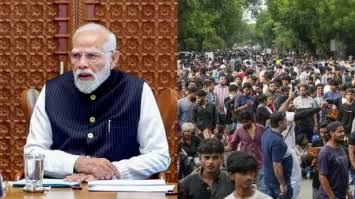
Prime Minister Narendra Modi announced the setup of fast-track courts to strictly punish perpetrators of examination paper leaks. The statement follows mass youth protests in New Delhi over irregularities in competitive tests like NEET-UG, as the government moves to enforce tighter anti-cheating laws and restore administrative credibility.
NEW DELHI — Prime Minister Narendra Modi pledged on July 23, 2026, to ensure "stringent punishment" and establish fast-track courts for individuals involved in question paper leaks. The announcement follows days of intense, youth-led street demonstrations in the national capital and other major cities over examination irregularities that have disrupted the academic futures of millions of students across India.
Speaking through official statements and social media communications, the Prime Minister emphasized that "nothing is more important than the welfare and future of our youth". He instructed relevant ministries to coordinate swiftly with judicial authorities to institute special court proceedings to fast-track cases linked to examination fraud.
Escalating Youth Demonstrations and Mass Mobilization
The Prime Minister's direct comments come amid widespread public unrest led by student groups and social movement organizations, including the Cockroach Janta Party (CJP). Protests escalated in New Delhi after thousands of demonstrators attempted to march toward Parliament during the opening week of the Monsoon Session. Clashes between protesters and law enforcement at Jantar Mantar resulted in tear gas deployment and dozens of injuries among both security personnel and participants.
The discontent stems from a series of high-profile examination failures over recent months. Key among them were widespread allegations surrounding the National Eligibility-cum-Entrance Test (NEET-UG) for medical admissions, which forced authorities to order re-examinations for over two million candidates. Further disruptions in online evaluation frameworks for high school examinations expanded the movement's focus toward broader systemic issues, including youth unemployment and institutional accountability.
Government Measures and Legal Frameworks
In response to the growing crisis, the Union Cabinet has reviewed administrative updates and structural overhauls to restore integrity to public testing agencies. Recent actions taken by the central government include:
Fast-Track Judicial Mechanism: Establishing dedicated courts to process cases under strict timelines to deter organized paper-leak networks.
Administrative Reshuffle: Reassigning senior officials within the Ministry of Education to restructure testing oversight departments.
Enforcement of Central Legislation: Implementing measures under the Public Examinations (Prevention of Unfair Means) Act to impose severe criminal penalties and monetary fines on illicit coaching centers and paper-leak syndicates.
Federal Investigations: Directing the Central Bureau of Investigation (CBI) to pursue nationwide probes into alleged key operatives and paper-leak rings.
Opposition leaders in Parliament have continued to disrupt legislative sessions, demanding direct ministerial resignations and additional parliamentary debates regarding testing security.
Official Sources Section
The reporting regarding legal frameworks and executive announcements is derived from official releases by the Prime Minister's Office (PMO), briefings from the Ministry of Education, and public statements released via the Press Information Bureau (PIB).
Quote Section
According to official statements issued by Prime Minister Narendra Modi:
"Nothing is more important than the welfare and future of our youth. Those who try to harm the future of our youth will not be spared. The government will take all necessary measures to establish fast-track courts to deal strictly with those involved in paper leaks."
Why It Matters
The national examination system forms the primary gateway to higher education and public sector employment for tens of millions of Indian citizens each year. Establishing fast-track courts and imposing stricter penalties aims to eliminate systemic corruption in recruitment processes, rebuild public trust in national testing agencies, and secure fair entry standards for students across all socio-economic backgrounds.
Key Facts at a Glance
Fast-Track Courts: Government announces specialized judicial mechanisms to accelerate prosecution of paper-leak offenses.
Mass Impact: Irregularities in major entrance tests like NEET-UG affected more than two million students nationwide.
Street Demonstrations: Protests led by student organizations at New Delhi's Jantar Mantar led to clashes with law enforcement.
Administrative Action: Central agencies including the CBI have executed multiple arrests tied to organized testing syndicates.
FAQ Section
What measures did PM Modi announce regarding paper leaks?
Prime Minister Modi announced the establishment of fast-track courts to ensure quick trials and strict penalties for individuals and syndicates involved in question paper leaks.
Which examinations triggered the recent widespread protests?
The primary driver was the alleged question paper leak in the National Eligibility-cum-Entrance Test (NEET-UG) for medical admissions, along with technical and evaluation disputes in other competitive examinations.
What legal provisions apply to paper-leak cases in India?
Offenders face prosecution under central laws, including the Public Examinations (Prevention of Unfair Means) Act, which outlines non-bailable offenses, heavy financial penalties, and imprisonment for organized cheating rings.
How are authorities securing future examinations?
The government is implementing stricter data encryption, limited physical access to testing materials, independent auditing by security agencies, and direct oversight of testing management firms.
Source: Prime Minister's Office, Ministry of Education, Press Information Bureau