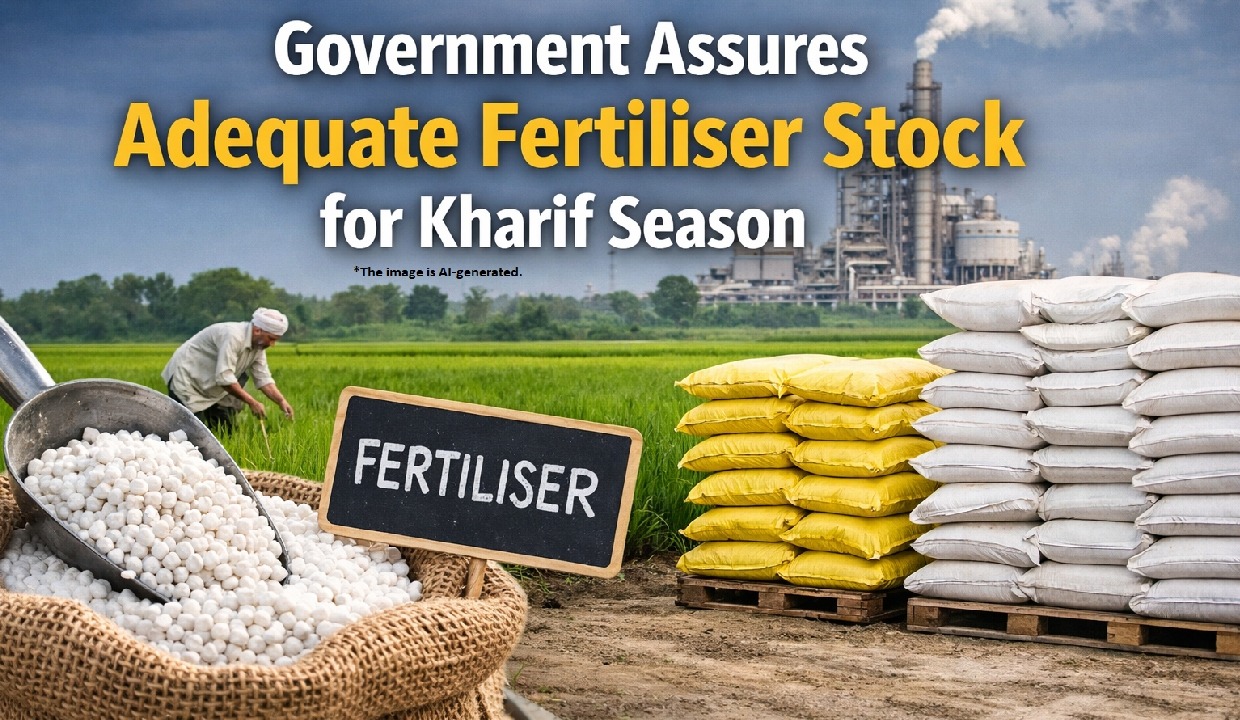
The Government of India has ensured robust, uninterrupted fertilizer availability across all states for Kharif 2026. Backed by expanded domestic production, strategic global imports, and subsidized pricing, national stocks for Urea, DAP, MOP, and NPKs comfortably exceed demand targets, insulating farmers against global supply disruptions.
NEW DELHI — The Government of India has confirmed that adequate, timely supplies of key agricultural fertilizers including Urea, Di-Ammonium Phosphate (DAP), Muriate of Potash (MOP), and NPK combinations are fully secured across all states and Union Territories for the ongoing Kharif 2026 sowing season.
Through coordinated efforts between the Department of Fertilizers, state agricultural departments, and domestic manufacturers, total available stocks of chemical inputs have consistently surpassed seasonal requirement benchmarks set by the Ministry of Agriculture and Farmers Welfare. The proactive stock positioning ensures that Indian farmers face no supply disruptions or price volatility during peak monsoon planting operations.
National Fertilizer Stock Position at a Glance
According to recent parliamentary disclosures and Ministry data, overall availability across all primary fertilizer categories remains comfortably higher than pro-rata requirement targets. Strong opening reserves, combined with continuous domestic manufacturing and long-term import arrangements, have effectively insulated India's agricultural sector from global supply chain fluctuations.
The data shows that availability exceeds minimum demand across every single nutrient segment. For instance, total Urea availability stands at 163.78 LMT against a seasonal requirement of 109.40 LMT, leaving a closing buffer stock of over 69 LMT. Similarly, DAP availability reached 39.54 LMT against an assessed requirement of 31.57 LMT.
Supply Chain Strategy and Diversified Sourcing
To maintain steady distribution across all farming belts, the Department of Fertilizers has executed a multi-pronged supply chain management plan. Key operational pillars include:
Indigenous Production Expansion: Maximizing capacity utilization across domestic gas-based urea plants including modernized units at Ramagundam, Gorakhpur, Sindri, Barauni, Panagarh, and Gadepan which together contribute over 76 LMT per annum in reassessed capacity.
Long-Term Global Contracts: Leveraging multi-year bilateral agreements, such as long-term supply deals with global suppliers in Saudi Arabia and North America, securing over 31 LMT of DAP/NPK annually.
Real-Time Digital Tracking: Monitoring state-wise demand, rake movements, and retail point-of-sale (PoS) inventory via the Integrated Fertilizer Monitoring System (iFMS) to prevent regional hoarding or artificial localized deficits.
Subsidy Protection: Fully absorbing global cost escalations under the Nutrient Based Subsidy (NBS) framework and statutory pricing mechanisms, maintaining the Maximum Retail Price (MRP) of Urea at ₹242 per 45 kg bag.
Official Sources
According to official parliamentary disclosures and statements issued by Union Minister of Chemicals and Fertilizers Shri Jagat Prakash Nadda:
"According to officials at the Ministry of Chemicals and Fertilizers, comprehensive measures have been taken to safeguard the country's fertilizer supply chain. Adequate availability of Urea, DAP, MOP, and NPKS has been successfully maintained across all states for the ongoing Kharif 2026 season through diversified sourcing, domestic capacity enhancement, and regular monitoring."
Impact on Farmers, Agriculture, and the Economy
The guaranteed availability of affordable soil nutrients carries direct, practical benefits for the nation's agrarian economy:
For Farmers: Provides complete security against input shortages or price surges, ensuring timely application during crucial early crop growth stages for paddy, pulses, oilseeds, and cotton.
For Rural Consumers & Food Security: Supports projected grain production targets, stabilizing food inflation metrics across domestic agricultural markets.
For Agribusinesses & Distributors: Enables smooth logistics planning, efficient rake movement along Indian Railways freight corridors, and steady inventory turnover at village-level cooperative outlets.
Why It Matters
Securing the fertilizer supply chain is central to India's national food security and economic stability. By securing advance stocks that exceed seasonal requirements by 40% to 50%, the government shields rural households from external geopolitical shocks, ocean freight volatility, and raw material import bottlenecks. The seamless distribution setup ensures that every agricultural district receives its allocated quota without administrative delays.
Key Facts at a Glance
Demand Met: Fertilizer availability consistently exceeds Kharif 2026 requirement targets across all major product categories.
Urea Buffer: Total Urea availability reached 163.78 LMT against a requirement of 109.40 LMT.
DAP Buffer: Total DAP availability reached 39.54 LMT against a requirement of 31.57 LMT.
Price Protection: Urea continues to be sold at the statutory MRP of ₹242 per 45 kg bag, with government subsidies absorbing global price variances.
Frequently Asked Questions (FAQ)
Is there any shortage of DAP or Urea during the Kharif 2026 season?
No. Official data from the Ministry of Chemicals and Fertilizers confirms that available stocks for Urea, DAP, MOP, and NPKs significantly exceed the required amounts set for the ongoing Kharif season.
How much does a bag of Urea cost for Indian farmers?
Urea is provided to farmers at a statutorily controlled Maximum Retail Price (MRP) of ₹242 per 45 kg bag (exclusive of local taxes), with the central government funding the remaining cost through direct subsidies to manufacturers.
How does the government monitor state-wise fertilizer distribution?
The Department of Fertilizers tracks production, rail dispatch, state receipt, and retail sales electronically in real-time using the Integrated Fertilizer Monitoring System (iFMS) and Direct Benefit Transfer (DBT) portal.
Source: Official regulatory statements, parliamentary replies, and operational data published by the Press Information Bureau (PIB) and the Department of Fertilizers.