President Droupadi Murmu and Prime Minister Narendra Modi unveiled a massive Rs 47,600 crore development package in Odisha, focusing on energy security, transportation infrastructure, and jobs. Key projects include a Rs 25,016 crore coal gasification facility and major railway upgrades to boost connectivity and employment across rural areas.
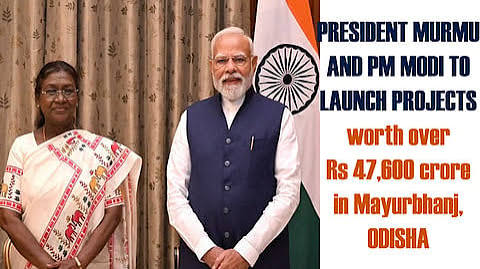
RAIRANGPUR — President Droupadi Murmu and Prime Minister Narendra Modi on Saturday, June 20, 2026, jointly launched a historic industrial development and employment infrastructure package valued at more than Rs 47,600 crore in Odisha. Making a rare joint public appearance in Rairangpur, Mayurbhanj district, the leaders inaugurated or laid the foundation stones for 72 mega-scale projects spanning energy security, heavy industry, transportation, and healthcare. Organizers confirmed that the coordinated initiative timed to mark the second anniversary of the state government under Chief Minister Mohan Charan Majhi is structurally designed to transform eastern India into a prominent growth hub while creating large-scale jobs in tribal and rural areas.
Heavy Industry and Clean Energy Drive Capital Expenditure
The foundation of the economic push centers on substantial energy and industrial infrastructure investments. According to official registries from the Ministry of Finance, the largest single allocation involves the Bharat Coal Gasification and Chemicals Limited (BCGCL) complex at Lakhanpur in Jharsuguda district. Valued at Rs 25,016 crore, India’s first commercial-scale coal-to-ammonium nitrate facility is engineered to promote cleaner utilization of domestic coal resources while systematically reducing international import dependence.
To secure long-term industrial energy requirements, the leaders laid foundation stones for advanced power generation facilities totaling Rs 17,717 crore. These include the 600 MW Upper Indravati Pumped Storage Project and the Stage-II expansion of the IB Thermal Power Station, which will integrate two state-of-the-art 660 MW super-critical generation units. Furthermore, a 300-tonne-per-day municipal solid waste-based compressed biogas facility was launched in Bhubaneswar to integrate sustainable waste management with regional fuel production.
Mass Connectivity Projects to Alleviate Freight Congestion
To ensure smooth operational logistics for newly planned manufacturing corridors, Prime Minister Modi dedicated two highly critical railway multi-tracking projects worth more than Rs 732 crore to the nation.
Howrah-Chennai Main Line Expansion
The first is the 19-kilometer Jakhapura-Jajpur Keonjhar Road-Baitarani Road multi-tracking project, constructed at a cost of Rs 323 crore as a vital section of the Bhadrak-Nergundi line. According to technical documentation filed by Indian Railways, this asset is expected to immediately ease severe traffic congestion on the heavily loaded Howrah-Chennai main line, optimizing both high-speed passenger transit and mineral freight movement.
Industrial Coal Corridors
The second railway project encompasses the 27-kilometer Hindol Road-Meramandali multi-tracking system, completed for Rs 409 crore under the Budhapank-Salegaon infrastructure plan. This corridor significantly upgrades train-handling capacity, ensuring the uninterrupted movement of coal, steel, power-sector inputs, and heavy industrial commodities across central Odisha.
Improving Public Health and Rural Services
The developmental roadmap extends beyond industrial infrastructure to directly improve public service delivery for local populations. The leaders formally inaugurated a new 300-bed District Headquarters Hospital building in Boudh, substantially expanding institutional medical access for central districts.
To improve regional transit, the government unveiled 24 automated Atal bus stands alongside nine automated vehicle testing stations distributed across multiple districts. Road transport parameters were further boosted by opening the newly constructed Nayagarh town bypass on National Highway 57 (NH-57) and executing road widening works along the Nuapada-Ghatipada section of NH-353.
Impact on Citizens, Workers, and Businesses
The mega-development push alters the economic landscape for multiple regional segments:
For Job Seekers and Industrial Workers: The construction and long-term operation of the coal gasification plants and power expansions are projected to generate thousands of direct technical jobs and indirect local service roles.
For Logistics Providers and Commuters: The combination of upgraded highway bypasses, new bridges like the Kathajodi River structure, and double-tracked rail systems minimizes commercial transit delays.
For Tribal Communities: The building of specialized sports complexes and dedicated tribal research facilities at Rairangpur guarantees that rural youth have direct pathways to education and economic self-reliance.
Official Sources Section
The financial parameters, industrial frameworks, and logistical timelines specified in this report are sourced from:
The Unified Project Inception Registry issued by the Press Information Bureau under the Ministry of Earth Sciences and the Prime Minister's Office.
The Corporate Investment Prospectus submitted by Coal India Limited for the BCGCL joint venture.
State Progress Logs compiled for the "Vikas ra dhara, Odisha sara" framework by the Government of Odisha.
Quote Section
"The massive investment proposals we are unlocking today position Odisha at the core of our 'Purvodaya' drive to transform eastern India. By combining green energy, advanced logistics, and direct skill development, we are ensuring that every tribal and rural community becomes an active participant in our journey toward a developed nation."
— According to officials summarizing the Prime Minister's address at Rairangpur
Why It Matters
For the national economy, the BCGCL gasification project changes how India utilizes domestic energy reserves, setting a template for reducing carbon emissions while manufacturing vital chemical components locally.
For citizens of Odisha, this massive deployment of capital means substantial improvements in daily public utilities, modern healthcare access, and regional transit times, raising the baseline standard of living across previously underserved rural blocks.
Key Facts at a Glance
Mega Capital Allocation: President Murmu and PM Modi unveiled 72 development projects collectively worth over Rs 47,600 crore.
Strategic Energy Focus: A massive Rs 25,016 crore was allocated to kickstart India's first commercial-scale coal-to-ammonium nitrate facility in Jharsuguda.
Rail Logistics Boost: More than Rs 732 crore has been deployed to multi-track crucial freight routes, smoothing coal and steel transport.
Maternal Village Upgrade: PM Modi announced that Pahadpur village will be transformed into a model 'Surya Gram' with solar power setup for every home.
FAQ Section
1. What is the main goal of the Rs 25,016 crore BCGCL project?
The Bharat Coal Gasification and Chemicals Limited (BCGCL) project aims to utilize domestic coal reserves using clean gasification technologies to produce ammonium nitrate locally, lowering chemical import reliance.
2. How do the new railway projects affect daily commuters?
The multi-tracking upgrades at Jakhapura and Hindol Road expand line capacity, reducing train delays on the Howrah-Chennai main line and separating slow-moving industrial freight from fast passenger lines.
3. What facilities are being created specifically for Mayurbhanj?
Rairangpur received a dedicated sports complex, an IGNOU regional learning center, and a modern tribal research facility to boost education, heritage preservation, and youth training.
Source: Ministry of Finance Portal, Indian Railways National Project Log, and Odisha Government Official Press Room.