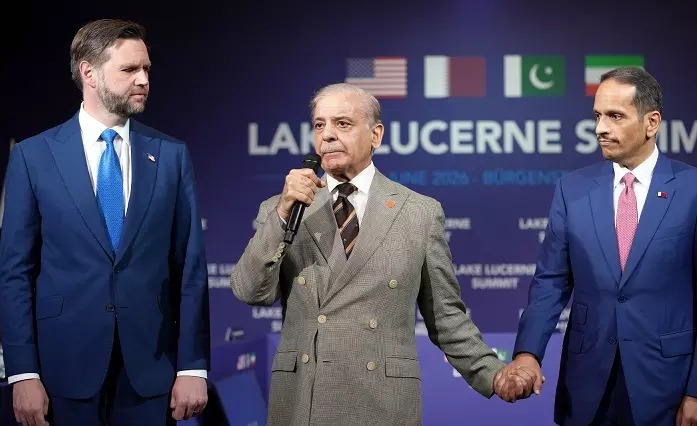
This international security brief outlines the 60-day peace roadmap finalized between the US and Iran in Switzerland. Mediated by Pakistan and Qatar, the deal creates technical panels for nuclear and sanction tracks, a Lebanese de-confliction cell, and an emergency communication line to ensure safe shipping transiting the Strait of Hormuz.
BUERGENSTOCK, Switzerland — The United States and Iran have formally agreed to a 60-day strategic roadmap aimed at securing a permanent peace deal to end the West Asia conflict. In a joint statement released on Monday, June 22, 2026, international mediators Pakistan and Qatar confirmed the successful conclusion of initial high-level talks held at the Bürgenstock alpine resort.
The primary breakthrough includes the immediate establishment of a direct communication line between Washington and Tehran designed to prevent military miscalculations and safeguard the passage of international commercial vessels navigating the critical Strait of Hormuz. This diplomatic milestone follows months of severe regional shipping disruptions and volatile energy markets.
Technical Working Groups and De-Confliction Mechanisms
The newly ratified 60-day roadmap builds upon the baseline framework established under the Islamabad Memorandum of Understanding (MoU) signed earlier in June. According to official disclosures by the Qatari Foreign Ministry, the two adversarial nations have agreed to form a supervisory High-Level Committee to oversee the upcoming round of technical negotiations.
The chief negotiators will manage specialized working groups covering nuclear parameters, global economic sanctions termination, and dispute resolution tracking. Concurrently, mediators verified that both states have agreed to implement a joint "de-confliction cell" with the Lebanese Republic to guarantee a cessation of parallel military operations inside Lebanon.
Overcoming Rhetoric and Preserving the Maritime Corridor
The Swiss diplomatic session concluded successfully despite a highly volatile start. Initial discussions on Sunday, June 21, were briefly disrupted when the Iranian delegation staged a temporary walkout in response to parallel warnings from US President Donald Trump regarding potential military strikes if regional proxy actions persisted.
However, intense closed-door sub-sessions led by US Vice President JD Vance and Iranian Parliament Speaker Mohammad Bagher Ghalibaf restored the operational timeline. Iranian Foreign Minister Abbas Araghchi subsequently announced that technical progress had been achieved concerning phased oil export waivers, the unfreezing of restricted offshore assets, and a projected $300 billion multi-state economic reconstruction plan.
Global Market Rebound and Supply Chain Impact
For global manufacturing logistics, commercial shipping enterprises, and consumer energy markets, the 60-day roadmap delivers a critical baseline stabilization. The Strait of Hormuz acts as the transit artery for approximately 20% of the world's daily petroleum supply.
Following the formal announcement of the de-confliction communication line, international energy benchmarks reacted immediately. Brent crude oil futures dropped 1.4% to trade at $79.40 per barrel on Monday morning, reducing raw transport input costs for maritime shipping lines.
Official Sources Section
The logistical timelines, working group definitions, and diplomatic parameters cited in this news report are derived directly from the joint diplomatic communiqués published on the official web server of the Ministry of Foreign Affairs of Qatar. Additional contextual data regarding export waivers and asset unfreezing tracks mirror the public statements issued by the Ministry of Foreign Affairs of the Islamic Republic of Iran and brief layout summaries filed by the United States Department of State.
Quote Section
In summarizing the transitional framework achieved during the overnight Swiss negotiations, the mediating bodies highlighted the cooperative atmosphere:
"According to officials from the Pakistani and Qatari delegations, the establishment of the high-level committee lays a stable foundation for the immediate commencement of technical talks, moving both parties toward a comprehensive agreement within the mandated 60-day window."
Why It Matters
For international trade organizations and global consumers, the implementation of a functional maritime communication line reduces the immediate threat of shipping insurance premium spikes. By providing a structured 60-day buffer zone backed by localized military de-confliction cells, the agreement protects global supply networks from sudden supply shocks, lowering systemic inflation risks for household commodities worldwide.
Key Facts at a Glance
The Timeline: The US and Iran have committed to a strict 60-day roadmap to finalize a permanent peace treaty.
Hormuz Protection: A dedicated communication line will connect both states to prevent accidental naval clashes in the Persian Gulf.
Regional Ceasefire: The deal incorporates a localized de-confliction cell to ensure a halt to active military engagements in Lebanon.
Economic Reconstruction: The framework includes preliminary tracking for an estimated $300 billion international reconstruction fund for Iran.
Market Reaction: Global Brent crude values receded to $79.40 per barrel immediately following the mediator disclosure.
FAQ Section
What is the exact function of the new Hormuz communication line?
The line of communication functions as a direct hotline between operating maritime commands to resolve real-time navigational misunderstandings and prevent accidental naval engagements involving commercial cargo vessels or state warships transiting the Strait of Hormuz.
What happens if a final peace agreement is not reached within 60 days?
Under the stipulations of the initial Islamabad Memorandum of Understanding, the 60-day technical negotiation window can be extended beyond the August deadline only through mutual, formal consensus between the US and Iranian governments.
Is Israel an official party to these Swiss peace negotiations?
No. Independent government reports confirm that Israel is not a formal signatory to the interim memorandum or the Swiss technical talks, though mediators have built-in parallel communication lanes to convey structural border safety details.
Source: Joint Ministerial Declarations from the Ministry of Foreign Affairs of Qatar and Ministry of Foreign Affairs of the Islamic Republic of Iran.